
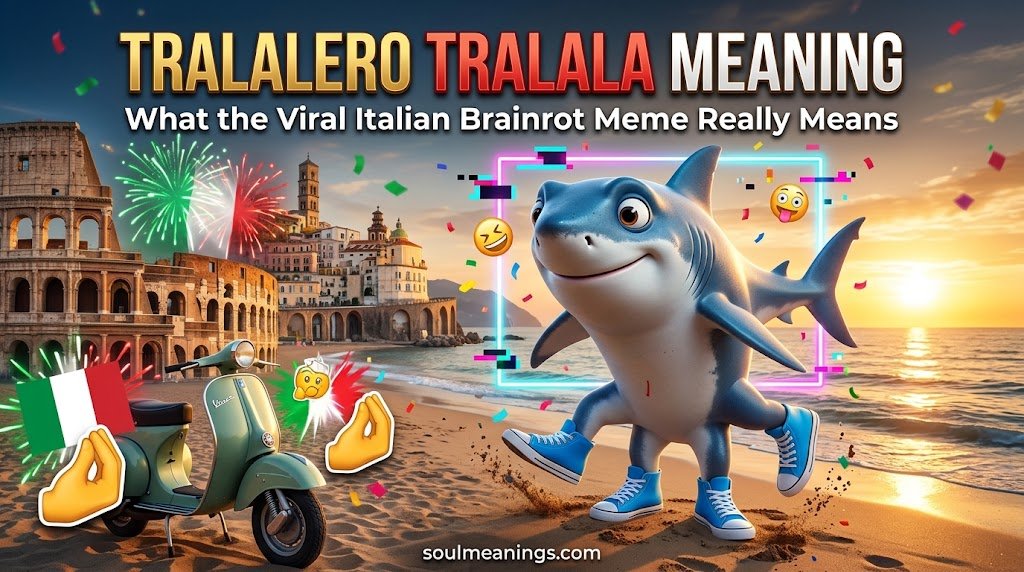
If you’ve seen a strange shark wearing sneakers while a dramatic voice repeats “Tralalero Tralala,” you’ve probably encountered one of the internet’s most recognizable Italian brainrot memes.
At first glance, the phrase sounds like cheerful nonsense. It has a musical rhythm and resembles the kind of syllables someone might sing without actual lyrics. However, the online meaning goes deeper than the words themselves. Tralalero Tralala became attached to a bizarre AI-generated character and then spread through TikTok, YouTube Shorts, Instagram Reels, memes, gaming videos, and other online communities.
The phrase also deserves some caution. Some versions of the original viral audio contain strong profanity and blasphemous language, including references that some religious audiences may find offensive. As the meme spread, many people began using only the catchy “Tralalero Tralala” portion without knowing or repeating the rest of the audio.
So, what does Tralalero Tralala mean? Is it actually Italian? Who is Tralalero Tralala? Why does the character look like a bizarre sneaker-wearing shark? And why did this seemingly meaningless phrase become so popular?
Here’s the complete explanation.
Quick Answer: What Does Tralalero Tralala Mean?
Tralalero Tralala is a viral meme phrase associated with the Italian brainrot trend of 2025. It doesn’t function as a normal Italian sentence with one fixed English translation.
The phrase became famous through a surreal AI-generated character commonly depicted as a blue shark with human-like legs wearing Nike-style sneakers. A synthetic or heavily stylized Italian-sounding narration helped turn the character and phrase into a recognizable internet meme.
The important distinction is this:
“Tralalero Tralala” by itself is essentially a catchy, nonsense-style refrain in the meme. Its online meaning comes from the character, audio, and surrounding joke rather than from a literal Italian translation.
Some versions of the associated audio contain profanity and blasphemous references. Therefore, the harmless-sounding phrase and the complete original audio shouldn’t automatically be treated as the same thing.
TL;DR
- Tralalero Tralala is part of the Italian brainrot meme trend.
- It isn’t a standard Italian expression with a precise dictionary definition.
- The phrase became associated with a bizarre shark character wearing sneakers.
- Its popularity grew rapidly through short-form videos in 2025.
- The phrase is usually used for absurd humor, meme references, and playful nonsense.
- Some versions of the original audio contain offensive religious language and profanity.
- Its meaning depends heavily on the video, image, caption, or conversation where you encounter it.
What Is Tralalero Tralala?
The simplest way to understand Tralalero Tralala meaning is to separate the words from the meme.
The phrase itself sounds like a vocal refrain. Similar nonsense syllables appear in songs, children’s rhymes, comedic performances, and playful speech. In Italian, related forms such as tra-la-la can function as musical or nonspecific vocal sounds. That doesn’t mean the entire viral phrase represents a normal Italian expression.
Internet culture gave Tralalero Tralala a much more specific identity.
Instead of simply representing a musical sound, it became the name associated with an absurd digital character. That character became one of the signature figures of the Italian brainrot phenomenon.
The joke relies heavily on contrast. You see something visually ridiculous, such as an anthropomorphic shark in sneakers. Then you hear an exaggerated voice delivering dramatic-sounding narration. The result feels simultaneously familiar and completely nonsensical.
That’s the point.
The Basic Tralalero Tralala Meaning
In everyday online use, the phrase can communicate several things without literally saying any of them:
- “This is absurd.”
- “I’m referencing the meme.”
- “This situation is ridiculously chaotic.”
- “Here’s a piece of Italian brainrot humor.”
- “I’m deliberately saying something nonsensical.”
The surrounding context does most of the work.
For example, someone might comment “Tralalero Tralala” under an intentionally bizarre video. They aren’t necessarily translating the phrase. They’re signaling that they recognize the meme and want to participate in the joke.
It’s similar to repeating a famous catchphrase. The phrase becomes a cultural shortcut.
Is Tralalero Tralala Real Italian?
This question causes a lot of confusion.
Tralalero Tralala should not be treated as a conventional Italian sentence. The viral phrase belongs to internet meme culture. Its Italian-sounding presentation is part of the creative style behind Italian brainrot.
That distinction matters.
Italian brainrot uses exaggerated Italian-sounding names and narration to create an intentionally ridiculous atmosphere. The language often mixes recognizable Italian words, invented expressions, distorted phrases, profanity, and nonsense.
Consequently, translating every word literally can miss the joke entirely.
Think of it like a fictional character named Captain Blah-Blah McBoom. The name might sound meaningful because it follows familiar language patterns. Yet the character’s name isn’t necessarily a phrase you would find in a dictionary.
Why the Phrase Sounds Italian
Italian has a recognizable sound pattern for many English-speaking listeners. Vowel-rich words, rhythmic syllables, expressive intonation, and repeated vowel endings can make invented speech sound Italian even when it isn’t grammatically meaningful.
Italian brainrot creators exploit that familiarity.
The result is a kind of linguistic illusion. Your brain recognizes the sound as culturally Italian even when the actual phrase doesn’t work like ordinary Italian conversation.
That makes the meme immediately recognizable.
Where Did Tralalero Tralala Come From?
The phrase emerged as part of the wider Italian brainrot explosion that became especially prominent on TikTok during 2025.
Italian brainrot refers to a family of surreal internet memes featuring AI-generated or AI-assisted characters, absurd names, synthetic narration, and intentionally chaotic stories.
Rather than developing from one traditional cartoon or television franchise, the trend grew through social media creation, remixing, reposting, and imitation.
Creators could produce an unusual character, give it an Italian-sounding name, add an exaggerated voice, and build a strange piece of lore around it.
Then another creator could remix it.
That cycle repeated.
The Tralalero Tralala Character
The character associated with Tralalero Tralala is commonly depicted as an anthropomorphic shark with human-like legs and sporty sneakers.
The image is deliberately illogical.
A shark belongs in the ocean. Sneakers belong on human feet. Neither element needs to make sense together. The absurd combination is exactly what gives the character its meme appeal.
The character’s recognizable traits include:
| Feature | Role in the Meme |
| Shark | Creates the central surreal image |
| Human-like legs | Adds visual absurdity |
| Sneakers | Makes the character instantly recognizable |
| Italian-sounding name | Connects it to Italian brainrot |
| Exaggerated narration | Builds the comedic style |
| Surreal lore | Encourages remixes and storytelling |
The visual identity matters because internet memes often need to be recognized within seconds.
A strange shark in sneakers does that job remarkably well.
How the Tralalero Tralala Meme Spread
Short-form video platforms provided the perfect environment for this type of meme.
TikTok, YouTube Shorts, and Instagram Reels reward content that viewers can understand almost immediately. A bizarre image paired with a distinctive sound can communicate the joke before the viewer even knows the backstory.
The Tralalero Tralala meme benefited from several characteristics that make online content highly remixable.
Short Audio
The phrase is easy to repeat.
That matters because memorable audio can travel from one video to another without requiring viewers to understand the original story.
Distinctive Character Design
The shark-and-sneaker combination provides a strong visual hook.
You don’t need a long explanation to recognize it.
Absurd Narration
The exaggerated voice creates a recognizable soundscape around the character.
Easy Remixing
Creators can place the character or audio into entirely different situations.
A meme might appear in:
- Gaming clips
- Reaction videos
- School jokes
- Sports edits
- Animation
- AI-generated stories
- Comment sections
- Meme compilations
- Short comedy sketches
Once that happens, the character stops belonging to one particular video.
It becomes shared internet vocabulary.
What Does Tralalero Tralala Translate To?
There isn’t a clean English translation that captures the meme’s full meaning.
The phrase’s “tra-la-la” structure resembles playful singing or meaningless vocalization. However, the viral audio associated with the character includes additional language that changes the tone considerably.
This is where many online explanations become misleading.
Someone might claim that “Tralalero Tralala” literally means a particular English sentence. That’s too simplistic.
A better explanation is that the phrase functions primarily as a meme refrain and character identifier.
Its significance comes from association.
Literal Meaning vs. Meme Meaning
| Type of meaning | Explanation |
| Literal | A playful, repetitive vocal sound |
| Linguistic | Not a standard Italian sentence |
| Meme meaning | A reference to Italian brainrot |
| Character meaning | Identifies the surreal shark character |
| Social meaning | Signals participation in the joke |
| Cultural meaning | Represents a newer form of absurd internet humor |
This distinction explains why people can use the phrase even when they don’t know Italian.
They aren’t necessarily communicating through translation.
They’re communicating through recognition.
Why Is Tralalero Tralala Associated With Italian Brainrot?
Italian brainrot became a recognizable meme category because creators repeatedly used a particular formula:
Strange image + Italian-sounding name + dramatic voice + absurd story = Italian brainrot.
The formula sounds simple. Its flexibility makes it powerful.
A character doesn’t need realistic anatomy. It doesn’t need a logical biography. It doesn’t even need a coherent plot.
In fact, excessive absurdity often makes the meme stronger.
Common Italian Brainrot Characteristics
- AI-generated or heavily manipulated visuals
- Anthropomorphic animals
- Unexpected combinations of objects and creatures
- Italian-sounding names
- Synthetic or exaggerated narration
- Repetitive catchphrases
- Invented character lore
- Surreal conflicts and relationships
- Rapidly changing meme stories
Tralalero Tralala fits neatly into this ecosystem.
Why Is Tralalero Tralala So Popular?
At first, the meme seems almost too simple.
That’s part of its strength.
Absurdity Is the Joke
Traditional humor often builds toward a punchline. Brainrot memes can skip that structure entirely.
Instead, the absurdity itself becomes the punchline.
A shark with legs isn’t funny because it delivers a sophisticated joke. It’s funny because your brain expects one thing and receives something completely different.
The mismatch creates comedic friction.
Repetition Makes It Memorable
The repeated “Tralalero Tralala” sound is easy to remember.
You don’t need to memorize a paragraph. You only need a few rhythmic syllables.
That makes it perfect for short videos.
The Character Is Easy to Recognize
A strong meme needs visual shorthand.
The Tralalero Tralala shark provides that shorthand. Once you’ve seen the character a few times, the image can trigger recognition immediately.
Young Internet Users Drive Remix Culture
Modern meme culture rarely moves in a straight line.
One person creates a joke. Someone else changes the audio. Another person adds a new character. A fourth person turns the idea into a gaming clip.
Soon, the original creator’s version becomes only one piece of a much larger ecosystem.
How People Use Tralalero Tralala Online
The phrase can serve different purposes depending on the platform and context.
| Online setting | Common use |
| TikTok | Meme audio, character videos, edits |
| YouTube Shorts | Comedy clips and compilations |
| Instagram Reels | Reposted memes and short edits |
| Gaming | Absurd reactions or character references |
| Comments | Meme recognition or playful nonsense |
| Group chats | Inside joke or random response |
| AI content | Character-based storytelling |
Suppose a friend sends you an impossibly chaotic video.
You might respond with “Tralalero Tralala 💀” simply because the situation reminds you of the meme.
The phrase doesn’t need to provide information.
It provides tone.
That distinction is important in internet language. Many modern expressions communicate attitude rather than literal facts.
Tralalero Tralala Meaning in Texting
In texting, Tralalero Tralala usually works as a meme reference rather than conventional slang.
Someone might send it when they want to be intentionally ridiculous. Another person might use it to show that they recognize the Italian brainrot trend.
For example:
Friend: “I just watched a video of a shark racing a crocodile on motorcycles.”
Reply: “Tralalero Tralala 😭”
The reply doesn’t literally explain anything.
It communicates:
“This is peak internet nonsense and I recognize the reference.”
What Does It Mean When Someone Texts Tralalero Tralala?
Depending on the conversation, it can mean:
- “This reminds me of that meme.”
- “I’m being silly.”
- “This is completely absurd.”
- “I’m joining the joke.”
- “I don’t have a serious response.”
- “That meme is stuck in my head.”
Context decides which interpretation makes the most sense.
Read More: WTV Meaning in Texting: What Does WTV Mean in a Text?
Is Tralalero Tralala Offensive?
This is one of the most important details to understand about the meme.
The phrase alone shouldn’t automatically be treated as profanity. However, versions of the audio associated with the original viral meme contain strong profanity and blasphemous language.
Some versions include references to God and Allah that can be deeply offensive to religious audiences.
That creates an important distinction:
A person repeating “Tralalero Tralala” may only be using the recognizable meme phrase. Another person may be quoting the complete audio, which contains offensive material.
You shouldn’t assume those uses are identical.
Why Context Matters
Imagine someone sees the shark character in a children’s meme compilation and repeats its name.
That doesn’t necessarily mean they’re endorsing every word from the original audio.
Likewise, a creator who deliberately uses the complete original sound may be invoking material that goes beyond harmless nonsense.
If you’re sharing the meme publicly, especially around children, schools, workplaces, or religious audiences, checking the exact audio is a sensible step.
The Controversy Around Tralalero Tralala
The controversy isn’t simply about a funny shark.
It comes largely from the content of the narration associated with the character.
Italian brainrot became popular partly because it pushed absurdity to extremes. Some viral audios also incorporated profanity, religious references, sexual jokes, and other deliberately provocative material.
That approach can create a shock-value effect.
For some viewers, that’s part of the humor. For others, it crosses a clear line.
This is why describing the entire trend as harmless children’s humor would be inaccurate.
At the same time, calling every use of Tralalero Tralala offensive would also oversimplify the situation.
The specific audio and context matter.
Tralalero Tralala and Other Italian Brainrot Characters
Tralalero Tralala doesn’t exist in isolation.
The character became part of a larger universe of bizarre figures created and expanded by internet users.
Other famous Italian brainrot characters include names such as:
- Bombardiro Crocodilo
- Bombombini Gusini
- Brr Brr Patapim
- Tung Tung Tung Sahur
- Lirili Larila
- Chimpanzini Bananini
- Ballerina Cappuccina
These characters don’t all share the same exact origins or design principles. However, they became associated with the same broader wave of surreal meme culture.
Why the Characters Work Together
Once several characters become recognizable, creators can build fictional relationships between them.
One video might portray a character as an enemy. Another could turn the same character into a friend. Someone else might invent a completely different story.
This resembles an improvised mythology.
There isn’t one official canon controlling every version.
That’s why Italian brainrot lore can feel chaotic. The chaos is part of the format.
Common Misunderstandings About Tralalero Tralala
“Tralalero Tralala Has One Secret Translation”
Not really.
The phrase doesn’t have one hidden English sentence that explains everything.
Its meme identity matters more than a literal translation.
“It Is a Normal Italian Expression”
No.
The viral phrase should not be presented as an ordinary Italian sentence that people commonly use in everyday conversation.
Its popularity comes from meme culture.
“It Always Means the Same Thing”
Not necessarily.
A comment, TikTok audio, character image, and group-chat message can use the phrase differently.
Internet slang is flexible.
“The Meme Is Completely Harmless”
That’s also too broad.
The simple phrase can appear in harmless contexts. However, some associated audio contains profanity and blasphemous material.
“Tralalero Tralala Is the Name of a Real Italian Character”
The character is an internet creation rather than a traditional Italian folklore figure.
It doesn’t come from established Italian mythology, classical literature, or historical folklore.
How to Understand Tralalero Tralala in Context
When you encounter the phrase, don’t immediately search for a literal translation.
Instead, look at the surrounding content.
A Simple Context Check
First, look at the image.
Is the familiar shark character present?
Next, listen to the audio.
Is someone repeating only the catchy phrase, or does the recording continue into explicit language?
Then, examine the caption.
The caption may reveal whether the creator is referencing Italian brainrot.
Finally, consider the conversation.
If someone texts the phrase after a ridiculous joke, they’re probably using it as a meme reaction rather than making a literal statement.
This approach gives you a much more accurate interpretation.
A Real-World Example of How Meme Meaning Changes
Consider three different situations.
Example One: A TikTok Edit
A creator shows the sneaker-wearing shark racing through a surreal digital city while the familiar audio plays.
Here, Tralalero Tralala primarily identifies the character and meme format.
Example Two: A Group Chat
Someone posts a completely ridiculous screenshot and another person replies:
“Tralalero Tralala 💀”
Here, the phrase functions as a humorous reaction.
Example Three: A Full Audio Clip
Someone shares the original or extended audio that contains profanity and blasphemous language.
Here, the phrase appears within a much more provocative piece of content.
The same words can therefore appear in very different situations.
Context changes the meaning.
Tralalero Tralala vs. Traditional Italian Expressions
It’s useful to compare the meme with actual Italian language.
| Tralalero Tralala meme | Ordinary Italian |
| Built for internet humor | Used for everyday communication |
| Often intentionally nonsensical | Follows established grammar |
| Connected to fictional characters | Connected to real speakers and communities |
| Frequently exaggerated | Naturally spoken or written |
| Designed for remixing | Used for practical communication |
| Meaning depends on meme context | Meaning comes from language and context |
This comparison doesn’t make the meme less interesting.
Quite the opposite.
It shows how internet communities can create recognizable forms of expression that behave differently from conventional language.
The Cultural Impact of Italian Brainrot
Italian brainrot illustrates something important about modern online culture.
People no longer need a television network, movie studio, or major publisher to create a character that millions of viewers recognize.
A strange image can appear online one day.
Then users remix it.
Then someone invents lore.
Then another creator gives it a rival.
Before long, the character has a recognizable name, sound, personality, and fictional history.
Tralalero Tralala represents that process particularly well.
AI-assisted image creation has also made surreal characters easier to produce. Creators can experiment with combinations that would have required considerably more artistic effort in earlier internet eras.
The result is an unusually fast meme ecosystem.
Why AI Matters to the Tralalero Tralala Trend
AI-generated imagery plays an important role in the broader brainrot phenomenon.
Traditional character design often starts with sketches, revisions, storyboards, and polished illustrations.
AI tools can produce an intentionally bizarre creature much faster.
That changes the economics of meme creation.
Creators can test strange ideas quickly:
- Shark + human legs
- Crocodile + aircraft
- Goose + bombers
- Monkey + banana
- Animal + household object
- Human-like creature + impossible anatomy
The stranger the combination, the more memorable it can become.
However, AI imagery alone doesn’t create a successful meme.
Community repetition does.
A character becomes culturally recognizable only after people repeatedly share, remix, parody, and reference it.
Why Nonsense Becomes Meaningful Online
At first, Tralalero Tralala may seem meaningless.
Yet that’s not quite true.
The phrase has acquired social meaning.
It can tell another person:
“I know this meme.”
It can also communicate:
“This situation is ridiculous.”
Or:
“Let’s not take this seriously.”
That’s similar to how many memes work. Their literal words aren’t necessarily important. Their shared cultural reference is.
Think about an inside joke between friends.
A short phrase might make no sense to an outsider. To the people who know the joke, however, it can trigger an entire story.
Internet memes operate on a much larger version of that principle.
Is Tralalero Tralala Still Popular?
The Italian brainrot wave reached major visibility in 2025 and continued spreading through 2026 across short-form social platforms and meme communities.
However, meme popularity isn’t static.
A phrase can dominate social feeds for months and then become less prominent as audiences move toward new characters, sounds, and formats.
That’s normal.
Internet culture moves quickly.
What tends to survive longer is the character’s recognizability. Even when a specific sound declines in popularity, people may continue referencing the character through images, jokes, merchandise, animations, gaming content, or newer variations.
Tralalero Tralala in Modern Internet Culture
The meme also shows how modern online humor increasingly blends several forms of media.
A single trend can combine:
- AI-generated artwork
- Synthetic voices
- Italian-inspired language
- Fictional storytelling
- TikTok editing
- Gaming culture
- Reaction memes
- User-created lore
- Comment humor
That combination makes the trend difficult to classify using older categories.
It’s not simply a cartoon.
It’s not simply slang.
It’s not simply an audio clip.
It’s a participatory meme format.
Users help create the meaning every time they remix it.
What Does Tralalero Tralala Say About Modern Slang?
The popularity of this phrase highlights a major shift in internet language.
Modern slang doesn’t always consist of abbreviations such as “LOL,” “TBH,” or “IDK.”
Sometimes slang takes the form of a sound, character name, image, or deliberately meaningless phrase.
That makes today’s online vocabulary much more visual and multimedia-driven.
A person may recognize a phrase because they’ve heard it repeatedly in videos rather than because they’ve encountered it in a dictionary.
That distinction matters when interpreting meme language.
FAQS
What does Tralalero Tralala mean?
Tralalero Tralala is a viral meme phrase associated with the Italian brainrot trend. It doesn’t have one fixed English translation. In online use, it commonly acts as a reference to the surreal shark character and the broader meme.
Is Tralalero Tralala actually Italian?
The phrase has an Italian-sounding style, but the viral meme expression shouldn’t be treated as a normal Italian sentence. Italian brainrot deliberately uses invented and exaggerated language to create absurd humor.
Who is Tralalero Tralala?
Tralalero Tralala refers to a surreal meme character commonly shown as a shark with human-like legs and sneakers. The character became widely associated with the Italian brainrot trend.
Why is Tralalero Tralala popular?
Its popularity comes from a combination of catchy repetition, absurd imagery, exaggerated narration, AI-assisted visuals, and easy remixing. Short-form platforms helped the meme spread rapidly.
Is Tralalero Tralala a bad word?
The phrase itself shouldn’t automatically be classified as a swear word. However, some versions of its associated viral audio contain profanity and blasphemous language. Always consider the exact audio or video being used.
Conclusion
The Tralalero Tralala meaning makes the most sense when you view it as an internet meme rather than a traditional Italian expression. The phrase became closely tied to the bizarre shark character, exaggerated narration, and surreal humor that define the Italian brainrot trend.Although the words sound Italian, Tralalero Tralala doesn’t have one precise English translation or standard everyday meaning in Italian. Online, people generally use it as a recognizable meme reference, a playful reaction, or a way to signal absurd humor.







1 thought on “Tralalero Tralala Meaning: What the Viral Italian Brainrot Meme Really Means”