
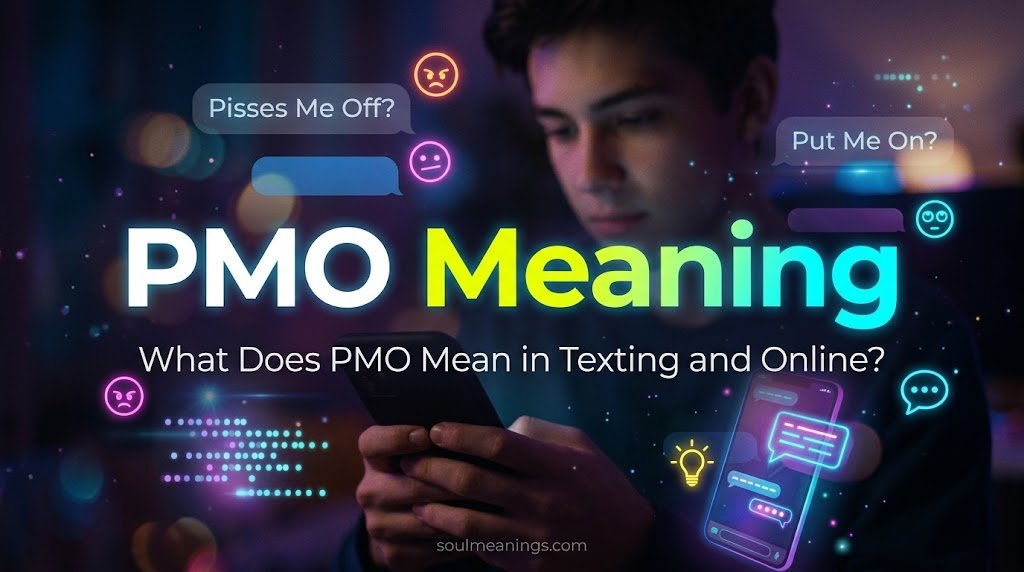
If someone sends you “PMO” in a text, comment, or direct message, the meaning isn’t always obvious. Unlike abbreviations with one fixed definition, PMO meaning changes with the conversation. In casual texting, it most often means “piss me off” or “put me on.” In a workplace, however, PMO commonly means Project Management Office.
That difference matters. A message such as “That really PMO” has a completely different meaning from “PMO to some good restaurants.” One expresses frustration. The other asks for a recommendation.
This guide explains what PMO means in texting, social media, business, and everyday conversations. You’ll also see realistic examples that make it easier to recognize the intended meaning at a glance.
Quick Answer: What Does PMO Mean?
PMO meaning in texting usually depends on context. The two most common slang meanings are:
- Piss me off — used when something annoys, frustrates, or angers someone.
- Put me on — used when asking someone to recommend, introduce, or connect you with something.
In professional settings, PMO usually means Project Management Office, a group that helps organizations coordinate projects, standards, processes, reporting, and governance.
For example:
“This traffic is really PMO.”
Here, PMO means “piss me off.”
Meanwhile:
“PMO to some good restaurants in Chicago.”
Here, PMO means “put me on,” meaning the person wants recommendations.
The surrounding words usually reveal which meaning the writer intended.
PMO Meaning at a Glance
Because PMO has several established uses, looking at the context is the quickest way to understand it.
| PMO Meaning | Full Meaning | Common Context |
| PMO | Piss me off | Texting and casual conversation |
| PMO | Pisses me off | Texting, comments, social media |
| PMO | Put me on | Texting, DMs, social media |
| PMO | Project Management Office | Business and project management |
| PMO | Prime Minister’s Office | Government and political contexts |
These meanings aren’t interchangeable. If a friend says, “PMO to that playlist,” they aren’t saying the playlist made them angry. They’re asking you to introduce them to it or recommend it.
Likewise, a company announcement mentioning the PMO probably isn’t discussing slang at all. It most likely refers to a Project Management Office.
What Does PMO Mean in Texting?
When people ask about PMO meaning in texting, they’re usually asking about slang rather than business terminology.
Texting encourages short expressions. Instead of typing an entire phrase, people often turn it into three letters. PMO works especially well because its meaning can be understood from the rest of the sentence.
Two slang interpretations stand out: “piss me off” and “put me on.”
PMO as “Piss Me Off”
The first common slang meaning is “piss me off.”
People use it to say that something annoys them, frustrates them, or makes them angry. The expression is informal and contains mild profanity, although the abbreviation itself softens the appearance of the phrase.
For example:
“People who drive 20 under the speed limit PMO.”
The speaker means that those drivers piss them off or seriously annoy them.
Another example:
“That noise is starting to PMO.”
Here, PMO means the noise is becoming irritating.
You’ll often see this meaning in:
- Text messages
- Social media comments
- Group chats
- Memes
- Casual posts
- Gaming conversations
- Conversations between friends
The tone can range from playful irritation to genuine anger.
For instance, a friend might text:
“You ate my leftovers again. PMO 😭”
The person may be genuinely annoyed, but the crying emoji suggests a playful tone.
PMO as “Pisses Me Off”
PMO can also represent “pisses me off.” The exact grammatical form depends on how the writer constructs the sentence.
Consider:
“That PMO.”
The intended meaning could be “That pisses me off.”
Or:
“Missing the bus every morning PMO.”
The speaker is saying that repeatedly missing the bus pisses them off.
Informal online language doesn’t always follow standard grammar. People shorten phrases according to how they sound rather than following formal writing rules.
That’s one reason you shouldn’t interpret PMO by looking at the abbreviation alone. Read the entire sentence.
PMO as “Put Me On”
The second major slang meaning is “put me on.”
This phrase usually means recommend something to me, introduce me to something, or connect me with someone.
For example:
“PMO to some good rap albums.”
The person wants music recommendations.
You might also see:
“PMO to a good barber.”
That means:
“Recommend a good barber to me.”
The phrase can also involve people and opportunities:
“Can you PMO with your manager?”
Depending on the situation, that could mean introduce me to your manager or help connect me with them.
“Put me on” has a broader cultural meaning than simply “recommend.” It can imply that someone is helping another person discover something valuable or gain access to a person, place, trend, product, or opportunity.
PMO Meaning on TikTok, Snapchat, Instagram, and Social Media
On social platforms, PMO meaning often depends heavily on the subject of the post.
Social media users regularly ask each other to “put them on” to music, clothing brands, restaurants, creators, products, shows, and other discoveries.
For example:
“PMO to some underrated Netflix shows.”
The person isn’t angry. They’re requesting recommendations.
Similarly:
“Who makes these? PMO!”
Here, PMO most likely means “put me on” or “tell me where I can get these.”
The abbreviation can also appear when someone expresses frustration:
“People who spoil movies PMO.”
That means “people who spoil movies piss me off.”
Common social-media situations for “put me on”
You may see PMO used when someone wants:
- A new artist
- A playlist
- A movie recommendation
- A TV series
- A restaurant
- A clothing brand
- A sneaker source
- A beauty product
- A gaming community
- A creator to follow
- A travel destination
- A useful app
- A particular service
The meaning is usually easy to spot because the phrase often appears alongside “to.”
PMO to some good coffee shops.
The structure points strongly toward “put me on to.”
PMO in comments
Comments can make PMO even more ambiguous because users often omit words.
Someone might comment:
“PMO 👀”
Under a post about a product, that likely means:
“Put me on. Where did you get it?”
Under a post complaining about an annoying experience, however, PMO could relate to frustration.
The post itself provides the missing context.
How to Tell Which PMO Meaning Someone Intended
When you’re unsure about what PMO means, don’t guess from the abbreviation alone. Look at the sentence around it.
Look at the Words Around PMO
The words following PMO can provide a major clue.
Compare these examples:
“PMO to that artist.”
This likely means “put me on to that artist.”
Now compare:
“That artist PMO.”
This likely means “that artist pisses me off.”
The same three letters produce completely different meanings.
A useful clue is the word “to.” When someone writes “PMO to” before mentioning music, food, clothing, entertainment, or another discovery, “put me on” is usually the intended meaning.
Consider the Conversation
The previous messages often settle the question immediately.
Imagine this exchange:
Friend: “I just found an amazing Thai restaurant.”
You: “PMO.”
Here, PMO almost certainly means “put me on” because you’re asking for the restaurant details.
Now consider:
Friend: “My brother ate the last slice again.”
You: “That would PMO me too.”
In this case, PMO means “piss me off.”
The subject controls the interpretation.
Consider the Tone
Tone also matters.
Words associated with anger, frustration, disappointment, or irritation point toward “piss me off.”
Words associated with discovery, recommendations, curiosity, or access point toward “put me on.”
| Context Clue | Likely Meaning |
| Anger or frustration | Piss me off |
| Complaining about someone | Piss me off |
| Asking for recommendations | Put me on |
| Asking about a product | Put me on |
| Asking for an introduction | Put me on |
| Music or entertainment discovery | Put me on |
| Business meeting or project | Project Management Office |
PMO Meaning in Different Sentences
Seeing examples in context makes the distinction much easier.
| Example | Likely PMO Meaning | What the Person Means |
| “This weather PMO.” | Piss me off | The weather annoys me. |
| “PMO to some good music.” | Put me on | Recommend some music. |
| “That guy really PMO.” | Piss me off | That guy makes me angry. |
| “PMO to a good pizza place.” | Put me on | Recommend a pizza place. |
| “Can you PMO with your friend?” | Put me on | Introduce or connect me with your friend. |
| “Slow Wi-Fi PMO.” | Piss me off | Slow Wi-Fi frustrates me. |
| “PMO to your barber.” | Put me on | Tell me about or recommend your barber. |
These examples show why context beats the abbreviation itself.
PMO Meaning in Professional and Business Settings
Outside social media, PMO takes on a much more formal meaning.
In project management, PMO stands for Project Management Office.
A Project Management Office is an organizational function that helps coordinate how projects operate. Depending on the organization, the PMO may create standards, monitor projects, manage reporting, coordinate resources, support project managers, and oversee governance.
The exact responsibilities vary. A small company might have a lean PMO with only a few people. A large enterprise may operate several PMOs across departments or regions.
What Does a Project Management Office Do?
A PMO may handle responsibilities such as:
- Project standards: Creating common methods and templates.
- Reporting: Collecting project information and presenting status updates.
- Governance: Establishing rules for how projects should operate.
- Resource coordination: Helping teams plan people and other resources.
- Risk oversight: Tracking major project risks and issues.
- Portfolio visibility: Giving leaders a broader view of multiple projects.
- Training: Helping project teams use consistent processes.
- Documentation: Maintaining project records and standards.
For example, imagine a company running 50 technology projects.
Without common processes, each team might report progress differently. One manager could use percentages. Another might use milestones. A third might only report whether the project is “on track.”
A PMO can create a shared reporting structure. That makes it easier for executives to compare projects and identify problems early.
Types of Project Management Offices
Organizations can structure PMOs differently.
Supportive PMO:
This type mainly provides guidance, resources, templates, training, and best practices. Project managers usually retain substantial control.
Controlling PMO:
This PMO takes a stronger role in ensuring teams follow organizational standards and processes.
Directive PMO:
A directive PMO exercises significant control over projects. It may directly manage projects and assign project managers.
These categories aren’t rigid rules. Companies often design PMOs around their own needs.
Read More: Tralalero Tralala Meaning: What the Viral Italian Brainrot Meme Really Means
PMO Meaning in Government and Politics
In government-related writing, PMO can also mean Prime Minister’s Office.
This meaning is particularly common in countries that have a prime minister as a major head of government.
The Prime Minister’s Office generally supports the prime minister and helps coordinate government business. Its precise structure and responsibilities vary by country.
This is very different from both texting slang and project management.
Capitalization can provide a clue, but context remains more reliable.
For example:
“The PMO issued a statement today.”
If the surrounding article discusses government policy, the intended meaning may be Prime Minister’s Office.
On the other hand:
“PMO to some good documentaries.”
That’s clearly casual slang.
PMO Meaning in Other Specialized Contexts
Abbreviations often develop different meanings within specific fields. PMO can appear in technical, organizational, governmental, and professional contexts.
However, obscure definitions shouldn’t automatically replace the common ones.
If you encounter PMO in a specialized document, look at the terminology surrounding it. A finance report, government announcement, project plan, or medical document may use abbreviations differently from a text message.
A useful rule is simple:
Don’t interpret an abbreviation in isolation. Interpret it within its subject area.
That approach prevents many misunderstandings.
Is PMO a Bad Word?
The answer depends on which PMO meaning someone uses.
When PMO means “piss me off,” it contains profanity. The phrase is common in informal speech, but it isn’t appropriate for every audience.
For example, you might use it casually with friends:
“That traffic really PMO.”
However, you probably wouldn’t use the expanded phrase in a formal business email.
Instead, professional alternatives include:
- “That really frustrates me.”
- “That’s quite frustrating.”
- “This situation is becoming difficult.”
- “I’m concerned about the delay.”
When PMO means “put me on,” there is no profanity involved.
“PMO to some good restaurants.”
That’s simply an informal request for recommendations.
Is PMO Rude or Offensive?
PMO isn’t automatically rude. Its tone comes from the meaning and situation.
When it means “piss me off,” it expresses irritation. The strength depends on what the speaker says around it.
Compare:
“That traffic PMO.”
with:
“You PMO so much.”
The first expresses frustration about a situation. The second directly targets another person and can sound confrontational.
“Put me on” usually carries a more relaxed tone.
“PMO to some good movies.”
That sounds like a casual request.
Still, context matters. Someone asking for an introduction might use “put me on” in a way that sounds demanding if they don’t phrase the request politely.
How to Reply When Someone Says PMO
Once you identify the meaning, responding becomes easy.
If PMO Means “Put Me On”
Suppose someone writes:
“PMO to some good horror movies.”
You could respond:
“Try Hereditary or The Witch. Both are worth watching.”
For a restaurant:
“There’s a great taco place downtown. I’ll send you the name.”
For music:
“You should listen to that new album. The production is crazy.”
If they’re asking for an introduction:
“Sure. I’ll introduce you two.”
The key is to answer the request rather than focusing on the abbreviation.
If PMO Means “Piss Me Off”
When someone says:
“My internet keeps cutting out. PMO.”
A natural response could be:
“Yeah, that would drive me crazy too.”
Or:
“That sounds frustrating. Has it been doing that all day?”
You can also keep it light:
“At this point, the router is asking for trouble.”
The best response depends on how serious the person’s frustration seems.
PMO vs Similar Texting Abbreviations
PMO belongs to a large family of short forms used in digital conversations. However, its multiple meanings make it more context-dependent than many common abbreviations.
| Abbreviation | Meaning | Typical Use |
| PMO | Piss me off / Put me on | Frustration or recommendations |
| IMO | In my opinion | Sharing an opinion |
| IMHO | In my humble opinion | Sharing an opinion |
| IDK | I don’t know | Expressing uncertainty |
| FYI | For your information | Providing information |
| LMK | Let me know | Asking someone to respond |
| WDYT | What do you think? | Requesting an opinion |
| TBH | To be honest | Giving an honest opinion |
| NGL | Not gonna lie | Introducing a candid statement |
The biggest distinction is that PMO can switch meanings within casual slang.
That’s why reading the entire sentence matters more than memorizing a single definition.
Common Mistakes When Interpreting PMO
A few simple mistakes can lead to completely wrong interpretations.
Assuming PMO Always Means “Piss Me Off”
This is probably the most common mistake.
If someone writes:
“PMO to that brand.”
They’re probably asking for information about the brand rather than saying the brand makes them angry.
Assuming PMO Always Means “Put Me On”
The opposite mistake happens too.
If someone writes:
“That delay PMO.”
They’re most likely expressing frustration.
Ignoring the Surrounding Words
The words around an abbreviation often provide the strongest clue.
Compare:
“PMO to some new artists.”
with:
“That artist PMO.”
The first asks for recommendations. The second expresses annoyance.
Confusing Slang With Project Management
A message from a coworker might say:
“The PMO needs the project report by Friday.”
This almost certainly refers to a Project Management Office, not texting slang.
Using a slang interpretation in a business document can create an amusing misunderstanding.
Using PMO in Formal Communication
Even when your audience understands slang, PMO may not fit a professional message.
Formal writing benefits from clarity. If there’s any chance of confusion, spell out what you mean.
PMO Meaning: Workplace vs Text Message
The contrast becomes especially clear when you place the meanings side by side.
| Feature | Texting/Social Media | Workplace |
| Common meaning | Piss me off / Put me on | Project Management Office |
| Tone | Informal | Professional |
| Typical audience | Friends and online communities | Employees and project teams |
| Example | “PMO to that playlist.” | “The PMO reviewed the project.” |
| Main clue | Conversation and slang | Business terminology |
| Function | Express emotion or request information | Coordinate projects and processes |
The letters haven’t changed. The environment has.
That’s why abbreviations are best understood as contextual shortcuts rather than fixed translations.
Real-World PMO Conversation Examples
Short conversations can show how naturally the abbreviation appears.
Example: “Put Me On”
Person A: “Where’d you find those sneakers?”
Person B: “PMO to the store. They have a lot of good stuff.”
Here, PMO means “put me on.” Person A wants the source of the sneakers.
Example: “Piss Me Off”
Person A: “The train is late again.”
Person B: “That would PMO me too.”
The second person means the delay would piss them off.
Example: Music Recommendation
Person A: “I’ve been listening to the same five artists all week.”
Person B: “PMO to some new music.”
This is a straightforward request for recommendations.
Example: Workplace
Person A: “Who handles the reporting standards for these projects?”
Person B: “The PMO team does.”
In this conversation, PMO means Project Management Office.
Example: Social Media
Person A: “This jacket is fire. Where’d you get it?”
Person B: “PMO!”
The second person is asking for information or a recommendation.
A Simple PMO Context Guide
When you encounter PMO meaning in a text message, run through these clues:
If someone is angry:
PMO probably means “piss me off.”
If someone wants a recommendation:
PMO probably means “put me on.”
If someone wants an introduction:
PMO probably means “put me on” or “connect me.”
If someone is discussing projects:
PMO probably means “Project Management Office.”
If someone is discussing a prime minister:
PMO may mean “Prime Minister’s Office.”
This quick mental checklist solves most everyday cases.
Why “Put Me On” Has a Different Feel
The phrase “put me on” isn’t merely another way to say “recommend.”
It can suggest that someone has discovered something valuable and wants another person to share that discovery.
Imagine a friend discovering an incredible little restaurant. They might say:
“You have to try this place.”
Another person could reply:
“PMO.”
The request carries a sense of “Let me in on what you’ve discovered.”
That’s why the phrase works so well online. Social platforms thrive on discovery. People constantly exchange music, fashion, food, creators, products, and experiences.
Why “Piss Me Off” Is So Common in Casual Language
The frustration-related meaning works for the same reason many slang abbreviations do: it compresses a familiar phrase.
Instead of writing:
“That really pisses me off.”
Someone might write:
“That really PMO.”
The shorter version fits fast-moving chats and comments.
It can also soften the visual impact of profanity. A reader still understands the emotion without seeing the full phrase.
However, the abbreviation doesn’t automatically make the sentiment polite. PMO still communicates annoyance.
Case Study: How Context Changes PMO
Consider three messages containing exactly the same abbreviation.
Message A
“PMO to some good jazz artists.”
Meaning: Put me on.
The person wants recommendations.
Message B
“People who spoil shows PMO.”
Meaning: Piss me off.
The person is complaining about spoilers.
Message C
“The PMO approved the project.”
Meaning: Project Management Office.
The conversation is professional.
This small comparison captures the central rule of PMO meaning: the surrounding context determines the definition.
The abbreviation itself doesn’t carry enough information.
FAQS
What does PMO mean in texting?
PMO commonly means “piss me off” or “put me on” in texting. “Piss me off” expresses annoyance or anger, while “put me on” asks someone to recommend or introduce you to something.
What does PMO mean on TikTok?
On TikTok and other social platforms, PMO commonly appears as “put me on” when someone wants recommendations or information. It can also mean “piss me off” when a user expresses frustration.
Does PMO mean “piss me off”?
Yes. “Piss me off” is a common slang meaning of PMO. For example, “That traffic PMO” means “That traffic pisses me off.”
What does “PMO to” mean?
“PMO to” usually means “put me on to.” It asks someone to recommend or introduce you to something, such as an artist, restaurant, product, movie, or other discovery.
What does PMO mean at work?
In a workplace, PMO usually means Project Management Office. A PMO can establish project standards, support project teams, coordinate reporting, and provide governance or oversight.
Conclusion
PMO doesn’t have one universal meaning. In everyday texting and social media, the two major slang definitions are “piss me off” and “put me on.”When someone uses PMO to express frustration, they’re saying that something annoys or angers them. When they use it to request a recommendation, they’re asking you to put them on to something interesting.









1 thought on “PMO Meaning: What Does PMO Mean in Texting and Online?”