
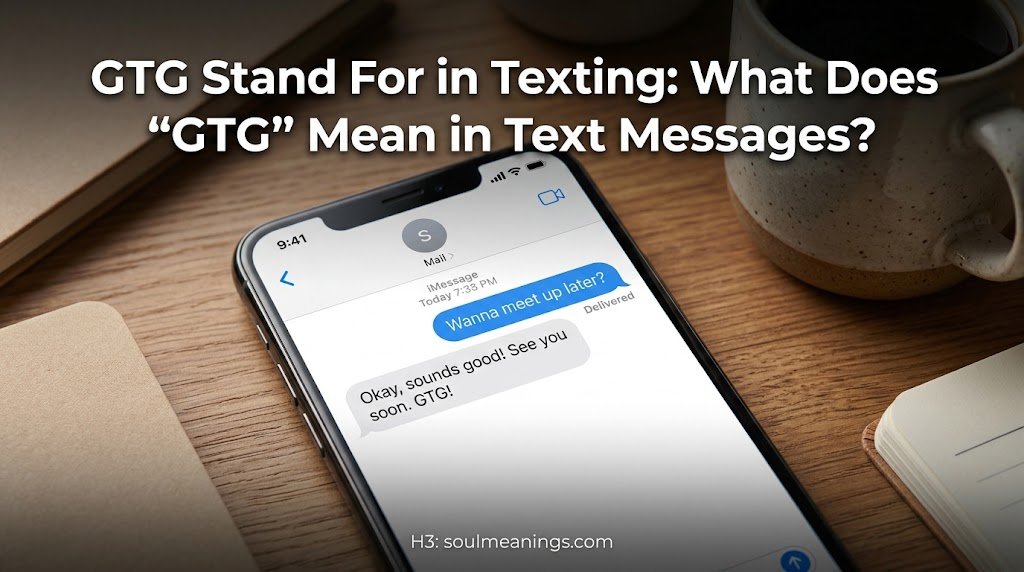
If someone sends you “GTG”, they usually aren’t dropping a secret code. They’re simply saying they need to leave.
GTG stands for “Got to Go” and is also commonly understood as the casual phrase “Gotta Go.” People use it in text messages, social media DMs, group chats, gaming conversations, and other informal online communication when they need to end a conversation or step away.
For example:
“GTG, my mom needs me.”
That simply means:
“Got to go. My mom needs me.”
The interesting part is the tone. A quick “GTG” can sound perfectly friendly in one conversation but slightly abrupt in another. The words around it, punctuation, timing, and relationship between the people all matter.
This guide explains exactly what GTG stand for in texting, how people use it, what it means from a guy or girl, how to respond, and how it compares with similar abbreviations such as G2G, BRB, TTYL, and AFK.
What Does GTG Mean in Texting?
GTG means “Got to Go” in texting. It tells the other person that the sender needs to leave, stop chatting, or become unavailable.
The abbreviation is especially common in casual conversations because it communicates the idea quickly.
Instead of typing:
“I have to go now because I have something else to do.”
Someone can simply type:
“GTG.”
The meaning stays clear because the conversation provides the context.
GTG Meaning at a Glance
| Abbreviation | Meaning | Common Use |
| GTG | Got to Go / Gotta Go | Leaving a conversation or activity |
| G2G | Got to Go | Similar to GTG |
| BRB | Be Right Back | Temporarily stepping away |
| TTYL | Talk to You Later | Ending the conversation with an intention to reconnect |
| AFK | Away From Keyboard | Temporarily unavailable, especially online or gaming |
| BBL | Be Back Later | Leaving with an expectation of returning later |
One important distinction stands out. GTG doesn’t necessarily promise that the person will return soon.
If someone says “BRB,” they usually expect to come back shortly. If they say “GTG,” they simply need to leave.
What Does GTG Stand For?
The most common expansion of GTG is:
GTG = Got to Go
In casual conversation, people may also interpret it as:
GTG = Gotta Go
“Got to go” is the more direct expansion of the letters. “Gotta go” reflects how people often pronounce the phrase in casual speech.
Both communicate essentially the same message.
For example:
- “GTG, I have class.” → Got to go, I have class.
- “GTG, dinner is ready.” → Gotta go, dinner is ready.
- “Sorry, GTG!” → Sorry, I need to leave.
- “GTG for now.” → I need to go for now.
So, if you’re wondering what GTG stand for in texting, the safest answer is “Got to Go.”
GTG Meaning in Different Texting Contexts
Although the basic meaning stays consistent, the situation can change how GTG feels.
A message sent between close friends may sound warm and casual. The same three letters sent without any explanation during an emotional conversation could feel much colder.
GTG in a Normal Conversation
In an ordinary text conversation, GTG usually means the person has to stop chatting.
For example:
Person A: “Are you watching the game tonight?”
Person B: “Yeah, probably. GTG though, I have to finish something.”
Here, GTG isn’t mysterious at all. Person B simply has another task to handle.
Another example:
“GTG, talk later!”
This sounds friendly because the sender adds a future point of contact.
GTG When Someone Is Busy
People often use GTG when another responsibility suddenly demands their attention.
They might need to:
- Go to work
- Attend class
- Eat dinner
- Answer a call
- Meet someone
- Leave the house
- Finish homework
- Go to sleep
- Handle a family matter
- Start another activity
For example:
“GTG, my ride is here.”
The message doesn’t suggest anger or boredom. The person’s transportation simply arrived.
GTG Between Friends
Friends often use GTG without worrying about formal grammar.
You might see:
“GTG bro, I’ll hit you up later.”
Or:
“GTG 😭 my parents are calling me.”
Because friends already understand each other’s communication style, the abbreviation can feel completely natural.
In close friendships, GTG doesn’t necessarily represent the end of the relationship or even the end of the day’s conversation. It may simply mean, “I have to disappear for a while.”
GTG in Group Chats
Group chats create another common situation.
Someone may write:
“GTG everyone. Have fun!”
That message announces that the person is leaving the conversation while allowing everyone else to continue talking.
It can also be shorter:
“GTG y’all.”
The abbreviation works particularly well in group chats because nobody needs a lengthy explanation.
Read More: JFC Meaning in Text: What Does JFC Mean in Texting and Social Media?
What Does GTG Mean From a Guy or Girl?
If a guy or girl texts you “GTG,” the basic meaning remains “Got to Go.”
There isn’t a special male or female definition.
That’s important because people sometimes try to decode ordinary abbreviations as hidden romantic signals. GTG alone doesn’t tell you whether someone likes you, dislikes you, feels awkward, or wants to end the relationship.
Context matters much more.
Compare these messages:
“GTG 😭 talk later!”
and
“GTG.”
The first feels more expressive and friendly. The second feels shorter and potentially more abrupt.
However, even “GTG.” doesn’t automatically mean something negative. The person could simply be in a hurry.
If a Guy Texts “GTG”
A guy might use GTG because:
- He needs to leave.
- Someone is calling him.
- He has work or school.
- He’s going somewhere.
- He needs to sleep.
- He has another commitment.
It doesn’t automatically mean he’s losing interest.
If a Girl Texts “GTG”
The same principle applies if a girl sends GTG.
She may simply be busy or need to leave.
Instead of analyzing the abbreviation itself, look at the whole conversation. Did she say she’d text later? Did she explain why she had to leave? Did she continue talking later?
Those details provide much more information than three letters.
GTG Meaning on Social Media
The GTG meaning in texting and social media generally stays the same.
You’ll see it in informal communication on platforms such as:
- Snapchat
- Facebook Messenger
- TikTok
- Discord
- Other messaging platforms
The platform doesn’t normally change what GTG means.
For example, an Instagram DM might say:
“GTG, I’ll send you the pictures tomorrow.”
A Snapchat conversation could contain:
“GTG, class is starting.”
A Discord user might write:
“GTG guys, see you tonight.”
In each case, the person needs to leave or stop participating.
Why GTG Works So Well Online
Digital conversations move quickly. People often don’t want to type full sentences when a familiar abbreviation communicates the same thought.
GTG functions almost like a verbal exit sign.
You see it and immediately understand:
The conversation is ending for now.
That’s why short abbreviations remain useful even as messaging platforms and communication habits change.
GTG Meaning in Gaming
Gaming is another setting where GTG appears frequently.
A player might need to leave a match because dinner is ready, a parent called them, work started, or they simply ran out of time.
For example:
“GTG after this round.”
This means the player plans to finish the current round and then leave.
Another example:
“Sorry guys, GTG. Catch you tomorrow.”
The player is ending the gaming session.
Common Gaming Examples
| Message | Likely Meaning |
| “GTG, dinner’s ready.” | The player needs to leave |
| “GTG after this match.” | The player will leave after the current game |
| “Sorry, GTG.” | The player has to stop playing |
| “GTG guys, work tomorrow.” | The player is ending the session because of work |
| “GTG, see you later.” | The player is leaving and expects to reconnect later |
Gaming context doesn’t create a completely different definition. GTG still means “Got to Go.”
The difference comes from the activity surrounding the message.
How to Tell What GTG Means From Context
Texting abbreviations can be deceptively short. Three letters don’t tell the whole story.
To understand the intended tone, look at the surrounding conversation.
Look at What Came Before GTG
Suppose you and a friend have been chatting normally.
They suddenly write:
“GTG, my boss just called.”
There’s little reason to interpret that negatively.
Now consider:
“GTG.”
after you asked an emotionally important question.
That could feel different. Still, you shouldn’t jump straight to a conclusion. The person might genuinely need to leave.
Check What Comes After GTG
A follow-up phrase often reveals the sender’s intention.
“GTG, talk tomorrow.”
sounds different from:
“GTG.”
The first message gives you a clear indication that the person expects another conversation.
Consider the Timing
Timing can provide useful clues.
If someone sends GTG during work hours, they may have to return to work. If they send it late at night, they might be heading to bed.
Context acts like a missing piece of a puzzle.
A Simple Context Guide
| Message | Likely Tone |
| “GTG, talk later!” | Friendly |
| “GTG, class is starting.” | Neutral |
| “Sorry, GTG!” | Polite or rushed |
| “GTG 😭” | Casual and expressive |
| “GTG.” | Brief or potentially abrupt |
| “GTG, I’ll text you tomorrow.” | Friendly and reassuring |
The key lesson is simple: don’t interpret GTG in isolation.
GTG Tone: Friendly, Neutral, Rushed, or Abrupt?
One of the most interesting things about texting is that punctuation and small additions can change the emotional flavor of a message.
Consider these four versions.
“GTG!”
The exclamation mark makes the message feel energetic or casual.
“GTG, talk later!”
This sounds friendly because the sender provides a clear goodbye.
“GTG, sorry!”
The word “sorry” suggests the person may feel bad about leaving suddenly.
“GTG.”
The period makes the message look more final. It can feel abrupt, although that doesn’t prove the sender is upset.
Texting has no facial expression or vocal tone. As a result, readers often infer emotion from tiny details.
That’s why punctuation, emojis, and follow-up words can matter.
GTG Texting Examples You Might Actually See
Here are realistic examples of GTG in text messages and what each one means.
Example: Leaving for Dinner
“GTG, dinner’s ready.”
The sender needs to leave the conversation because dinner is ready.
Example: Going to Class
“GTG, my class starts in five.”
The sender has limited time and needs to stop chatting.
Example: Friendly Goodbye
“GTG! Catch you later.”
The sender is leaving but clearly intends to talk again.
Example: Gaming
“GTG after this round.”
The sender plans to finish the current game before leaving.
Example: Family Calling
“GTG, my mom’s calling me.”
The sender needs to deal with something immediately.
Example: Going to Sleep
“I’m exhausted. GTG, goodnight.”
The sender is ending the conversation because they’re going to bed.
Example: Unexpected Interruption
“Sorry, GTG! Something came up.”
The person has encountered an unexpected reason to leave.
A Short Case Study: Why Context Changes GTG
Imagine two different conversations.
Conversation One
Alex: “Want to play another round?”
Sam: “Sure, but GTG after this one. I have work early.”
Here, GTG clearly means “I need to leave after this.”
There’s no negative emotional signal.
Conversation Two
Alex: “Can we talk about what happened earlier?”
Sam: “GTG.”
The meaning still literally means “Got to Go.” However, the timing makes the message harder to interpret.
Sam might genuinely be busy. Sam might also be uncomfortable discussing the subject.
The abbreviation itself doesn’t provide enough evidence to decide.
That’s why context matters more than the acronym.
How to Reply When Someone Says GTG
When someone tells you GTG, the best response is usually simple.
You don’t need to write an essay. A short acknowledgment works perfectly.
Good replies include:
- “Okay, talk later!”
- “No worries!”
- “Catch you later.”
- “Sure, take care!”
- “Alright, see you!”
- “Sounds good.”
- “Talk soon!”
If they sound rushed, don’t bombard them with additional questions.
For example:
Them: “GTG, my ride’s here.”
A natural response would be:
“No worries. Talk later!”
There’s no need to respond with five more questions while they’re literally walking out the door.
If You Want to Keep the Conversation Going
If the topic matters, you can acknowledge their departure while leaving the door open:
“No problem. Just text me when you’re free.”
That response respects their time without making assumptions.
FAQs
What does GTG stand for in texting?
GTG stands for “Got to Go” in most text conversations. People use it when they need to leave a chat, stop an activity, or become unavailable.
What does GTG mean from a guy?
When a guy texts GTG, it usually means “Got to Go.” It doesn’t automatically mean he’s annoyed or losing interest. The surrounding conversation provides more useful clues about his tone.
Is GTG the same as G2G?
Yes. GTG and G2G generally mean the same thing: “Got to Go.” Both are informal abbreviations used to tell someone that you need to leave.
Is GTG rude in a text?
GTG isn’t inherently rude. However, a short “GTG” can feel abrupt in certain conversations. Adding words such as “sorry,” “talk later,” or “take care” can make the message sound warmer.
How should you reply to GTG?
A simple response usually works best. You can say “No worries,” “Talk later,” “Catch you later,” or “Take care.” If the person sounds rushed, there’s no need to keep the conversation going.
Conclusion
GTG usually stands for “Got to Go” in texting. It’s a quick, casual way to tell someone that you need to leave a conversation, stop an activity, or become unavailable. You may see it in text messages, social media DMs, group chats, and gaming conversations.
The tone can change depending on the situation. “GTG, talk later!” sounds friendly and reassuring, while a simple “GTG” may feel more abrupt. Still, you shouldn’t assume someone is angry or uninterested based on the abbreviation alone.





1 thought on “GTG Stand For in Texting: What Does “GTG” Mean in Text Messages?”