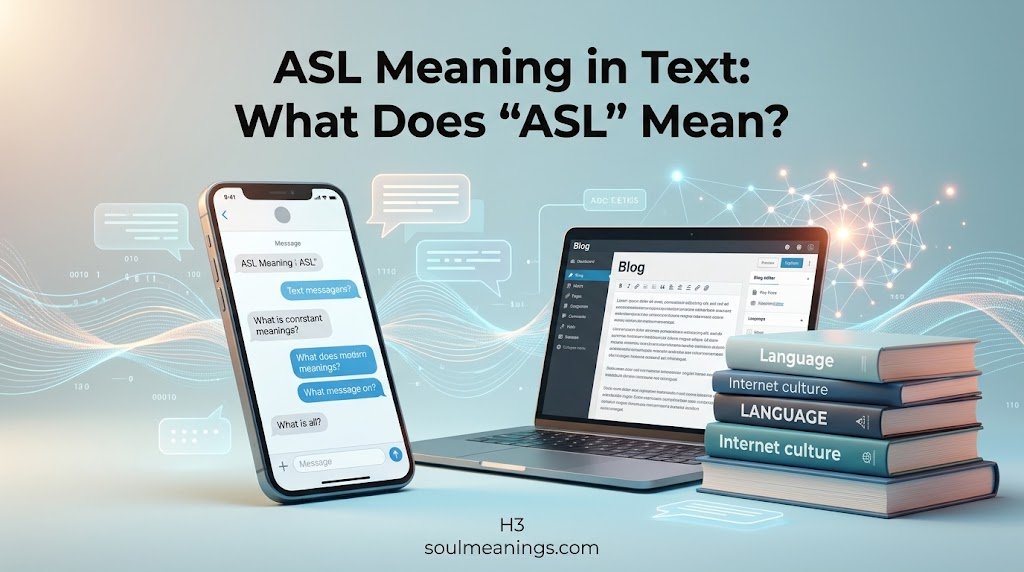
Seeing “ASL?” in a text can leave you wondering what the person actually means. Are they asking your age, sex, and location? Are they talking about American Sign Language? The answer depends on the conversation.
ASL meaning has two major uses. In older internet slang, ASL stands for “Age, Sex, Location.” People used it to quickly ask strangers for basic personal information in chatrooms and instant messaging. Today, ASL is also widely recognized as American Sign Language, a complete visual language used by many Deaf and hard-of-hearing people in the United States and parts of Canada.
That difference matters. A three-letter abbreviation can point to two completely different ideas.
If someone writes, “Do you know ASL?”, they’re probably asking whether you know American Sign Language. If a stranger suddenly sends “ASL?”, especially in an old-fashioned chat context, they may be asking for your age, sex, and location.
This guide explains both meanings, how to recognize the intended one, how ASL developed in online culture, and how to respond when someone sends you “ASL?”
What Does ASL Mean in Texting?
In texting and older online chat culture, ASL commonly means “Age, Sex, Location.”
It worked as a quick way for strangers to exchange three basic pieces of information. Instead of typing:
“How old are you? What’s your sex? Where are you from?”
someone could simply type:
“ASL?”
The abbreviation became especially recognizable during the early days of internet chatrooms, instant messaging, and anonymous online communities.
For example:
Person A: Hey, ASL?
Person B: 22, female, Texas.
Here, ASL clearly means Age, Sex, Location.
The phrase doesn’t have to appear with punctuation. You might see:
- ASL?
- ASL
- A/S/L?
- What’s your ASL?
- ASL please
These forms generally point to the same traditional internet meaning.
However, this usage feels much more dated today than it did during the early internet era. Modern users are more likely to ask these questions separately, especially because privacy expectations have changed.
Why Did “ASL” Become Popular?
The internet once felt much more anonymous than it does today. People entered public chatrooms with usernames rather than detailed profiles. A short abbreviation made it easy to start a conversation with a stranger.
Think of ASL as an old internet icebreaker.
Someone could type three letters and immediately learn basic information about another person. It was fast, simple, and easy to understand among regular chatroom users.
Today, that style can feel surprisingly blunt.
Asking a stranger for their age, sex, and location in the opening message may come across as intrusive. Modern social platforms already provide profiles, photos, bios, interests, and other information, so the need for a three-letter introduction has largely faded.
ASL Meaning: Age, Sex, Location Explained
The traditional ASL meaning breaks into three separate questions.
| Letter | Meaning | What the person is asking |
| A | Age | How old are you? |
| S | Sex | What is your sex? |
| L | Location | Where are you located? |
Each part served a particular purpose in anonymous online conversations.
A = Age
The first letter, A, stands for age.
A person asking “ASL?” might expect an answer such as:
- 18
- 21
- 25
- 30
Age could help people decide whether they had similar interests or whether a conversation was appropriate.
It also mattered in online dating and social chatrooms, where users often wanted to know whether another person was around their age.
Still, age is personal information. You don’t have to disclose it simply because someone asks.
S = Sex
The S traditionally stood for sex.
Older internet users often used this term to ask whether someone was male or female. The wording reflects the culture and terminology common in those online spaces at the time.
Modern conversations can be more nuanced. Someone may ask about gender rather than sex, especially when discussing identity.
That’s one reason the traditional ASL question can sound dated today.
L = Location
The final letter, L, means location.
In older chatrooms, someone might answer with a city, state, country, or general region:
- California
- Chicago
- Texas
- Canada
- New York
It usually didn’t mean an exact street address.
That’s important because location information can become identifying when combined with other details. Telling a stranger that you’re somewhere in California is very different from giving them your home address.
What Does “ASL?” Mean When Someone Texts You?
When someone simply sends “ASL?”, the traditional interpretation is:
“What is your age, sex, and location?”
This interpretation becomes more likely when:
- A stranger starts the conversation.
- The chat happens in an anonymous environment.
- The conversation has an older internet or chatroom feel.
- The person asks for personal information immediately.
- Nothing else in the conversation relates to sign language.
For example:
Stranger: Hey
You: Hi
Stranger: ASL?
In this situation, Age, Sex, Location is probably the intended meaning.
By contrast:
Friend: I’m taking a communication class.
You: Nice! What are you studying?
Friend: ASL.
Here, the abbreviation almost certainly means American Sign Language.
Context is the key.
ASL Meaning as American Sign Language
The other major ASL meaning is American Sign Language.
ASL is a complete natural language used by many Deaf people and other members of Deaf communities in the United States. It is also used by people who learn it for communication, education, family relationships, work, accessibility, or personal interest.
One common misconception deserves attention:
ASL isn’t simply English performed with your hands.
ASL has its own linguistic structure. It has its own vocabulary, grammar, syntax, and patterns of expression.
Facial expressions and body movements also play important grammatical and conversational roles.
For example, facial expression can help communicate whether a signer is asking a question, emphasizing a point, or expressing a particular emotional tone.
Is ASL the Same as English?
No.
English and ASL are different languages.
ASL doesn’t simply translate every spoken English word into a corresponding hand movement. Its sentence structure and grammatical features can differ significantly from English.
That’s why learning ASL involves more than memorizing signs.
You need to understand how the language works.
Is ASL Universal?
No.
ASL isn’t a universal sign language.
Different countries and communities use different sign languages. For example, British Sign Language, Australian Sign Language, and ASL are distinct languages.
Interestingly, British Sign Language and American Sign Language aren’t the same language, despite the fact that both countries primarily speak English.
ASL has historical connections to French Sign Language, along with influences from sign languages that developed in North America.
This linguistic history helps explain why spoken English doesn’t determine ASL grammar.
Read More: OMK Meaning in Text: What Does “OMK” Mean When Someone Texts You?
How to Tell Which ASL Meaning Someone Intended
The easiest way to understand ASL meaning in text is to examine the words around it.
Don’t look at the abbreviation alone. Look at the entire conversation.
| Message or Situation | Most Likely Meaning |
| “ASL?” from an anonymous stranger | Age, Sex, Location |
| “What does ASL stand for?” in a slang discussion | Age, Sex, Location |
| “I’m learning ASL.” | American Sign Language |
| “Do you know ASL?” | American Sign Language |
| “My daughter takes ASL classes.” | American Sign Language |
| “ASL interpreter” | American Sign Language |
| “ASL?” in an old-style chatroom | Age, Sex, Location |
| Accessibility or Deaf community discussion | American Sign Language |
Look at the Verb
The words around ASL can provide a major clue.
Consider:
“Do you know ASL?”
That sounds like a question about a language.
Now consider:
“Hey, ASL?”
That sounds like the old personal-information abbreviation.
The surrounding language acts like a signpost.
Look at the Setting
A classroom, accessibility discussion, or Deaf community group makes American Sign Language much more likely.
An anonymous chatroom makes Age, Sex, Location more likely.
The same three letters can therefore have completely different meanings without either person making a mistake.
What Does ASL Mean on Snapchat, Instagram, TikTok, and Social Media?
On modern social media, ASL meaning depends heavily on context.
A person discussing language learning might post:
“I’ve been studying ASL for six months.”
Here, ASL means American Sign Language.
Someone sending a private message to a stranger might write:
“ASL?”
Here, the traditional internet meaning may apply.
However, social platforms don’t have one universal ASL definition.
ASL on Snapchat
A direct message such as:
“ASL?”
could refer to Age, Sex, Location, particularly when a stranger sends it without any previous discussion.
But if someone says:
“I’m practicing ASL tonight.”
they’re almost certainly talking about American Sign Language.
ASL on Instagram
Instagram conversations can go either way.
A post about Deaf culture, accessibility, interpreting, or language education strongly points toward American Sign Language.
A random message asking “ASL?” may use the older chat abbreviation.
ASL on TikTok
TikTok has a broad mix of language communities, so context matters even more.
You might see ASL in educational videos about sign language. You might also encounter the abbreviation in comments or direct messages using older internet slang.
The platform itself doesn’t decide the meaning.
Is ASL Still Commonly Used for “Age, Sex, Location”?
The Age, Sex, Location meaning still exists, but it isn’t as culturally dominant as it once was.
It belongs strongly to the history of early online chat.
During the growth of public chatrooms and instant messaging, users had few ways to learn basic information about strangers. ASL became a compact social shortcut.
Modern platforms changed that environment.
Today, profiles often display:
- Age or age range
- Location
- Photos
- Interests
- Relationship information
- Education
- Work
- Hobbies
Because users have more information available before they even start talking, the old three-letter question isn’t as necessary.
It also carries a distinctly old-school internet flavor.
If someone uses “ASL?” today, the phrase may sound nostalgic, blunt, flirtatious, or simply unfamiliar depending on the audience.
Why Did People Use “ASL?” in Online Chatrooms?
Early internet chat was built around speed.
People often communicated through short messages, usernames, abbreviations, and shorthand. Typing a full sentence repeatedly could slow down a fast-moving conversation.
ASL solved that problem.
Instead of asking three separate questions, a person typed three letters.
ASL?
That’s efficient. It also became a recognizable social ritual.
A typical interaction might look like this:
Alex: Hi
Jordan: Hey
Alex: ASL?
Jordan: 20, female, Ohio
Alex: 22, male, Michigan
The exchange established basic information within seconds.
ASL as an Internet Icebreaker
The abbreviation functioned somewhat like today’s profile-based introduction.
On a modern social platform, you might glance at someone’s bio before starting a conversation.
In an older chatroom, you often had almost nothing to go on.
ASL filled that gap.
It wasn’t necessarily meant to be complicated. It was simply a fast way to find out who you were talking to.
Is It Safe to Answer an “ASL?” Message?
You can answer if you’re comfortable. However, you don’t owe a stranger personal information.
That distinction matters.
A broad answer such as:
“I’m in Texas.”
reveals less than:
“I live at 123 Example Street.”
Likewise, giving an age range can reveal less than providing your exact birth date.
Be Careful With Combinations of Information
A single detail may seem harmless. Several details together can become much more revealing.
For example:
- Your exact age
- Your school
- Your neighborhood
- Your workplace
- Your daily schedule
Together, those details can make you easier to identify.
For online conversations, a safer approach is to keep personal information broad until you trust the person.
Safer Responses to “ASL?”
You can respond without answering the question directly.
Try:
- “What do you mean by ASL?”
- “Are you asking about American Sign Language?”
- “I don’t share personal details online.”
- “I’d rather keep that private.”
- “Why do you ask?”
A simple boundary can save you a lot of trouble.
ASL vs. Other Similar Internet Abbreviations
The traditional abbreviation sometimes appears as A/S/L rather than ASL.
The slash marks don’t fundamentally change the meaning.
| Form | Meaning |
| ASL | Age, Sex, Location |
| A/S/L | Age, Sex, Location |
| ASL? | Usually asks for age, sex, and location |
| “What’s your ASL?” | Usually asks for the same information |
You may also encounter the abbreviation in discussions about internet history.
When that happens, the phrase usually refers to the classic chatroom expression rather than American Sign Language.
FAQS
What does ASL mean in text messages?
In text messages, ASL can mean “Age, Sex, Location.” It was widely used in older internet chatrooms when strangers wanted basic personal information. However, ASL can also mean American Sign Language, so the surrounding conversation matters.
What does “ASL?” mean from a stranger?
When a stranger sends “ASL?”, they usually mean “Age, Sex, Location?” They’re asking how old you are, your sex, and where you’re located. You don’t have to answer if you don’t feel comfortable sharing personal information.
Does ASL mean American Sign Language?
Yes. ASL stands for American Sign Language in conversations about Deaf communities, sign language, accessibility, or language learning. ASL is a complete natural language with its own grammar and structure.
Is ASL slang still used today?
The “Age, Sex, Location” meaning still appears online, but it has a strong old-school internet feel. Modern users may be more familiar with ASL meaning American Sign Language, especially in educational and accessibility-related contexts.
How can I tell which ASL meaning someone means?
Look at the context. If someone randomly messages “ASL?” they’re likely asking for age, sex, and location. If someone says “I’m learning ASL,” they’re referring to American Sign Language. When you’re unsure, simply ask what they mean.
Conclusion
Understanding ASL meaning is easier when you pay attention to context. In older internet slang, ASL means “Age, Sex, Location,” a phrase once common in chatrooms and online conversations between strangers. Today, that usage still exists, although it can sound dated.
At the same time, ASL widely means American Sign Language, especially in conversations about Deaf culture, language learning, accessibility, and communication. ASL is a complete natural language with its own grammar, vocabulary, and structure.






1 thought on “ASL Meaning in Text: What Does “ASL” Mean?”