
Have you ever walked away from a conversation thinking, “Wait, did that really happen the way I remember it?” Maybe someone denied saying something you clearly remember. Perhaps they told you that you’re being too sensitive when you raised a reasonable concern. Over time, these exchanges can leave you doubting your own memory and judgment.
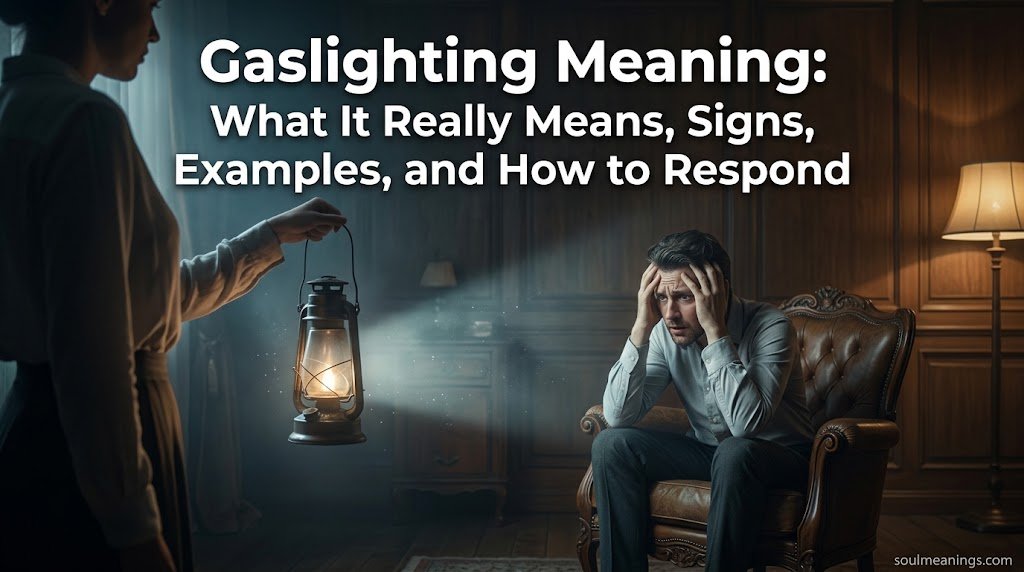
That experience helps explain the gaslighting meaning. Gaslighting describes a pattern of psychological manipulation in which someone repeatedly causes another person to question their perception, memory, judgment, or understanding of events.
However, there’s an important distinction to make. Not every lie, disagreement, mistake, or argument is gaslighting. The term has become extremely common online, yet its meaning becomes less useful when people apply it to every unpleasant interaction.
Understanding the real meaning of gaslighting means looking at the pattern, the context, and the way someone responds when you challenge their version of events.
What Does Gaslighting Mean?
Gaslighting means repeatedly manipulating someone into questioning their own perception, memory, judgment, or sense of reality.
The behavior can take different forms. A person might deny something that happened, insist that you remember an event incorrectly, dismiss your feelings, change the story after being confronted, or make you feel unreasonable for noticing a contradiction.
The key word is repeatedly.
Imagine a friend says something hurtful during an argument. Later, you bring it up and they genuinely remember the conversation differently. That alone doesn’t prove gaslighting. Human memory isn’t a video recording, and two people can honestly remember the same event in different ways.
The situation becomes more concerning when the person repeatedly denies clear events, twists conversations, dismisses your observations, and pressures you to accept their version of reality.
Simple Gaslighting Meaning
In plain English, gaslighting is essentially:
Making someone repeatedly doubt what they know, remember, see, or feel through manipulation or persistent denial.
For example:
You: “You told me yesterday that you’d already spoken to the manager.”
Them: “I never said that. You make things up all the time.”
If this happens once because both people genuinely remember the conversation differently, it may simply be a disagreement.
If someone regularly denies statements they made, rewrites conversations, attacks your memory, and uses your uncertainty to avoid accountability, the pattern may be gaslighting.
Where Did the Term Gaslighting Come From?
The word gaslighting has a surprisingly specific origin.
The term comes from the 1938 British stage play Gas Light, written by Patrick Hamilton. The story was later adapted into films, including the 1940 British film Gaslight and the better-known 1944 American film starring Ingrid Bergman, Charles Boyer, and Joseph Cotten.
In the story, a husband manipulates his wife into questioning her perception of reality. One memorable part of the plot involves the home’s gaslights changing in brightness. When his wife notices the lights behaving strangely, he denies that anything has changed.
The manipulation goes beyond simply telling a lie. He tries to convince her that her own observations cannot be trusted.
That idea eventually became the modern psychological term gaslighting.
The word now applies far beyond the original story. People use it to describe manipulative behavior in romantic relationships, families, friendships, workplaces, and other social settings.
How Does Gaslighting Work?
Gaslighting often works gradually rather than all at once.
A person doesn’t necessarily wake up one morning and suddenly convince someone to distrust their entire memory. Instead, repeated interactions can chip away at confidence.
A typical pattern may look like this:
Event → Denial → Confusion → Self-Doubt → Repeated Manipulation
For example, imagine that your partner repeatedly makes plans without telling you. When you ask about it, they say you were informed. You remember otherwise.
The next time it happens, they tell you that you’re “always forgetting things.”
Eventually, you might stop asking questions because you assume your memory must be wrong.
That’s where the manipulation becomes especially powerful. The issue isn’t just the original disagreement. Your confidence in your own judgment has become part of the conflict.
Common Gaslighting Tactics
Someone may use several tactics at once, including:
- Flat denial: “That never happened.”
- Memory attacks: “You always remember things wrong.”
- Trivialization: “You’re making a huge deal out of nothing.”
- Blame shifting: “I only did that because you made me.”
- Contradiction: Denying information you clearly witnessed.
- Selective storytelling: Leaving out important details to change the apparent meaning.
- Personal attacks: Calling you irrational, unstable, dramatic, or overly sensitive.
- Changing the subject: Turning attention toward your behavior instead of addressing the original issue.
- Rewriting conversations: Giving a dramatically different account of what was said.
- Social pressure: Claiming that everyone else agrees with them.
One tactic doesn’t automatically establish gaslighting. The broader pattern matters.
Common Signs of Gaslighting
Gaslighting can be difficult to recognize while you’re experiencing it because the manipulation often targets your confidence.
You may start noticing changes in your own behavior before you recognize what’s happening.
You Constantly Question Your Memory
You might repeatedly ask yourself:
- “Did I really hear that?”
- “Maybe I misunderstood.”
- “Am I remembering this incorrectly?”
- “Was I actually the one who caused the problem?”
Occasionally questioning your memory is completely normal. Constantly doing so after interactions with one particular person is more significant.
You Apologize Even When You’re Not Sure What You Did
Another warning sign involves frequent apologies.
You may find yourself saying sorry simply to end an argument, even when you don’t understand what you supposedly did wrong.
That can create an unhealthy pattern where keeping the peace becomes more important than resolving the actual issue.
You Feel Confused After Ordinary Conversations
Healthy disagreements can be uncomfortable. They shouldn’t consistently leave you feeling mentally scrambled.
If simple conversations repeatedly turn into complicated arguments about what happened, what you said, or what you supposedly meant, pay attention to the pattern.
You Feel Like You Must Watch Every Word
Some people begin rehearsing conversations before speaking because they expect their words to be twisted.
You may start thinking:
“If I say this, they’ll find a way to make it my fault.”
That kind of constant conversational caution can signal an unhealthy dynamic.
You Need Proof to Trust Yourself
Keeping screenshots, messages, recordings, or notes isn’t automatically problematic. Documentation can be useful in many practical situations.
However, if you feel you must collect evidence of every conversation simply to convince yourself that your memory is reliable, that deserves attention.
You Stop Trusting Your Own Judgment
This is one of the more serious effects.
You might start asking the other person what you should think, what happened, whether you’re overreacting, or whether your feelings are valid.
The more you surrender your own judgment, the easier it becomes for another person to control the narrative.
Common Gaslighting Phrases and What They Mean
Certain phrases frequently appear in conversations involving gaslighting. However, a phrase alone doesn’t prove that someone is gaslighting you.
Context matters.
| Phrase | Possible Manipulative Function |
| “That never happened.” | Denies an event |
| “You’re imagining things.” | Attacks your perception |
| “You’re too sensitive.” | Dismisses your emotional response |
| “You’re remembering it wrong.” | Challenges your memory |
| “You’re crazy.” | Attempts to discredit you |
| “You’re always the problem.” | Shifts blame |
| “I was only joking.” | Dismisses the impact of harmful words |
| “Everyone thinks you’re overreacting.” | Uses social pressure |
| “You made me do it.” | Avoids personal responsibility |
| “You’re making a big deal out of nothing.” | Minimizes the concern |
Consider the difference between “I remember that differently” and “You’re imagining things again.”
The first statement leaves room for two people to have different memories.
The second attacks the person’s credibility.
That distinction matters.
Gaslighting Examples in Real-Life Situations
Gaslighting doesn’t belong to one type of relationship. It can appear wherever people have ongoing interactions and unequal levels of trust, influence, or power.
Gaslighting in Romantic Relationships
Romantic relationships can create fertile ground for this behavior because partners often know each other’s emotional triggers and personal history.
Consider this example:
Alex: “You told me you’d call me after work.”
Jordan: “No, I didn’t.”
Alex: “You definitely did. We talked about it at lunch.”
Jordan: “You’re always creating problems. You must have imagined the conversation.”
If Jordan genuinely forgot making the promise, that’s different from deliberately manipulating Alex.
Now imagine the same pattern happens repeatedly. Jordan makes promises, denies making them, attacks Alex’s memory, and eventually convinces Alex that remembering conversations is impossible.
The repeated pattern is the important part.
Gaslighting Between Friends
Friendships can involve gaslighting too.
Suppose a friend repeatedly excludes you from group plans. When you mention it, they respond:
“We never excluded you. You just don’t make an effort.”
If you were repeatedly left out despite trying to participate, the response shifts the conversation away from the behavior and toward blaming you.
A single misunderstanding isn’t necessarily gaslighting. A continuing pattern of denial and blame deserves closer attention.
Gaslighting in Families
Family relationships can become complicated because people often share years of history.
A parent, sibling, or relative might dismiss someone’s recollection of a past event by saying:
- “That never happened.”
- “You’re remembering your childhood completely wrong.”
- “You’re just being dramatic.”
- “Everyone else remembers it differently.”
Family members can genuinely remember the past differently. Memories change over time, and people naturally interpret experiences through their own perspective.
The issue becomes more serious when someone consistently uses denial and manipulation to invalidate another person’s experiences or avoid responsibility.
Gaslighting at Work
Workplace situations require extra care because disagreement doesn’t automatically equal psychological manipulation.
For example, a manager might give unclear instructions. Later, the manager may honestly believe they explained the task differently.
That’s poor communication.
A more troubling pattern occurs when someone repeatedly changes instructions, denies previous conversations, blames employees for the resulting mistakes, and insists that the employee is simply forgetful.
Keeping clear written records can help in these situations.
For example:
“Just confirming our conversation today: the report is due Friday and should include the three sections we discussed.”
A simple written confirmation creates clarity without turning every workplace interaction into a courtroom drama.
Gaslighting Through Text Messages and Social Media
Digital communication creates another interesting problem because written messages can provide a record of what someone actually said.
Someone might claim:
“I never said that.”
You can scroll back and see the exact message.
However, digital conversations can still be manipulated through selective screenshots, deleted messages, missing context, edited stories, or claims about what a message supposedly meant.
For example, someone may screenshot one sentence from a long conversation while leaving out the messages immediately before and after it.
That’s not automatically gaslighting. It becomes relevant when someone repeatedly uses selective information to make you doubt what actually happened.
Gaslighting vs. Lying, Manipulation, and Disagreement
These terms overlap, but they don’t mean exactly the same thing.
| Behavior | What It Means | Simple Example |
| Lying | Deliberately giving false information | “I didn’t take your money.” |
| Gaslighting | Undermining someone’s confidence in their perception or memory | “You never saw me take it. You’re imagining things.” |
| Manipulation | Influencing someone to gain an advantage | Using guilt to force agreement |
| Disagreement | Two people hold different views or memories | “That’s not how I remember it.” |
| Miscommunication | People misunderstand information | “I thought you said Thursday.” |
| Defensiveness | Protecting oneself from criticism | “I don’t think I handled that well.” |
The distinctions matter because calling every unpleasant interaction gaslighting can make the term almost meaningless.
A person can lie without gaslighting.
A person can manipulate without gaslighting.
Two people can remember an event differently without either person manipulating the other.
Is Gaslighting Always Intentional?
Intent makes the subject more complicated.
Some people use gaslighting tactics deliberately. They know what happened, deny it anyway, and understand that the denial creates confusion.
Other situations may involve defensiveness, faulty memory, shame, poor communication, or an inability to accept responsibility.
For example, someone might confidently say:
“I never said that.”
They may genuinely believe it.
That doesn’t automatically mean they are deliberately gaslighting you.
However, the absence of clear malicious intent doesn’t make harmful behavior harmless. If someone repeatedly dismisses your concerns and refuses to engage honestly with evidence, the effect on the relationship still matters.
Instead of trying to read someone’s mind, focus on observable patterns.
Ask:
- Does this happen repeatedly?
- Does the person acknowledge mistakes?
- Can they discuss evidence calmly?
- Do they respect your perspective?
- Do they change their story whenever accountability appears?
- Do conversations leave you increasingly confused?
- Can disagreements happen without personal attacks?
Those questions often provide more useful information than trying to determine someone’s hidden motives.
Read More: ASL Meaning in Text: What Does “ASL” Mean?
Psychological Effects of Gaslighting
Repeated manipulation can affect how a person sees themselves and their relationships.
Self-Doubt
You may stop trusting your own memory.
Something that once felt obvious can suddenly seem uncertain.
Reduced Confidence
When someone repeatedly tells you that your judgment is wrong, your confidence can gradually shrink.
You might begin seeking approval before making ordinary decisions.
Emotional Exhaustion
Constantly defending your perception takes energy.
Even small conversations can feel like mental heavy lifting.
Difficulty Making Decisions
If you’ve learned to distrust your judgment, making choices can become harder.
You might constantly seek reassurance from others.
Social Withdrawal
Some people withdraw because they don’t want to explain the situation repeatedly. Others fear that friends or family members won’t believe them.
Increased Anxiety or Distress
Persistent conflict and uncertainty can contribute to significant emotional distress.
The effects aren’t identical for everyone. Gaslighting isn’t a medical diagnosis, and not every person exposed to manipulative behavior experiences the same consequences.
Why Do People Gaslight Others?
There isn’t one universal reason.
Possible motives include:
- Avoiding accountability
- Maintaining control
- Protecting a false story
- Shifting blame
- Avoiding consequences
- Maintaining power in a relationship
- Deflecting uncomfortable conversations
- Preserving an image of themselves
These explanations can help you understand behavior. They don’t excuse it.
A person who feels embarrassed about a mistake may become defensive. Someone seeking control may deliberately distort reality. The outward behavior can look similar even when the underlying motivation differs.
That’s another reason to focus on patterns instead of amateur mind-reading.
How to Tell If You’re Being Gaslighted
If you’re unsure about a situation, step away from the emotional heat and look at the pattern.
Check What You Can Verify
Look at messages, calendars, emails, receipts, written instructions, or other objective information when appropriate.
Facts don’t settle every emotional disagreement. They can clarify what actually happened.
Watch the Pattern
Ask yourself:
“Does this happen once, or does it keep happening?”
Repeated behavior tells you much more than one strange conversation.
Notice How the Person Handles Evidence
A healthy person may say:
“You’re right. I forgot about that.”
Someone behaving manipulatively may move the goalposts:
“Okay, I said that. But you made me say it.”
The subject changes, yet accountability never arrives.
Talk to Someone You Trust
An outside perspective can help when you’ve become too close to the situation.
Choose someone who listens carefully rather than someone who automatically takes sides.
Don’t Diagnose the Other Person
You don’t need to decide that someone is a narcissist, sociopath, or anything else to recognize unhealthy behavior.
You can set a boundary without assigning a psychological label.
How to Respond to Gaslighting
Arguing harder isn’t always the answer.
In fact, endless debates over tiny details can create an exhausting loop.
Instead, keep your response clear and grounded.
Stick to Specific Facts
Instead of:
“You always lie to me.”
Try:
“The message says Friday. That’s what I’m responding to.”
Specific statements are harder to derail.
Don’t Feel Forced to Prove Every Feeling
Your emotional response doesn’t require courtroom-level evidence.
You can say:
“That’s how the situation affected me.”
Another person doesn’t have to agree with your feelings for those feelings to exist.
Set Clear Boundaries
A boundary might sound like:
“I’m willing to discuss what happened, but I’m not going to continue if you insult me.”
Then follow through.
Leave Circular Arguments
Some conversations never move forward.
If every answer creates another accusation, repeating yourself won’t necessarily solve the problem.
You can end the conversation:
“We’re not reaching an agreement, so I’m stepping away for now.”
That’s not weakness. Sometimes it’s simply refusing to keep running on a treadmill.
Examples of Healthy Responses to Gaslighting
Here are practical responses you can adapt to different situations:
“I remember the conversation differently, and I’m not going to argue about whether my memory is valid.”
“We can disagree about what happened. Please don’t tell me what I felt.”
“Let’s look at the messages instead of arguing about what was written.”
“I understand that you see it differently. My decision still stands.”
“I’m willing to discuss the issue, but I won’t stay in a conversation where I’m being insulted.”
Notice the common thread.
These responses don’t require you to win the argument. They protect your ability to make your own decisions.
FAQs
Can gaslighting make you question your memory?
Yes. Repeated gaslighting can make you doubt whether you correctly remember conversations, events, or decisions. The constant denial can gradually weaken your confidence in your own recollection.
What is the difference between gaslighting and emotional manipulation?
Gaslighting is a type of manipulation that specifically targets someone’s perception, memory, judgment, or sense of reality. Emotional manipulation is broader and can include guilt-tripping, intimidation, flattery, or other tactics used to influence someone’s behavior.
Can a person gaslight themselves?
The phrase “self-gaslighting” describes repeatedly dismissing your own feelings, memories, or experiences without enough reason. For example, you might think, “It wasn’t that bad, so I shouldn’t feel upset,” even when your reaction makes sense. However, this differs from interpersonal gaslighting because another person isn’t directly manipulating you.
Does gaslighting always involve lying?
No. Gaslighting can involve lies, but it can also involve denial, minimization, blame shifting, contradiction, or repeatedly dismissing someone’s perception. The central issue is the pattern of undermining another person’s confidence in their own understanding of events.
How can you regain confidence after being gaslighted?
Start by reconnecting with your own observations and decisions. Writing down important events, talking with trusted people, setting clear boundaries, and getting professional support when needed can help rebuild confidence. Most importantly, remember that you don’t need another person’s approval to recognize how an experience affected you.
Conclusion:
Understanding the gaslighting meaning starts with recognizing the difference between ordinary disagreement and repeated psychological manipulation. Gaslighting can make you question your memory, judgment, feelings, and perception of events.
However, one lie or conflicting memory doesn’t automatically mean someone is gaslighting you. The pattern matters. Repeated denial, blame shifting, minimizing your concerns, and attacking your ability to trust yourself are stronger warning signs.








1 thought on “Gaslighting Meaning: What It Really Means, Signs, Examples, and How to Respond”