
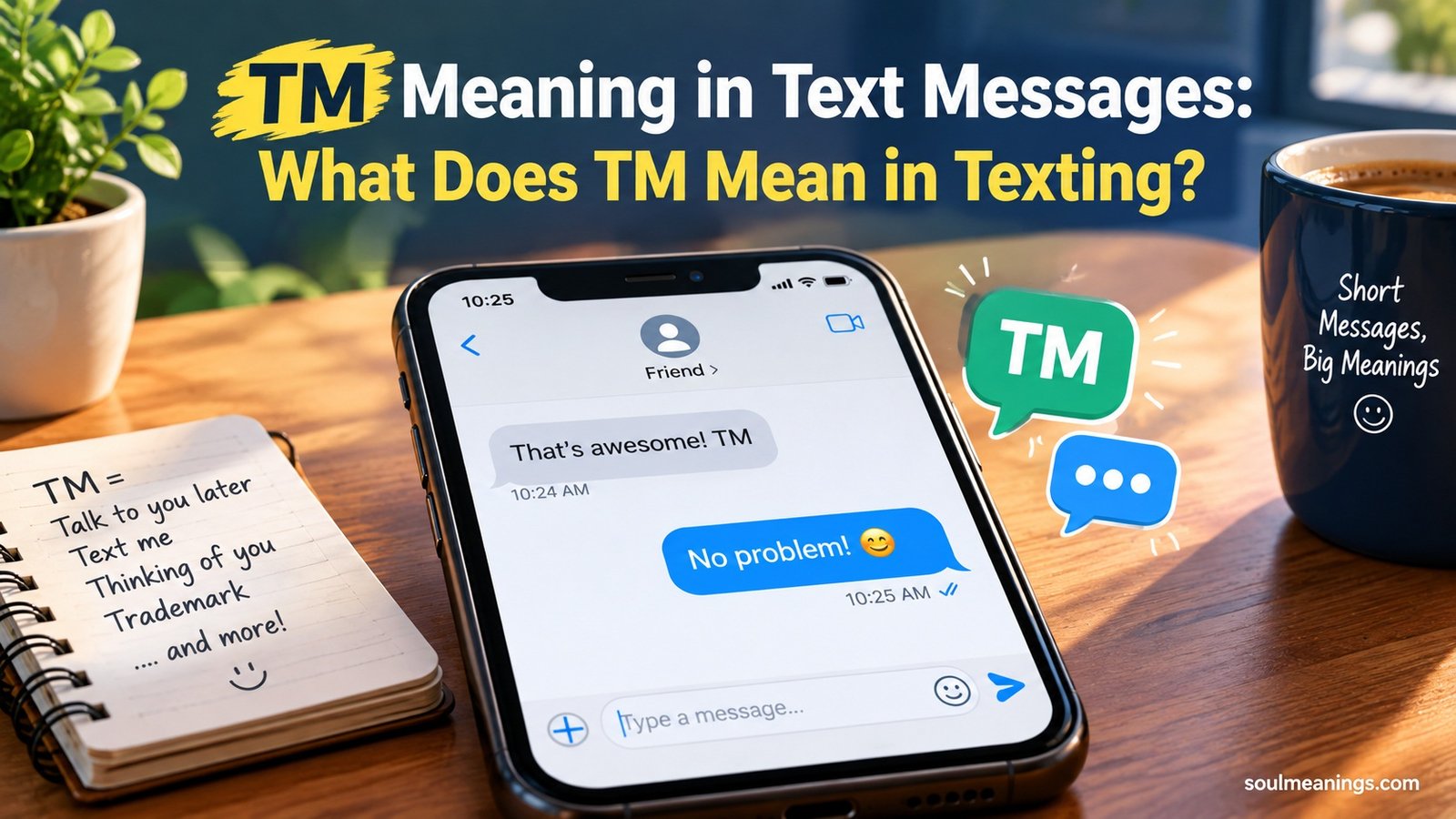
You get a message that says, “See you TM.” The meaning seems obvious once you know the shorthand. But then you see “TM” in a conversation about a brand, logo, or product, and suddenly the same two letters mean something completely different.
So, what does TM mean in text messages?
In casual texting, TM commonly means “tomorrow.” People use it as a quick abbreviation when talking about plans, appointments, deadlines, meetings, or anything happening the next day. The abbreviation is recognized as an internet and text-message shorthand for “tomorrow.”
Quick Answer: What Does TM Mean in Text Messages?
TM most commonly means “tomorrow” in casual text messages.
For example:
“Can we talk TM?”
means:
“Can we talk tomorrow?”
People use TM because it’s short, fast, and easy to type. It often appears in conversations about schedules, plans, work, school, appointments, travel, and social activities.
However, TM can also mean “trademark” when the conversation involves branding, names, logos, products, or intellectual property. The official trademark symbol is ™. According to the USPTO, TM may be used for a trademark associated with goods even without federal registration.
A simple rule makes the difference easy:
| If TM appears in a conversation about… | It probably means… |
| Plans or schedules | Tomorrow |
| Meetings or appointments | Tomorrow |
| Something happening the next day | Tomorrow |
| Brands or company names | Trademark |
| Logos or slogans | Trademark |
| Product names | Trademark |
When the meaning still isn’t clear, look at the sentence before and after TM. Context beats guesswork.
What Does TM Mean in Texting?
In ordinary texting, TM is commonly used as an abbreviation for “tomorrow.” It works much like other informal shortcuts that remove unnecessary letters from familiar words.
For example, someone might write:
- “See you TM.”
- “I’ll send it TM.”
- “Are you free TM?”
- “Let’s finish this TM.”
- “What time are you coming TM?”
In each example, the topic involves a future plan. That makes tomorrow the natural interpretation.
The abbreviation can appear in lowercase as tm or uppercase as TM. Texting doesn’t always follow strict capitalization rules, so the case usually doesn’t change the intended meaning.
TM Meaning in Text: Tomorrow
The strongest clue is the time-related context.
Imagine this conversation:
Alex: Are we still meeting this week?
Sam: Yeah, TM around 6.
Here, TM clearly refers to tomorrow. The sender is talking about a future meeting and giving a time.
Here’s another example:
“I’m exhausted tonight. I’ll finish it TM.”
Again, the meaning is straightforward. The writer plans to finish something the following day.
This use is especially practical because tomorrow is a relatively long word for something that appears constantly in casual conversation. Texting encourages people to shorten familiar expressions when both sides can understand them easily.
The same principle explains why people use abbreviations such as TMR and TMRW. None of these forms needs to appear in formal writing. They’re simply shortcuts that fit fast-moving digital conversations.
Why Does TM Mean Tomorrow in Text Messages?
The answer is mostly convenience.
Text conversations reward speed. When you’re replying to a friend, you usually don’t need to write every word in its most formal form. A short abbreviation can communicate the same idea with less effort.
Consider these two messages:
“I’ll call you tomorrow.”
and
“I’ll call you TM.”
The first sounds completely natural. The second sounds more casual and compressed. Yet both communicate the same basic idea.
This kind of shorthand has become part of online communication because people often type while multitasking. A quick message might be sent while someone is walking, commuting, working, studying, or switching between several conversations.
Still, TM isn’t a universal abbreviation that everyone uses. Some people prefer TMR, TMRW, or the full word tomorrow. Others may use TM for something else entirely.
That’s why context remains essential.
TM Meaning: Trademark
Outside casual texting, TM has a well-established meaning: trademark.
You may have seen it as a small symbol after a brand or product name:
ExampleBrand™
The USPTO explains that a trademark can be a word, phrase, symbol, design, or combination that identifies goods or services and distinguishes them from competitors.
The ™ symbol tells people that the owner is claiming the mark as a trademark. For goods, the owner can use TM even without filing a federal trademark application. For services, SM can be used instead. Once a mark has federal registration, the owner can use ® for the registered mark in the applicable goods or services.
So, these symbols aren’t interchangeable:
| Symbol | Meaning | General use |
| ™ | Trademark | Unregistered trademark claim for goods |
| SM | Service mark | Unregistered mark for services |
| ® | Registered trademark | Federally registered mark |
This is different from using TM as texting shorthand for tomorrow.
Example of the Difference
Consider these two messages:
“I’ll see you TM.”
Here, TM = tomorrow.
Now compare:
“The company added ™ to its new brand name.”
Here, TM = trademark.
The letters are identical. The context isn’t.
That tiny difference is why blindly assigning one meaning to every instance of TM can create confusion.
TM Meaning in Text Messages vs. Trademark
The easiest way to understand TM meaning in text messages is to separate casual conversation from branding language.
When TM Means Tomorrow
Look for words connected to:
- Today
- Tomorrow
- Later
- Morning
- Evening
- Meeting
- Call
- Visit
- Work
- School
- Plans
- Appointment
- Schedule
For example:
“Are you working TM?”
The message clearly asks about the following day.
When TM Means Trademark
Look for words connected to:
- Brand
- Logo
- Product
- Company
- Name
- Slogan
- Registration
- Intellectual property
- Trademark
- Business
For example:
“Can we put TM after the brand name?”
That conversation has nothing to do with tomorrow. It concerns trademark notation.
A Simple Comparison
| Message | Meaning of TM | Why |
| “See you TM.” | Tomorrow | Refers to a future meeting |
| “I’ll call TM.” | Tomorrow | Refers to a future call |
| “Are you free TM?” | Tomorrow | Refers to scheduling |
| “Can we use TM after the name?” | Trademark | Refers to branding |
| “The company uses Brand™.” | Trademark | Appears with a brand name |
The sentence usually provides enough evidence.
How People Use TM in Text Conversations
TM usually appears where a normal word would appear. That’s an important clue.
If someone says:
“I’ll send the photos TM.”
the abbreviation acts like a time word.
You can mentally replace it with tomorrow:
“I’ll send the photos tomorrow.”
If the sentence still makes perfect sense, you’ve probably found the intended meaning.
This substitution test works surprisingly well.
Example: Planning
“What time should we meet TM?”
Replace TM with tomorrow:
“What time should we meet tomorrow?”
The sentence works naturally.
Example: Work
“I’ll finish the report TM.”
Replace TM with tomorrow:
“I’ll finish the report tomorrow.”
Again, the meaning fits.
Example: Personal Conversation
“Let’s talk about it TM.”
The writer probably means:
“Let’s talk about it tomorrow.”
The surrounding topic gives you the answer without needing a separate abbreviation dictionary.
Read More: TF Meaning in Texting: What Does DTF Mean in a Text?
TM Meaning in Social Media and Online Chats
You may encounter tm in text messages, direct messages, group chats, comments, and other casual online conversations.
The basic interpretation remains context-driven.
For instance:
“Are you coming TM?
If friends are discussing plans, tm almost certainly means tomorrow.
Meanwhile:
“That brand name needs a TM.”
has a completely different meaning.
Social media also introduces another possibility: people sometimes use TM humorously to imitate the trademark symbol. A person might attach ™ to an invented phrase or joke to make it look like a proprietary catchphrase.
For example:
“Being late is my personality™.”
This isn’t necessarily a legal trademark claim. It can simply be playful internet humor.
That’s an important distinction. The symbol can carry a formal branding meaning while also appearing as a joke or stylistic device online.
Examples of TM Meaning in Text Messages
Realistic examples make the distinction much easier to understand.
TM Meaning Tomorrow
“See you TM!”
Meaning: See you tomorrow.
“Can you send me the file TM?”
Meaning: Can you send me the file tomorrow?
“I’m busy today. Maybe TM?”
Meaning: Maybe tomorrow?
“Are you free TM evening?”
Meaning: Are you free tomorrow evening?
“Let’s finish the project TM.”
Meaning: Let’s finish the project tomorrow.
TM Meaning Trademark
“Do we need TM after the product name?”
Meaning: Do we need the trademark designation after the product name?
“The logo has a TM next to it.”
Meaning: The logo includes the trademark symbol.
“Can we use that name with TM?”
Meaning: The discussion concerns trademark use.
Ambiguous Examples
Some messages don’t provide enough information.
“TM works for me.”
This probably means tomorrow works for me if the conversation concerns scheduling.
However, if the discussion concerns branding, you need more context.
That’s why reading the previous message matters.
How to Tell Which TM Meaning Someone Intended
When you see TM, don’t immediately decide what it means. Instead, scan the sentence for clues.
Check the Topic
First, ask what the conversation is about.
If you’re discussing weekend plans, tomorrow is likely.
If you’re discussing a company name, trademark makes more sense.
Check the Words Around TM
Look for nearby verbs and nouns.
Words such as meet, call, go, work, send, finish, visit, see, and come often point toward a time reference.
Words such as brand, name, logo, product, company, and symbol point toward trademark usage.
Check the Message Before It
A short message may not contain enough information by itself.
Suppose someone writes:
“TM?”
That could be unclear.
But if the previous message says:
“Can we meet Saturday instead?”
then TM? probably means something like “Tomorrow?”
Context fills in the missing information.
Check the Message After It
Sometimes the following sentence provides the clue.
“TM. Around 8?”
The time reference strongly suggests tomorrow.
In contrast:
“TM. Put it after the brand name.”
clearly points toward trademark terminology.
TM Meaning in Different Situations
When a Friend Says TM
Among friends, TM often means tomorrow when you’re making plans.
For example:
“Movie TM?”
This naturally reads as:
“Movie tomorrow?”
The informal style fits casual conversation.
When a Coworker Says TM
In a workplace chat, TM may also mean tomorrow if the conversation concerns deadlines or schedules.
For example:
“I’ll send the updated file TM.”
The meaning is easy to understand.
However, professional communication benefits from clarity. If the timing matters, writing “tomorrow” removes any possibility of confusion.
When Someone Talks About a Brand
If someone says:
“Should we add TM to the name?”
they probably aren’t talking about tomorrow.
They’re discussing trademark notation.
This is especially likely when the conversation involves branding, product launches, logos, business names, or slogans.
When TM Appears Alone
A standalone “TM” can be ambiguous.
Suppose someone simply sends:
TM
There’s not enough information to confidently identify the meaning.
The best response may be:
“Do you mean tomorrow?”
That’s not awkward. It’s better than confidently misunderstanding the message.
Is TM Formal or Informal?
When TM means “tomorrow,” it’s an informal texting abbreviation.
You might use it with:
- Friends
- Family
- Close coworkers
- Group chats
- Casual online contacts
It’s less suitable for:
- Formal business letters
- Contracts
- Academic assignments
- Official notices
- Important professional instructions
Compare these:
Casual:
“I’ll send it to TM.”
Formal:
“I’ll send it tomorrow.”
The second version is clearer and more polished.
There’s nothing wrong with texting shorthand in the right setting. The problem occurs when informal abbreviations enter situations where precision matters.
TM Meaning in Texting: Trust Me, Text Me, and Other Uses
Search results and slang-reference sites sometimes list additional interpretations of TM, including “trust me,” “text me,” “text message,” and “too much.”
However, these meanings shouldn’t automatically be treated as equally common.
That distinction matters because online abbreviation lists often collect possibilities from different communities. A meaning can exist without being the interpretation most people would choose in an ordinary conversation.
Trust Me
Some slang references use TM for “trust me.”
Example:
“TM, you’ll love this restaurant.”
Here, the sender is reassuring the recipient.
Still, the meaning depends heavily on the writer’s personal habits and the conversation.
Text Message
Some abbreviation references also list TM as “text message.”
For example:
“Send me a TM when you arrive.”
In that sentence, the writer could mean text message.
Again, context matters.
Too Much
Some contemporary slang sites list “too much” as another possible interpretation.
For example:
“That was TM.”
The writer could intend “too much.”
However, this isn’t a meaning that should automatically override the much stronger tomorrow interpretation in a scheduling conversation.
The safest approach is simple: treat uncommon meanings as context-dependent rather than universal definitions.
FAQS
What does TM mean in text messages?
TM most commonly means “tomorrow” in casual text messages. For example, “See you TM” means “See you tomorrow.” In other contexts, TM can mean trademark, especially when discussing brands, names, or products.
Does TM mean tomorrow in texting?
Yes. TM is commonly used as a shortened form of “tomorrow” in informal texting. You may see it when someone talks about plans, meetings, appointments, work, school, or activities happening the next day.
What does TM mean on social media?
On social media, TM can mean “tomorrow” when people discuss plans or schedules. It can also refer to trademark, particularly when it appears with a brand name or the ™ symbol. The surrounding conversation usually reveals which meaning applies.
Does TM mean trademark?
Yes. TM can stand for “trademark.” The ™ symbol commonly indicates a claimed trademark for goods. This use differs from the casual texting abbreviation TM, which often means tomorrow.
What does TM mean from a guy or girl?
TM doesn’t have a special meaning based on someone’s gender. A guy or girl might use TM to mean tomorrow, trademark, or another context-specific abbreviation. The words around TM provide a much better clue than the sender’s gender.
Conclusion
The TM meaning in text messages depends on the conversation around it. In casual texting, TM usually means “tomorrow,” especially when someone is talking about plans, appointments, or something happening the next day. For example, “I’ll call you TM” simply means “I’ll call you tomorrow.”
However, TM can also mean “trademark” when you see it beside a brand name, product, slogan, or business phrase. In other conversations, it may have less common meanings, so context matters.









1 thought on “TM Meaning in Text Messages: What Does TM Mean in Texting?”