
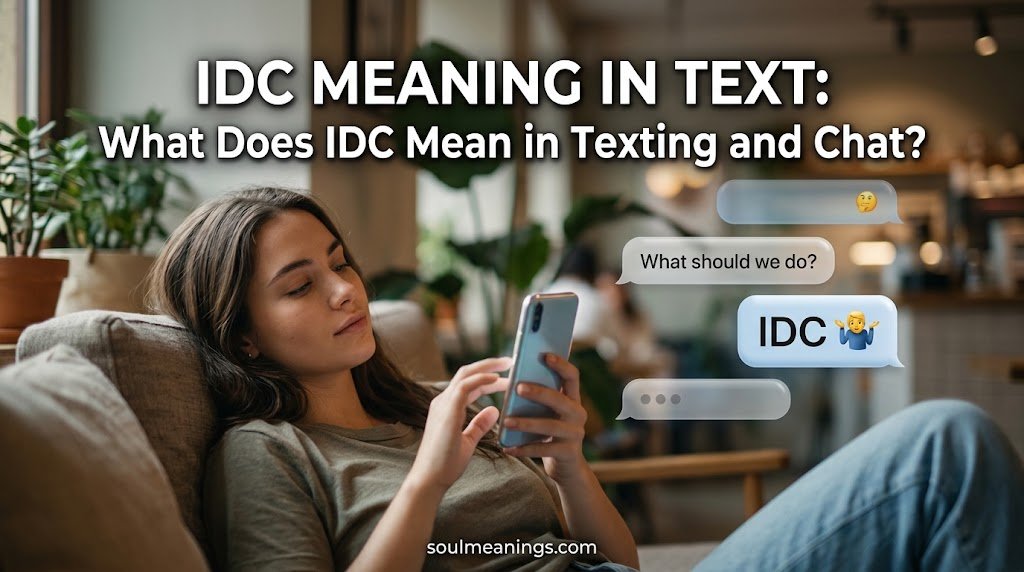
You get a message that simply says “IDC”, and suddenly a three-letter abbreviation leaves you wondering what the person actually means. Are they relaxed? Annoyed? Hurt? Or simply saying that the choice doesn’t matter to them?
In most texting and social media conversations, IDC means “I don’t care.” People use it to show indifference, say they have no preference, or signal that they don’t want to keep discussing something.
However, context changes everything. Compare “IDC which movie we watch ” with “IDC. Do whatever you want.” Both contain the same abbreviation, yet they can carry completely different emotional tones.
This guide explains IDC meaning in text, how people use it, what it can imply in different situations, and how to respond without jumping to conclusions.
IDC Meaning in Text at a Glance
The most common IDC meaning in text is “I don’t care.” It’s an informal initialism used in text messages, direct messages, group chats, comments, gaming conversations, and other casual online communication.
Someone might use IDC because they genuinely don’t have a preference. They might also use it because they’re frustrated or want to end a discussion.
| Term | Meaning | Typical Use |
| IDC | I don’t care | Casual texting and online chats |
| idc | I don’t care | Informal messages and DMs |
| IDC. | I don’t care. | Can feel blunt or final |
| idc | I don’t care | Often casual or playful |
| IDC anymore | I don’t care anymore | Often suggests frustration or emotional withdrawal |
The important point is that IDC usually describes the speaker’s attitude toward a subject. It doesn’t automatically mean they don’t care about the person they’re talking to.
For example:
“Do you want tacos or pizza?”
“IDC, you choose.”
Here, IDC probably means the sender has no preference.
Now consider:
“You keep ignoring what I’m saying.”
“IDC.”
That version can sound dismissive because the conversation has a completely different emotional setting.
What Does IDC Stand For?
IDC stands for “I don’t care.”
Each letter represents part of the phrase:
- I = I
- D = don’t
- C = care
IDC belongs to the large family of abbreviated expressions that developed around fast digital communication. Instead of typing the full phrase, people shorten it to three letters.
The abbreviation works because both people already understand the underlying words.
You’ll usually see it in informal settings rather than polished professional writing. A friend might text “idc what we eat” without thinking twice. A person writing a formal business email would normally choose something like “I don’t have a preference.”
Is IDC an Acronym or an Initialism?
Strictly speaking, IDC is an initialism because people generally pronounce the individual letters rather than saying them as one spoken word.
You’ll typically read it mentally as:
I-D-C
rather than as a single word.
In everyday conversation, however, people often use the broader term acronym for shortened online expressions. What matters for texting is simple: IDC is a shorthand way to write “I don’t care.”
What Does IDC Mean in a Text Message?
When someone sends IDC in a text message, the basic meaning remains “I don’t care.” Yet that statement can represent several different attitudes.
Sometimes it means “Either option is fine.”
At other times, it means “That issue doesn’t matter to me.”
In a tense conversation, it may mean “I don’t want to talk about this anymore.”
That’s why reading the surrounding messages matters more than decoding the abbreviation itself.
IDC as “I Have No Preference”
This is one of the most harmless uses.
Imagine you’re planning dinner with a friend:
Friend: “Chinese or Mexican?”
You: “IDC. You pick.”
Friend: “Mexican it is.”
Here, IDC doesn’t necessarily communicate irritation. The sender simply doesn’t care which option wins.
You could replace IDC with:
- “Either is fine.”
- “You choose.”
- “I’m good with whatever.”
- “I don’t mind.”
In this situation, IDC is closer to “I don’t mind” than “I don’t care about anything.”
IDC as “This Doesn’t Matter to Me”
People also use IDC when a particular detail seems unimportant.
For example:
“Do you want the blue one or the black one?”
“IDC. They’re both good.”
The sender isn’t necessarily dismissing the other person. They simply don’t consider the decision important enough to debate.
Think of it like choosing a seat at a movie theater when several seats remain open. If you genuinely don’t mind where you sit, IDC can communicate that quickly.
IDC as a Dismissive Response
The same abbreviation can become much sharper when someone uses it during an emotional exchange.
Consider:
“You promised you’d tell me first.”
“IDC.”
That response may sound cold because it dismisses an issue that matters to the other person.
In this setting, IDC can communicate:
- “I don’t want to discuss this.”
- “Your concern doesn’t matter to me.”
- “I’m done arguing.”
- “I’m not interested in explaining myself.”
The abbreviation hasn’t changed. The context has.
How IDC Is Used in Texting, DMs, and Social Media
IDC appears across many forms of casual digital communication.
You’ll commonly encounter it in:
- Text messages
- Instagram DMs
- Snapchat messages
- TikTok comments
- Group chats
- Gaming chats
- Discord conversations
- Online forums
- Social media replies
- Casual conversations between friends
Digital communication encourages brevity. When people already understand a phrase, there’s little reason to type every word.
For example:
“idc what time we leave”
takes less effort than:
“I don’t care what time we leave.”
That convenience helps explain why abbreviations remain common in informal online conversations.
Lowercase “idc” vs. Uppercase “IDC”
Both generally mean the same thing.
“idc” often feels relaxed and casual because lowercase writing has become common in online conversations.
“IDC” can appear more emphatic, but capitalization alone doesn’t prove anger.
Compare:
“idc which one you get”
with:
“IDC WHICH ONE YOU GET”
The second message uses capitalization for emphasis. It may feel more forceful because of the entire presentation rather than the letters themselves.
IDC Tone and What It Can Really Mean
One of the trickiest things about IDC meaning in text involves tone.
Face-to-face communication gives you several clues. You hear someone’s voice, see their facial expression, and notice their body language.
Text removes most of those signals.
As a result, the reader has to interpret tone from word choice, punctuation, timing, emojis, and context.
| Text | Possible Interpretation | Tone |
| “idc what we eat” | No food preference | Neutral |
| “IDC, you choose ” | Doesn’t mind | Playful |
| “IDC anymore” | Has stopped caring | Frustrated |
| “IDC. Do whatever.” | Doesn’t want to engage | Dismissive |
| “IDC!” | Strong emphasis | Possibly irritated |
| “idc lol” | Casual indifference | Relaxed |
Punctuation Can Change the Feeling
Punctuation doesn’t create a fixed meaning, but it can affect how a message feels.
Compare:
“idc”
“idc lol”
“IDC.”
“IDC. Do whatever you want.”
The first might feel casual.
The second may soften the statement.
The third can feel more final.
The fourth sounds more confrontational because the sender adds another dismissive phrase.
That’s why interpreting a text requires more than looking up the abbreviation.
Read More: WTH Meaning in Text: What Does WTH Mean in Texting and Chat?
Does IDC Sound Rude?
Sometimes.
The phrase “I don’t care” can sound blunt because it directly communicates indifference.
Imagine telling someone a story and receiving:
“IDC.”
You may reasonably feel dismissed.
Now imagine asking:
“Should we order burgers or pizza?”
and getting:
“IDC ”
The same expression feels much lighter.
When IDC Usually Sounds Neutral
IDC often sounds harmless when:
- The topic is minor.
- The sender gives you permission to choose.
- The conversation remains friendly.
- They add a laughing emoji or similar softener.
- They explain that either option works.
For example:
“IDC where we go. Pick somewhere close.”
The second sentence makes the intended meaning clearer.
When IDC May Sound Rude
It can feel rude when:
- Someone raises a serious concern.
- The sender responds during an argument.
- The message appears intentionally abrupt.
- The sender repeatedly dismisses the same topic.
- The message follows an emotional confession.
For example:
“I’ve been upset about this all day.”
“IDC.”
Here, the response may come across as deliberately insensitive.
Still, one message doesn’t provide enough information to know exactly what someone feels.
IDC vs. Similar Texting Abbreviations
Several texting abbreviations look or sound related to IDC. However, their meanings aren’t interchangeable.
| Abbreviation | Full Meaning | What It Communicates |
| IDC | I don’t care | Indifference |
| IDK | I don’t know | Uncertainty or lack of knowledge |
| IDGAF | I don’t give a fuck | Strong indifference with profanity |
| TBH | To be honest | Candid or direct statement |
| IMO | In my opinion | Personal viewpoint |
| NVM | Never mind | Withdrawal or dismissal of a previous point |
| IKR | I know, right? | Agreement or shared reaction |
The distinction between IDC and IDK matters especially often.
If someone asks:
“What time does the store close?”
and you answer:
“IDK.”
you’re saying you don’t know.
If you answer:
“IDC.”
you’re saying the closing time doesn’t matter to you.
Those responses communicate entirely different things.
IDC vs. IDGAF: What’s the Difference?
IDC and IDGAF can both express indifference. The major difference lies in intensity and language.
IDC means:
“I don’t care.”
IDGAF means:
“I don’t give a fuck.”
The second expression contains profanity and usually sounds much more aggressive or emphatic.
For example:
“IDC what they think.”
sounds relatively ordinary.
“IDGAF what they think.”
sounds significantly stronger.
IDC fits many casual conversations where IDGAF would sound unnecessarily harsh.
Because IDGAF includes profanity, it can also be inappropriate in professional, school, family, or unfamiliar social settings.
IDC Meaning From a Guy vs. From a Girl
The meaning of IDC doesn’t change based on gender.
If a guy texts IDC, it normally means “I don’t care.” If a girl sends IDC, the abbreviation carries the same basic definition.
What changes is the context and communication style of the individual.
For example, one person might use IDC frequently to mean:
“Either choice works.”
Another person might only use it during arguments.
That’s why trying to decode someone’s feelings based solely on whether they’re male or female can lead you down the wrong path.
Look at the conversation instead.
What were you discussing? What did they say before IDC? What did they say afterward? Do they normally text this way?
Those clues provide far more useful information.
What Does IDC Mean From a Crush or Partner?
Receiving IDC from someone you like can feel more significant than receiving it from a casual acquaintance.
That’s understandable. When emotions are involved, a short message can suddenly feel like a cryptic note.
However, IDC doesn’t automatically mean your crush has lost interest.
Depending on the conversation, it could mean:
- They genuinely don’t mind.
- They’re frustrated.
- They don’t want to argue.
- They’re trying to appear detached.
- They feel hurt.
- They’re ending an uncomfortable conversation.
- They simply don’t consider the topic important.
Consider this exchange:
You: “Do you want to see a movie Friday or Saturday?”
Them: “IDC, either day works.”
That’s probably straightforward.
Now compare:
You: “I feel like you haven’t been interested in talking lately.”
Them: “IDC.”
That response carries a much heavier tone.
The best approach isn’t to build an entire story around three letters. Read the surrounding conversation and consider the person’s usual communication style.
What Does IDC Mean in an Argument?
Arguments make IDC particularly difficult to interpret.
Someone might use it because they’ve become frustrated. They may feel that continuing the conversation won’t accomplish anything.
For example:
Person A: “Why didn’t you tell me earlier?”
Person B: “IDC anymore. Let’s just drop it.”
Here, IDC may signal emotional withdrawal rather than simple indifference.
The phrase “IDC anymore” deserves particular attention because the word “anymore” changes the message.
Compare:
“IDC.”
= I don’t care.
“IDC anymore.”
= I no longer care about this.
The second statement often suggests that the speaker’s attitude changed over time.
Why “IDC” Can Escalate an Argument
When someone says “I don’t care” during a disagreement, the other person may hear something stronger:
“Your feelings don’t matter.”
That may not be what the sender intended. Texting leaves plenty of room for misinterpretation.
If the relationship matters, clarifying the meaning can prevent a small misunderstanding from becoming a bigger conflict.
How to Respond When Someone Texts “IDC”
Your best response depends on what the conversation suggests.
There’s no universal reply because IDC can be neutral, playful, irritated, or dismissive.
If They Mean “Either Is Fine”
Keep things simple:
- “Okay, I’ll pick.”
- “Sounds good.”
- “Let’s go with pizza.”
- “Cool, I’ll decide.”
There’s no reason to turn a neutral message into a serious conversation.
If They Seem Annoyed
A calm response works better than matching their tone.
You could say:
“No worries. We can leave it for now.”
Or:
“You seem frustrated. Do you want to talk about it?”
This gives the other person room without forcing them into another argument.
If They Sound Dismissive
Sometimes the best move is to step back.
You don’t need to chase someone who clearly doesn’t want to engage at that moment.
A simple response such as:
“Okay, we’ll leave it there.”
can prevent unnecessary escalation.
If You Aren’t Sure What They Mean
Ask.
It might feel awkward for a moment, but direct communication beats guessing.
Try:
“Do you mean you don’t mind, or are you upset about it?”
That question gives the sender two clear possibilities without accusing them of being rude.
How to Use IDC Naturally in a Text
IDC works best in informal communication.
It’s especially natural when you’re talking with friends, relatives, gaming partners, or people who already understand your texting style.
Examples include:
“idc which restaurant we choose.”
“IDC who wins .”
“idc what they say.”
“Honestly idc anymore.”
The expression can also appear at the beginning, middle, or end of a sentence.
When You Should Spell It Out
Sometimes writing “I don’t care” is clearer.
Use the full phrase when:
- The topic is serious.
- You need to avoid ambiguity.
- You’re communicating with someone unfamiliar with texting shorthand.
- You’re writing professionally.
- The abbreviation might make your message sound colder than intended.
For example, instead of:
“IDC what happens next.”
you might write:
“I don’t really have a preference about what happens next.”
The second version gives you more room to communicate your intended tone.
Examples of IDC in Real Text Conversations
Seeing IDC in context makes its different meanings easier to recognize.
Making Plans
Alex: “Want to meet at 6 or 7?”
Sam: “IDC, either works.”
Alex: “Let’s do 7.”
Meaning: Sam has no preference.
Choosing Food
Alex: “Burgers or tacos?”
Sam: “idc you pick.”
Alex: “Tacos then.”
Meaning: Casual indifference with a friendly tone.
Discussing Entertainment
Alex: “Do you want to watch the comedy or thriller?”
Sam: “IDC. I’m good with either.”
Meaning: Both options are acceptable.
During an Argument
Alex: “You said you’d call me.”
Sam: “I know.”
Alex: “Then why didn’t you?”
Sam: “IDC anymore.”
Meaning: Sam may be frustrated or emotionally checked out.
Responding to Gossip
Alex: “Did you hear what they said about you?”
Sam: “IDC what they think.”
Meaning: Sam doesn’t want to give the opinion attention.
In a Group Chat
Mia: “Where should everyone meet?”
Jake: “IDC.”
Lena: “Let’s meet at the coffee shop.”
Meaning: Jake doesn’t have a preference.
FAQS
What does IDC mean in text?
IDC means “I don’t care.” People commonly use it in text messages, DMs, group chats, and social media. Depending on the context, it can mean they have no preference or don’t want to discuss a topic further.
Is IDC rude in texting?
IDC can sound rude depending on the context and tone. For example, “IDC which movie we watch” may sound neutral. However, replying “IDC” to someone sharing a serious concern can feel dismissive or cold.
What does IDC mean from a girl or guy?
The meaning of IDC doesn’t change based on gender. It normally stands for “I don’t care.” The surrounding conversation and the person’s usual texting style matter more when you’re trying to understand the intended tone.
What is the difference between IDC and IDK?
IDC means “I don’t care,” while IDK means “I don’t know.” IDC expresses indifference or a lack of preference. IDK expresses uncertainty or a lack of knowledge.
For example, “IDC where we eat” means the person has no preference. “IDK where we should eat” means they aren’t sure.
What does IDC mean from a crush?
When a crush sends IDC, don’t assume it means they don’t care about you. They may simply have no preference about the topic. However, if they use IDC during an emotional conversation, it could sound dismissive or suggest frustration. The surrounding messages provide better clues than the abbreviation alone.
Conclusion
Understanding IDC meaning in text is simple at its core: IDC usually stands for “I don’t care.” However, those three letters can carry different tones depending on the conversation.Someone might use IDC to say they don’t have a preference. In another situation, they may use it to show frustration, dismiss a topic, or signal that they don’t want to continue an argument. That’s why the surrounding words matter just as much as the abbreviation.
For example, “IDC which restaurant we choose” usually sounds harmless. Meanwhile, “IDC anymore” can suggest emotional distance or frustration. Even punctuation, emojis, and the relationship between the people involved can affect how the message feels.






1 thought on “IDC Meaning in Text: What Does IDC Mean in Texting and Chat?”