
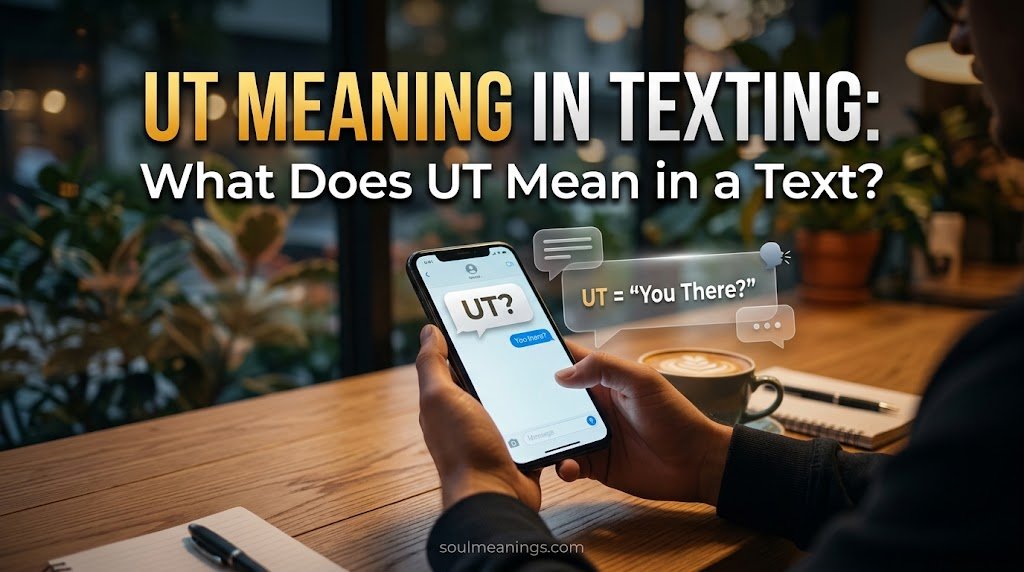
Seeing UT in a text message can leave you scratching your head. Two letters can point to completely different things depending on the conversation, the person who sent them, and the platform where you saw them.
Unlike common texting shortcuts such as “LOL,” “BRB,” or “TBH,” UT doesn’t have one universally accepted meaning in everyday texting. In many conversations, it isn’t slang at all. It may refer to Utah, a school or organization, a technical term, or a phrase understood only from the surrounding context.
That distinction matters. If someone sends “I’m moving to UT next year,” the letters probably refer to a place. If someone writes “UT?” in a private chat, the meaning could be completely different. Guessing without reading the rest of the conversation can easily send you down the wrong path.
This guide explains UT meaning in texting, its possible interpretations, how people use it online, and the quickest ways to figure out what someone means.
UT Meaning in Texting: The Quick Answer
The simplest answer is that UT has no single standard meaning in texting.
Its meaning depends heavily on context. One of the most established uses is UT as an abbreviation for Utah, especially in conversations involving locations, travel, school, sports, weather, or moving.
For example:
“We’re driving through UT on Friday.”
Here, UT means Utah.
However, if you encounter “UT” in a casual message without any obvious connection to Utah, don’t automatically assume that’s what the sender means. The abbreviation can represent different names, organizations, concepts, or shorthand depending on the conversation.
What Does UT Mean in Texting?
In practical terms, UT can mean different things in different conversations. There isn’t a universal texting dictionary that gives UT one fixed definition.
Before interpreting it, consider:
- What was the conversation about?
- Who sent the message?
- Where did you see UT?
- What words appeared before or after it?
- Does UT refer to a place, organization, school, or phrase?
- Does the sender normally use abbreviations?
Context is the key. Think of UT as a label with several possible destinations. The surrounding conversation tells you which one to choose.
What Does UT Stand for in Texting?
The letters UT can function as an abbreviation rather than traditional internet slang. That’s an important difference.
Internet slang usually develops from informal online communication. Terms such as “LOL,” “sus,” and “delulu” have recognizable social uses. An abbreviation such as UT, however, can simply shorten a proper name or location.
UT as Utah
One of the clearest established uses of UT is the postal abbreviation for Utah.
Utah is one of the 50 U.S. states, and its official two-letter postal abbreviation is UT. You may therefore see it in texts involving travel, addresses, sports, weather, jobs, school, or relocation.
For example:
“My sister lives in UT now.”
The meaning is straightforward: the person’s sister lives in Utah.
Another example:
“The weather in UT looks rough this weekend.”
Again, the abbreviation refers to Utah.
This use isn’t really texting slang. It’s a recognized geographic abbreviation that people may carry into casual conversations.
UT as a School or Organization Abbreviation
UT can also appear when people shorten the name of a university, institution, company, organization, or local group.
For example, someone discussing college might use UT to refer to an institution whose name commonly gets shortened to those letters. The exact institution depends on the conversation.
That’s why a message such as:
“Are you going to UT this fall?”
can’t always be interpreted from the letters alone.
If the conversation concerns college admissions, campus life, or football, the sender may have a particular university in mind. The surrounding discussion provides the missing information.
UT as a Topic-Specific Abbreviation
Some communities use two-letter abbreviations that make perfect sense to insiders but look mysterious to everyone else.
Gaming groups, workplaces, schools, sports communities, fandoms, and online communities often develop their own shorthand. In these settings, UT may have a specialized meaning that isn’t common in general texting.
That doesn’t mean every specialized definition qualifies as mainstream slang. It simply means the abbreviation has meaning within a particular context.
Read More: PH Meaning in Texting: What Does PH Mean in a Text?
UT Meaning on Snapchat, Instagram, TikTok, and Social Media
People often assume that an abbreviation must have a special definition because they encountered it on social media. That’s not necessarily true.
UT doesn’t have one universal social-media meaning across Snapchat, Instagram, TikTok, Facebook, X, or other platforms.
The platform can provide clues, but the content surrounding the abbreviation matters more.
For example, consider these messages:
“Thinking about moving to UT.”
“UT is beautiful this time of year.”
“Heading back to UT tomorrow.”
All three strongly suggest Utah when the conversation concerns geography.
Now imagine seeing:
“UT?”
That message is much harder to interpret. Without additional context, there’s no reliable reason to assign one specific meaning.
UT in Social Media Comments
Comments create another layer of ambiguity because people often leave extremely short responses.
A commenter might write only:
“UT?”
That could refer to a location, an organization, an inside joke, or something mentioned elsewhere in the post.
The smartest approach is to inspect the original caption, video, comments, hashtags, or profile context before deciding what UT means.
UT in Group Chats
Group chats can make abbreviations even more confusing.
Imagine three friends discussing colleges. One person writes:
“I got into UT!”
The other participants may immediately understand which school the sender means because everyone already knows the discussion.
A person who joins the chat later, however, might have no idea.
Shared context acts like a private dictionary. Once you know what everyone has been discussing, two letters can become perfectly clear.
UT Meaning in Different Texting Contexts
Context can dramatically change how you interpret an abbreviation.
| Context | What UT Could Refer To | What Helps You Identify It |
| Travel | Utah | Destination, road trip, flights, hotels |
| Weather | Utah | Forecast or regional weather discussion |
| Moving | Utah | Housing, jobs, relocation |
| College | A university or institution | Admissions, campus, classes |
| Sports | A school or team | Team names, games, athletes |
| Work | Organization or internal abbreviation | Workplace terminology |
| Social media | Context-specific reference | Caption, comments, hashtags |
| Private chat | Sender-specific shorthand | Previous messages |
This table highlights an important point: UT isn’t self-explanatory in every message.
Why Context Matters So Much
Abbreviations remove information.
When someone writes “Utah,” you immediately know the intended word. When they write “UT,” they remove most of that information and expect you to reconstruct it.
That works when both people share the same context.
For example:
“How’s UT?”
If you and a friend have been talking about a trip to Utah, you probably understand the message instantly.
If you’ve been discussing your friend’s university, however, you might interpret it differently.
The abbreviation hasn’t changed. The context has.
How to Tell What UT Means in a Text
You don’t need to become an internet slang detective. A few simple checks usually solve the mystery.
Look at the Words Around UT
Start with the sentence itself.
Compare:
“We’re flying to UT tomorrow.”
with:
“Did you hear from UT?”
The first clearly sounds geographic. The second requires more information.
Words such as fly, drive, visit, move, weather, road, state, city, hotel, and trip can point toward Utah.
On the other hand, words involving school, classes, campus, application, team, professor, or graduation may point toward an educational institution.
Consider Who Sent the Message
The sender matters.
A friend who lives in Utah may naturally use UT when talking about home. A college student may use the same letters to refer to their university. A coworker may use them as an internal abbreviation.
Your relationship with the sender gives you valuable context.
Check the Conversation Topic
Look back at the previous few messages.
Suppose the conversation looks like this:
“Where are you moving after graduation?”
“Probably UT.”
The discussion concerns relocation, so Utah becomes a reasonable possibility.
Now consider:
“Did you choose a college yet?”
“Yeah, I’m going to UT.”
The second conversation points toward a university or institution.
Never interpret an isolated abbreviation when the surrounding messages are available.
Look for Capitalization
Capitalization can sometimes provide a clue, although it isn’t conclusive.
UT in capital letters often looks like an abbreviation or initialism. A sender may capitalize it because they’re referring to a formal name.
Still, don’t rely on capitalization alone. People type quickly, and casual messages don’t always follow formal capitalization rules.
Ask for Clarification
If the meaning remains unclear, simply ask.
You could say:
“What do you mean by UT?”
Or:
“UT as in Utah?”
That’s often faster than making a guess.
There’s nothing awkward about asking. In fact, clarification can prevent an entire conversation from going sideways.
UT Texting Examples and Sample Conversations
Realistic examples make the ambiguity easier to understand.
Example Between Friends
Friend 1: “Where are you guys heading this summer?”
Friend 2: “Probably UT for a few days.”
Friend 1: “Utah?”
Friend 2: “Yep!”
Here, the travel discussion makes UT = Utah a sensible interpretation.
Example About Moving
Friend 1: “Did your job transfer go through?”
Friend 2: “Yeah. Looks like I’m moving to UT.”
Friend 1: “That’s exciting. When?”
The phrase “moving to” strongly suggests a geographic location. In this context, UT most naturally points to Utah.
Example About College
Friend 1: “Where are you going after high school?”
Friend 2: “I think I’m choosing UT.”
Friend 1: “Nice. Did you get your acceptance?”
Here, the college-related conversation tells you that UT probably refers to an educational institution rather than a state.
Example in a Group Chat
Person A: “Are we still meeting Friday?”
Person B: “Yeah, at UT.”
Person C: “Wait, which place?”
Person C’s confusion is understandable. The abbreviation doesn’t provide enough information by itself.
Person B might then clarify:
“The place we talked about yesterday.”
This shows why shorthand works best when everyone shares the same background information.
Example Where UT Is Ambiguous
Consider:
“I might go to UT next year.”
That sentence doesn’t provide enough information.
Does UT mean Utah? A university? Something else?
You need another clue.
A better response would be:
“Do you mean Utah or the university?”
That’s more useful than confidently choosing one interpretation.
UT vs. Similar Text Abbreviations
Texting contains hundreds of short forms, and several can look similar at a glance.
| Abbreviation | Common Meaning | Typical Use |
| UT | Context-dependent; often Utah in geographic contexts | Locations and specialized contexts |
| U | You | Casual texting |
| UR | Your / you’re | Informal messages |
| U2 | You too | Quick replies |
| TBH | To be honest | Opinions and personal reactions |
| IDK | I don’t know | Uncertainty |
| IMO | In my opinion | Giving an opinion |
| BTW | By the way | Changing or adding a topic |
These abbreviations aren’t interchangeable.
For example:
“U2!”
usually means “you too!”
Meanwhile:
“I’m moving to UT.”
has a completely different function.
The difference may seem obvious when the full sentences are shown. In a fast-moving chat, however, short abbreviations can blur together.
Is UT a Slang Word or an Abbreviation?
UT is better treated as a context-dependent abbreviation rather than automatically calling it slang.
That distinction helps prevent misinformation.
Slang generally carries a social or cultural meaning beyond simply shortening a name. Abbreviations can serve a much more practical purpose.
For instance, UT is an official postal abbreviation for Utah. Someone using it in a text isn’t necessarily trying to sound trendy or use internet slang. They’re simply using a familiar short form.
The same principle applies to abbreviations for institutions and organizations.
Why Some People Call UT Slang
People sometimes label any shortened expression as “text slang.” Online articles may also group many abbreviations together because they’re all short and informal.
However, that broad definition can create confusion.
If someone writes:
“I’ll be in UT next week.”
they aren’t necessarily using slang. They’re using a shortened geographic reference.
Not every abbreviation you encounter online is internet slang.
Is UT Rude, Offensive, or Inappropriate?
On its own, UT isn’t inherently rude or offensive.
The tone comes from the message around it.
For example:
“I’m visiting UT next month.”
is neutral.
Likewise:
“Are you still in UT?”
is also neutral if UT refers to Utah or another known reference.
However, an abbreviation can become confusing when the recipient doesn’t know what it means. Confusion isn’t the same thing as offensiveness.
When UT Can Cause Misunderstanding
Problems usually happen when:
- The recipient doesn’t know the abbreviation.
- The conversation has several possible meanings.
- The sender assumes too much shared context.
- The abbreviation refers to an organization with a similar name.
- The message is extremely short.
For important conversations, clarity beats cleverness.
Should You Use UT in Text Messages?
You can use UT when the person you’re messaging is likely to understand it.
For casual conversations, abbreviations can make messages faster and more relaxed.
They’re particularly useful when:
- You’ve already established what UT refers to.
- You’re talking with someone familiar with the same abbreviation.
- The conversation concerns a specific location or organization.
- The meaning is obvious from the surrounding messages.
However, writing the full term may be better when the recipient could reasonably misunderstand it.
When to Avoid Ambiguous Abbreviations
Professional communication deserves extra clarity.
Instead of writing:
“I’ll be in UT next week.”
you might write:
“I’ll be in Utah next week.”
That small change eliminates uncertainty.
The same rule works for school, work, customer service, applications, and formal correspondence.
If misunderstanding could create a problem, spell it out.
Why Do People Use Short Abbreviations Like UT?
Texting rewards efficiency.
People often communicate while walking, commuting, eating lunch, watching television, or juggling several conversations. Short forms reduce typing and keep exchanges moving.
There’s also a social reason.
Abbreviations can make communication feel more casual and familiar. Friends develop shared shortcuts because everyone already understands the code.
It’s similar to having an inside joke. The fewer words you need to explain, the more efficiently the group communicates.
Common Reasons People Use Abbreviations
- Speed: Shorter messages take less time to type.
- Convenience: Two letters can replace a longer name.
- Habit: Frequent texters naturally develop shorthand.
- Shared context: Friends may already know what the abbreviation means.
- Character limits: Some platforms encourage concise communication.
- Informal tone: Abbreviations can make messages feel less formal.
However, efficiency has a trade-off.
The more information you remove, the more context the reader needs.
FAQS
What does UT mean in texting?
UT doesn’t have one universal meaning in texting. In geographic conversations, it commonly refers to Utah, which has the official postal abbreviation UT. In other conversations, it can refer to an institution, organization, or context-specific term.
What does UT mean on social media?
There isn’t one universal social-media definition of UT. Its meaning depends on the caption, comment, conversation, and community where it appears. If the post concerns travel or geography, UT may refer to Utah.
Is UT slang?
UT can appear in informal texting, but it isn’t automatically slang. It often functions as an abbreviation. For example, UT is the official two-letter postal abbreviation for Utah.
Does UT have more than one meaning?
Yes. UT can have multiple meanings, depending on context. It can refer to Utah, an educational institution, an organization, or a specialized term used by a particular group.
Is UT appropriate for professional messages?
It depends on what UT means and whether the recipient understands it. For formal communication, spelling out an ambiguous term usually provides greater clarity.
Conclusion
The UT meaning in texting isn’t locked to one universal definition. That’s the most important point to remember.In conversations about geography, travel, relocation, weather, or places, UT commonly refers to Utah. Since UT is Utah’s official postal abbreviation, that interpretation has a clear and established basis.However, UT can also refer to a university, organization, or specialized term depending on the conversation. Social media doesn’t automatically give the abbreviation a different meaning either. The surrounding words and shared context still matter most.









1 thought on “UT Meaning in Texting: What Does UT Mean in a Text?”