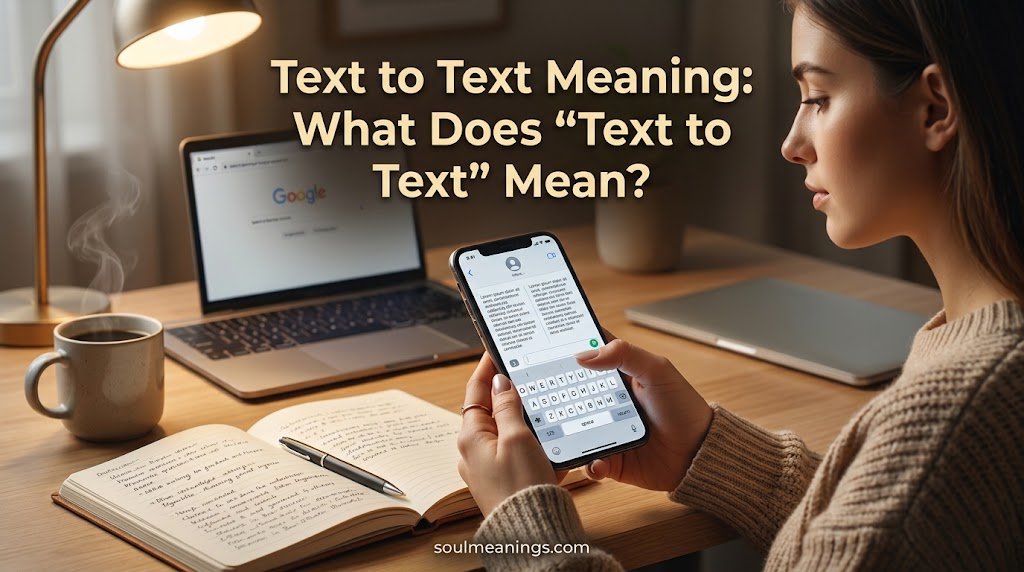
The phrase Text to Text Meaning can seem simple at first, yet its meaning changes depending on where you encounter it. In a classroom, it usually describes a reading strategy that connects one text with another. In literature, it can involve comparing themes, characters, arguments, or writing styles. In everyday communication, the phrase may simply describe a relationship between two pieces of written content.
That context matters.
If a teacher asks you to make a text-to-text connection, you aren’t being asked to connect a story to your personal life. You’re being asked to connect it with another text you have read, heard, watched, or studied. Educational resources commonly define the concept this way, describing text-to-text connections as relationships between a current text and other texts the reader already knows.
For example, suppose you’re reading a novel about a young person fighting against an unfair social system. You remember another novel with a similar conflict. Comparing the two stories creates a text-to-text connection.
The key isn’t simply noticing that two works have something in common. The useful part comes from explaining how they connect and why that connection matters.
Quick Answer: What Is the Text to Text Meaning?
Text to text means connecting one text with another text. In reading and education, a text-to-text connection occurs when you relate what you’re currently reading to another book, story, article, poem, movie, song, speech, or other text you’ve encountered.
For example:
“This novel reminds me of another book because both main characters struggle with pressure from their communities.”
That’s a text-to-text connection.
The two texts don’t need to be identical. They can share a theme while having completely different characters, settings, plots, or endings. In fact, meaningful differences can make the comparison even more useful.
Text to Text Meaning in Simple Words
Think of two texts as two conversations happening at different times.
One text gives you an idea. Another text gives you something to compare it with. Your job is to notice the relationship between them.
You might compare:
- Themes
- Characters
- Plots
- Conflicts
- Settings
- Arguments
- Author’s purpose
- Tone
- Symbols
- Genres
- Historical ideas
- Central messages
Educational reading resources specifically identify comparisons involving story elements, genres, topics, authors, and other texts as common forms of text-to-text connection.
What Does Text to Text Mean in Reading?
In reading instruction, text to text has a specific and well-established meaning.
It describes a connection between the text you’re reading now and another text you’ve previously read or heard. The other work might be a novel, short story, poem, article, news report, historical doc
Imagine that you’re reading a story about a child who moves to a new town and struggles to make friends.
You suddenly remember another story about a character experiencing the same kind of loneliness.
That’s your first connection.
A stronger response goes further:
“Both characters feel isolated after moving somewhere unfamiliar. However, the first character responds by becoming more outgoing while the second character withdraws from others.”
Now you’ve moved beyond recognition into comparison and analysis.
That’s where text-to-text thinking becomes valuable.
A Simple Text-to-Text Example
Imagine these two fictional texts:
Text A: A teenager moves to another state and has trouble fitting into a new school.
Text B: A young character starts at a new school and feels invisible because nobody knows them.
A weak connection would be:
“Both stories are about school.”
A stronger connection would be:
“Both characters experience loneliness when entering an unfamiliar school environment.”
An even deeper connection would be:
“Both stories show how unfamiliar environments can create loneliness, but they present different ways of overcoming that feeling.”
The final example doesn’t merely identify a similarity. It explains the relationship between the texts.
What Is a Text-to-Text Connection?
A text-to-text connection is a relationship a reader identifies between a current text and another text.
The National Council of Teachers of English’s ReadWriteThink resources describe text-to-text connections as one of three common connection strategies, alongside text-to-self and text-to-world. Their classroom strategy materials are designed for grades 3–8 and focus on helping students recognize these relationships while reading.
The connection can be obvious or subtle.
Two novels might share the same basic plot. That’s an obvious connection.
Two poems might use different stories but explore the same idea about loss. That’s subtler.
Two news articles might describe the same event from different perspectives. That’s another form of comparison.
What Can You Connect Between Two Texts?
| Element | What You Can Compare |
| Theme | What important idea does each text explore? |
| Characters | How are the characters similar or different? |
| Conflict | What problem drives each text? |
| Plot | Do important events follow similar patterns? |
| Setting | How does location or time affect each work? |
| Tone | Does each text feel serious, humorous, hopeful, tense, or tragic? |
| Author’s purpose | Why did each writer create the text? |
| Argument | What claims or positions does each text present? |
| Symbolism | Do similar objects or images represent related ideas? |
| Genre | Do both works belong to the same type of literature? |
| Message | What does each text ultimately communicate? |
This gives you a useful framework when a teacher asks you to explain a text-to-text connection.
Text to Text Meaning in Education
The educational use of Text to Text Meaning is especially important because it forms part of a broader reading strategy known as making connections.
Readers don’t approach every new text with an empty mind. They bring previous knowledge, experiences, ideas, and other texts with them. Making connections helps readers use that existing knowledge while interpreting something new. ReadWriteThink explains that strategic readers can draw on prior knowledge and experiences to connect with a text and develop stronger understanding.
This is why teachers often ask questions such as:
- “What does this remind you of?”
- “Have you read another story like this?”
- “How is this character similar to someone in another book?”
- “How are these two authors treating the same topic?”
- “What idea appears in both texts?”
- “How are the authors’ approaches different?”
Those questions encourage readers to build bridges between texts.
Why Teachers Use Text-to-Text Connections
A text-to-text connection can help students:
- Activate prior knowledge
- Compare ideas
- Identify themes
- Recognize patterns
- Understand unfamiliar concepts
- Analyze characters
- Examine different perspectives
- Strengthen reading comprehension
- Develop critical-thinking skills
- Support evidence-based writing
However, simply making a connection isn’t enough.
A useful connection needs an explanation.
Saying, “These books are similar,” tells the reader very little. Explaining what is similar, what is different, and why those details matter creates a much stronger response.
Text to Text vs. Text to Self vs. Text to World
One of the easiest ways to understand text-to-text meaning is to compare it with the other two major connection types.
Reading instruction commonly distinguishes text-to-text, text-to-self, and text-to-world connections.
| Connection | What You Connect | Example |
| Text-to-text | One text to another text | “This character reminds me of a character in another novel.” |
| Text-to-self | A text to your own experience | “This story reminds me of moving to a new school.” |
| Text-to-world | A text to the wider world | “This story connects with a historical event I studied.” |
Text-to-Text
You connect the current work with another work.
Example:
“The two novels both explore the pressure young people experience when adults make decisions for them.”
Text-to-Self
You connect the text with something from your own life.
Example:
“The character’s nervousness reminds me of my first day at a new school.”
Text-to-World
You connect the text with something outside your personal experience.
Example:
“The conflict in the story reminds me of a historical struggle for equal rights.”
ReadWriteThink gives similar distinctions, describing text-to-self as a connection with personal experience, text-to-text as a connection with other reading, and text-to-world as a broader connection with events and knowledge outside the reader’s immediate experience.
Text to Text Meaning in Literature
Literature provides endless opportunities for text-to-text comparisons.
A reader might discover that two novels have completely different plots yet explore the same theme. Another comparison might reveal that two authors portray similar characters in opposite ways.
For example, imagine two stories about ambition.
In the first story, ambition helps the protagonist overcome difficult circumstances.
In the second, ambition causes the protagonist to sacrifice important relationships.
Both texts explore ambition. Yet they don’t deliver the same message.
That difference is worth examining.
Common Literary Text-to-Text Comparisons
You can compare:
Characters:
Do the main characters face similar problems? Do they react differently?
Themes:
Do both works explore friendship, freedom, identity, ambition, grief, courage, or belonging?
Conflict:
Do the protagonists struggle against similar people, systems, environments, or internal fears?
Setting:
Does the setting influence the characters in comparable ways?
Tone:
Does one author make the subject hopeful while another creates a darker mood?
Symbols:
Does an object carry a similar meaning in both works?
Ending:
Do the texts resolve similar conflicts in different ways?
Author’s purpose:
Are both writers trying to entertain, persuade, criticize, inform, or challenge the reader?
These comparisons turn reading into something more active. Instead of simply moving from page to page, you begin noticing patterns.
Read More: NSFW Definition: What It Means, Where You’ll See It, and How to Use It
Text to Text Meaning in Writing
Text-to-text thinking also becomes useful when writing essays, comparisons, and literary analysis.
Suppose an assignment asks you to compare two poems.
A weak essay might summarize the first poem and then summarize the second.
That’s two summaries.
It isn’t necessarily a comparison.
A stronger approach places the two texts into conversation with each other.
For example:
Both poems describe loss through images of changing seasons. However, the first poem treats change as painful while the second presents it as a natural part of life.
Notice what happens here.
The sentence identifies a similarity, introduces a difference, and explains the central idea connecting both works.
A Useful Comparison Formula
When you’re stuck, use this structure:
Text A does X, while Text B does Y. Both texts connect through Z.
For example:
Text A presents isolation as frightening, while Text B presents solitude as peaceful. Both texts explore how being alone can change a person’s understanding of themselves.
This structure gives you somewhere to start without forcing every comparison into the same formula.
Text to Text Meaning in Different Contexts
The phrase text to text doesn’t always appear in a classroom.
Its exact meaning depends on the surrounding language.
| Context | Meaning of “Text to Text” |
| Reading class | Connecting one text with another |
| Literature | Comparing works, themes, characters, or ideas |
| Writing assignment | Analyzing relationships between texts |
| Research | Comparing information from multiple written sources |
| Everyday language | Referring to relationships between written messages or passages |
| Technology | May describe one written-text process producing or transforming another |
The educational meaning is the most clearly established use of the phrase in reading instruction.
Therefore, if you encounter text-to-text on a school worksheet, reading guide, or literature assignment, it usually means connecting the current text to another text.
Text to Text Meaning in Technology
Technology creates another possible use for the phrase.
In technical discussions, people sometimes use “text-to-text” to describe one form of written input being transformed into another written output. The exact process depends on the software, application, or system being discussed.
For example, a tool might transform:
Original text → translated text
or:
Long text → summarized text
or:
Question → written answer
However, don’t confuse this broad technological use with text-to-speech.
These terms describe different processes.
Text to Text vs. Text to Speech
Text-to-text generally involves written material remaining in written form.
Text-to-speech converts written language into spoken audio.
For example:
Text: “The rain started before sunrise.”
A text-to-speech system might read that sentence aloud.
A text-to-text system could instead translate, summarize, rewrite, classify, or otherwise transform the written material into another written output.
| Term | Input | Output |
| Text-to-text | Written text | Written text |
| Text-to-speech | Written text | Speech/audio |
| Speech-to-text | Spoken language | Written text |
| Text-to-image | Written prompt | Image |
| Text-to-video | Written prompt or script | Video |
The exact technical definition of a text-to-text process depends on the system being described. Therefore, context matters more in technology than the phrase itself might suggest.
Text to Text Meaning in Research and Informational Reading
Text-to-text connections aren’t limited to fiction.
They can also help when you’re reading nonfiction.
Imagine that you’re researching climate policy and find two articles discussing the same issue.
Article A presents one explanation.
Article B presents another.
Instead of treating each article as an isolated source, you can compare their:
- Main claims
- Evidence
- Examples
- Assumptions
- Sources
- Conclusions
- Areas of agreement
- Areas of disagreement
This approach can expose differences that aren’t obvious when you read each article separately.
Example: Comparing Two Informational Texts
Imagine Text A says a particular historical event resulted primarily from economic pressure.
Text B emphasizes political conflict.
A useful text-to-text analysis wouldn’t simply say:
“The articles are different.”
It would explain:
“Both texts identify the same historical event, but they emphasize different causes. Text A focuses on economic conditions while Text B gives greater attention to political disputes.”
That comparison tells the reader something meaningful.
FAQS
What does Text to Text mean?
Text to Text means connecting one text with another. In reading, it usually involves comparing themes, characters, ideas, conflicts, or other details between two texts.
What is an example of a text-to-text connection?
A simple example is connecting two novels that both explore friendship. You might explain how both stories portray friendship differently and what those differences reveal about each author’s message.
What is the difference between text-to-text and text-to-self?
Text-to-text connects one text with another text. Text-to-self connects a text with your own experiences, memories, or personal knowledge.
What is the difference between text-to-text and text-to-world?
A text-to-text connection links two texts. A text-to-world connection links a text with broader real-world events, issues, history, or knowledge.
Why are text-to-text connections important?
Text-to-text connections help you understand ideas more deeply. They allow you to spot patterns, compare perspectives, recognize differences, and support your interpretations with specific evidence.
Conclusion
Understanding Text to Text Meaning becomes much easier when you focus on the connection between two pieces of writing. A text-to-text connection happens when you compare one text with another and identify something they share, such as a theme, character, conflict, message, setting, or idea.
These connections can make reading more meaningful. Instead of treating each book, article, poem, or story as a separate piece, you begin to notice how different texts can discuss similar ideas in completely different ways.




1 thought on “Text to Text Meaning: What Does “Text to Text” Mean?”