
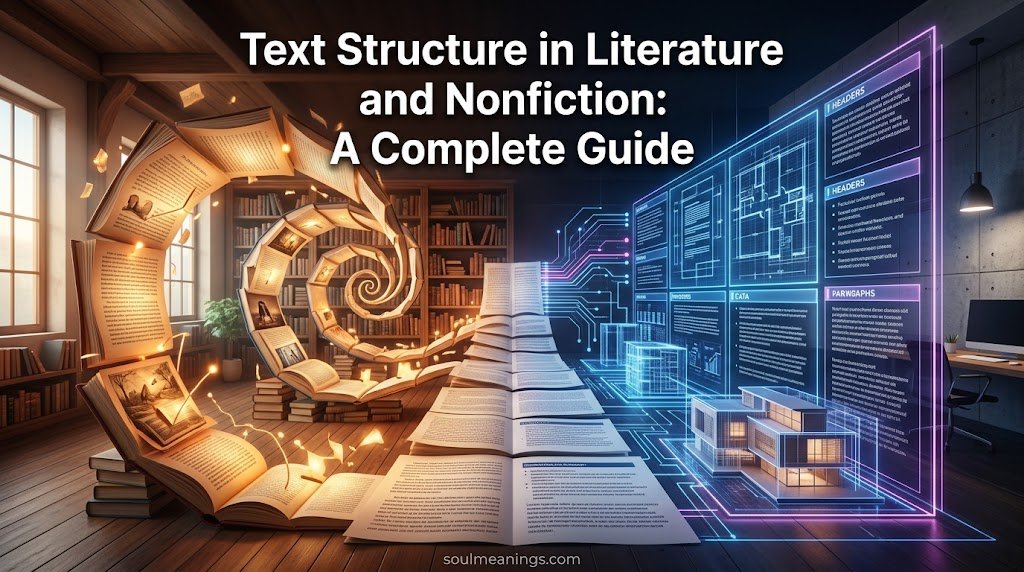
Have you ever read a story that jumps between the past and present, or a nonfiction article that explains a problem before offering a solution? Those choices aren’t random. They reflect text structure.
Text structure in literature and nonfiction describes how an author organizes ideas, events, information, arguments, and details. It gives a piece of writing its framework. Without structure, even strong ideas can feel scattered or difficult to follow.
A novelist might rearrange events to create suspense. A historian may present events chronologically. A science writer might explain a problem, examine its causes, and then describe possible solutions. Each writer uses structure to guide you through the material.
Understanding text structure in literature and nonfiction makes reading easier and literary analysis much stronger. It also helps you become a better writer because you start noticing not only what an author says but how the author builds the text.
What Is Text Structure in Literature and Nonfiction?
Text structure is the way an author organizes and connects the parts of a written work.
Those parts might include:
- Ideas
- Events
- Arguments
- Evidence
- Descriptions
- Characters
- Scenes
- Paragraphs
- Chapters
- Sections
- Conclusions
Think of text structure as the framework of a building. The words are the materials, while the structure determines where everything fits.
For example, imagine two articles about the same historical event. One begins with the earliest event and moves toward the present. Another begins with the consequences and then works backward to explain what caused them.
The information may overlap, yet the reading experience will feel completely different.
That’s because organization changes meaning, emphasis, and reader expectations.
Text Structure vs. Text Organization
The terms text structure and text organization often overlap. In practical reading, both refer to how an author arranges material.
However, text structure usually focuses more closely on the relationship between ideas or events.
For example:
A writer explains a drought, describes its causes, and then discusses its effects.
That’s a cause-and-effect structure.
Meanwhile, saying that the writer divides the article into an introduction, three body sections, and a conclusion describes the broader organization.
Text Structure vs. Literary Structure
Literary structure can cover more than the organizational patterns commonly taught in nonfiction.
A novel might use:
- Flashbacks
- Multiple narrators
- Parallel storylines
- Circular endings
- Fragmented scenes
- Embedded stories
- Nonlinear chronology
Nonfiction can use these techniques too, especially in memoirs, biographies, narrative journalism, and creative nonfiction.
The key question remains the same:
How has the author arranged the material, and what does that arrangement accomplish?
Why Authors Use Different Text Structures
Authors choose structures based on their purpose.
A writer explaining how a volcano erupts needs a different organization from a novelist building suspense around a murder mystery. Likewise, a persuasive essay needs a different framework from a biography.
Common reasons for choosing a particular structure include:
- Making information easier to understand
- Showing relationships between ideas
- Establishing a timeline
- Building suspense
- Emphasizing important information
- Comparing different viewpoints
- Explaining causes and consequences
- Presenting evidence for an argument
- Developing a character
- Controlling the pace of a story
- Creating surprise or irony
- Guiding the reader toward a conclusion
Structure isn’t decoration. It performs a job.
When an author changes the structure, the reader often receives the information differently.
Read More: PMO Meaning in Text: What Does PMO Mean in Texting?
Main Text Structures in Nonfiction
Nonfiction writers frequently use recognizable organizational patterns. Learning these patterns makes informational texts much easier to understand.
Chronological or Sequential Text Structure
A chronological structure presents events according to time. A sequential structure presents information in a particular order, which doesn’t always have to involve historical time.
A biography might begin with childhood, move through education and career, and finish with later achievements.
A recipe uses sequence:
Gather ingredients → prepare them → cook them → serve the meal.
A historical article might use chronology:
Early events → turning point → major development → aftermath.
Common clues include:
- First
- Before
- After
- Later
- Eventually
- Meanwhile
- Next
- Finally
- Years later
Chronological structure works particularly well for:
- Biographies
- Historical accounts
- Memoirs
- Timelines
- Personal narratives
- Historical journalism
- Instructions
Cause-and-Effect Text Structure
Cause-and-effect structure explains why something happened and what happened because of it.
For example, an article about coastal flooding might explain how rising sea levels, stronger storms, and land subsidence contribute to flooding. It could then describe effects on homes, transportation, and ecosystems.
Important signal words include:
- Because
- Since
- Therefore
- Consequently
- As a result
- Due to
- Leads to
- Causes
- Results in
One important detail matters here: a passage doesn’t become cause and effect simply because it contains the word because.
You need to examine the larger relationship between ideas.
Compare-and-Contrast Text Structure
A compare-and-contrast structure examines two or more subjects by discussing their similarities, differences, or both.
For example, an article might compare electric vehicles with gasoline-powered vehicles by discussing:
| Feature | Electric Vehicles | Gasoline Vehicles |
| Energy source | Electricity | Gasoline |
| Powertrain | Electric motor | Internal combustion engine |
| Refueling | Charging | Fueling |
| Tailpipe emissions | No tailpipe emissions | Produces tailpipe emissions |
| Typical energy storage | Battery | Fuel tank |
Writers commonly organize comparisons in two ways.
Point-by-point: Each feature gets discussed for both subjects.
Subject-by-subject: The writer discusses one subject fully before moving to the other.
Common clues include:
- Similarly
- Likewise
- Unlike
- In contrast
- However
- Whereas
- Both
- On the other hand
Problem-and-Solution Text Structure
Problem-and-solution writing identifies an issue and then discusses one or more ways to address it.
The basic pattern looks like this:
Problem → Causes or effects → Possible solution → Supporting explanation
This structure appears frequently in:
- Editorial essays
- Policy discussions
- Business writing
- Environmental articles
- Educational texts
- Technical writing
For example, a writer might describe overcrowded city transportation, explain why congestion occurs, and then examine public transportation improvements.
A genuine problem-and-solution passage usually does more than mention a problem and then change subjects. The later information should directly address the earlier issue.
Description Text Structure
Descriptive structure develops a subject through specific details.
The subject might be:
- A person
- A location
- An object
- An event
- An animal
- A scientific concept
- A historical setting
A writer describing the Grand Canyon, for example, might move through its colors, geological layers, landscape, size, and surrounding environment.
Description often relies on:
- Sensory details
- Physical characteristics
- Examples
- Specific facts
- Spatial relationships
The organization may also follow space, such as left to right, top to bottom, outside to inside, or near to far.
Classification and Division
Classification organizes information into groups or categories.
Suppose an article discusses renewable energy. Instead of describing every technology randomly, the author might divide the subject into:
- Solar energy
- Wind energy
- Hydropower
- Geothermal energy
- Biomass energy
This structure helps readers understand a complicated subject by breaking it into manageable categories.
Order of Importance
Some nonfiction writers arrange ideas according to importance.
An article might begin with background information before gradually presenting its most significant finding. Another might lead with the most important point and then provide supporting details.
News writing frequently uses a related pattern called the inverted pyramid, where important information appears early and supporting details follow.
The placement of information can therefore influence what readers notice first.
Question-and-Answer Structure
A question-and-answer structure organizes information around questions.
For example:
What causes a solar eclipse?
The writer answers the question and then explains the relevant astronomical alignment.
This structure works especially well for:
- Educational articles
- Interviews
- Guides
- Frequently asked questions
- Explanatory writing
Claim-and-Evidence Structure
Argumentative and analytical writing often follows a claim-and-evidence pattern.
The writer makes a point, presents evidence, explains that evidence, and connects it back to the larger argument.
A simplified pattern looks like:
Claim → Evidence → Explanation → Connection
Strong analytical writing doesn’t simply drop facts onto the page. It explains why those facts matter.
Text Structures in Literature
Literary works can use the same basic organizational ideas found in nonfiction, but fiction gives authors additional freedom.
A novelist can manipulate time, perspective, pacing, and information to influence how you experience the story.
Narrative Structure
Narrative structure describes how a story organizes its events.
A basic narrative might follow:
Beginning → Development → Crisis → Resolution
However, real stories can become much more complicated.
A novel might introduce the outcome first, return to earlier events, switch narrators, and eventually reconnect with the opening scene.
That’s still the structure.
The important issue is how the author controls the order in which you discover the story.
Linear Text Structure
A linear narrative follows events in chronological order.
For example:
Childhood → adolescence → adulthood → later life
This structure gives readers a clear sense of progression.
It often works well when the transformation of a character matters. You can see how one event leads to another and how earlier experiences shape later choices.
Nonlinear Text Structure
A nonlinear narrative doesn’t present events in straightforward chronological order.
The author might begin with an important event and then return to earlier moments.
For example:
Present crisis → childhood memory → return to present → earlier revelation → final outcome
Nonlinear structure can create suspense because readers receive information gradually.
Instead of asking only “What happens next?”, you may also wonder:
“What happened before this?”
That second question can become the engine of the story.
Three-Act Structure
The three-act structure divides a narrative into three broad movements:
Act I — Setup
The story introduces the world, characters, central situation, and major conflict.
Act II — Confrontation
The conflict develops. Obstacles become more complicated and the character faces increasing pressure.
Act III — Resolution
Major conflicts reach a conclusion and the consequences become clear.
Not every story fits this model perfectly. It’s better understood as an analytical framework than an unbreakable rule.
Five-Part Dramatic Structure
Another widely used framework divides a story into:
- Exposition
- Rising action
- Climax
- Falling action
- Resolution
The exposition establishes essential background.
During the rising action, conflicts and complications build.
The climax represents a major turning point.
The falling action shows the consequences.
Finally, the resolution brings the central narrative movement toward an ending.
This model can help readers discuss plot without assuming every story follows an identical formula.
In Medias Res
The Latin phrase in medias res means “into the middle of things.”
A story using this technique begins after the action has already started.
Instead of introducing every detail first, the author drops the reader into a significant moment and provides background later.
Imagine opening a novel with:
The courtroom had already gone silent when Maya realized the letter was missing.
You immediately have questions.
What letter?
Why does it matter?
How did Maya get there?
That information gap can create momentum.
Circular or Ring Structure
A circular structure brings the ending back to something from the beginning.
The connection might involve:
- The same location
- A repeated image
- A recurring phrase
- A similar event
- A character returning home
- A repeated question
- A transformed version of the opening situation
The ending doesn’t necessarily mean nothing changed.
In fact, the contrast between the beginning and ending can reveal how much a character has changed.
Frame Narrative
A frame narrative places one story inside another.
The outer story creates the frame while the inner story provides the main narrative.
This technique can involve:
- A storyteller speaking to an audience
- A character reading a document
- A discovered journal
- A witness recounting events
- One character telling another character a story
The frame can also affect reliability. Readers may need to consider who is telling the story and why.
Episodic Structure
An episodic story develops through a series of connected episodes.
Each episode may have its own smaller conflict while contributing to a broader narrative.
This structure works particularly well for:
- Adventure stories
- Travel narratives
- Character-centered novels
- Series
- Quest stories
The episodes may feel somewhat independent while still building a larger picture.
Parallel Structure
Parallel structure occurs when two or more storylines develop alongside one another.
The characters or events might share:
- Similar goals
- Opposing beliefs
- Comparable experiences
- Different responses to the same problem
- Connected outcomes
Parallel storylines can highlight contrasts without requiring the narrator to explain those contrasts directly.
Fragmented Structure
A fragmented narrative presents information in pieces.
Readers may encounter:
- Short scenes
- Memories
- Documents
- Different perspectives
- Disconnected moments
- Sudden shifts in time
The reader gradually reconstructs the larger story.
Fragmentation can reflect the way memory works. It can also create uncertainty or emphasize that different characters understand the same events differently.
FAQS
What is the most common text structure in nonfiction?
Chronological, cause-and-effect, compare-and-contrast, problem-and-solution, and descriptive structures are among the most common patterns in nonfiction. Authors often combine several structures within the same article or chapter.
What is the most common structure in literature?
Many stories use a linear narrative structure, where events unfold in chronological order. However, literature also frequently uses nonlinear, circular, episodic, framed, and parallel structures to control pacing and reveal information.
How does text structure affect the reader?
Text structure influences what readers notice, when they receive important information, and how they connect different ideas or events. A chronological structure can make development easy to follow, while a nonlinear structure can create suspense or mystery.
Can the structure of a text change its meaning?
Yes. The same events or facts can create different impressions depending on their arrangement. For example, revealing a character’s past before a major decision may create a different interpretation than revealing that past afterward.
How can students improve at identifying text structure?
Start by identifying the author’s purpose. Then look at how ideas or events connect. Ask whether the passage follows time, explains causes and effects, compares subjects, presents a problem and solution, or develops an argument. Signal words can help, but the overall organization matters most.
Conclusion
Text structure in literature and nonfiction gives writing its shape, direction, and purpose. Whether an author follows a timeline, compares two ideas, explains cause and effect, or builds a story through flashbacks, the structure determines how readers experience the information.
In nonfiction, structures such as chronological order, cause and effect, compare and contrast, problem and solution, description, classification, and claim-and-evidence help organize complex ideas. In literature, writers can go further by using linear, nonlinear, circular, episodic, parallel, fragmented, and frame structures to create suspense, reveal character, control pacing, and deepen meaning.







1 thought on “Text Structure in Literature and Nonfiction: A Complete Guide”