
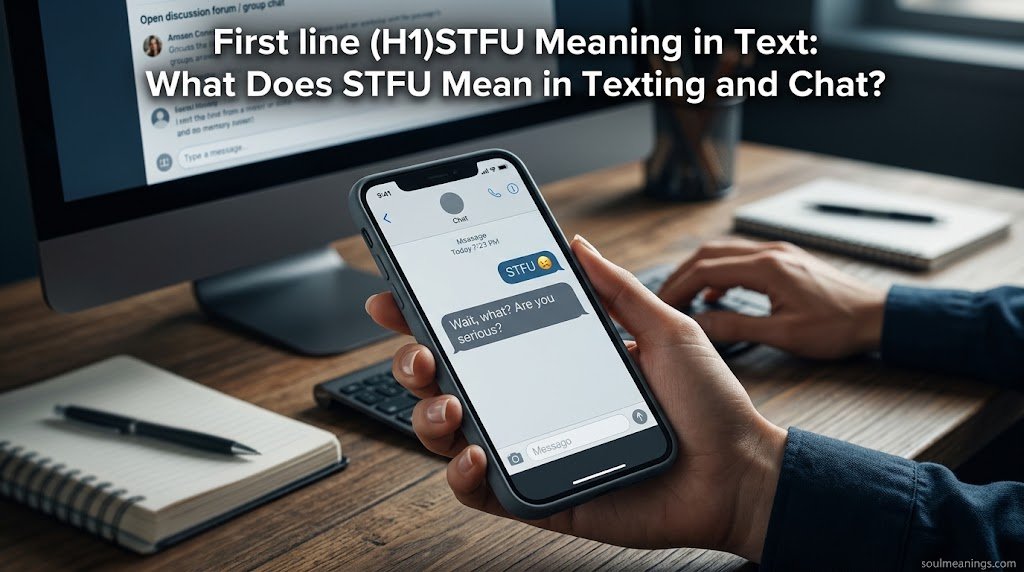
If someone sends you “STFU”, they probably aren’t talking about a secret code. In most texts, chats, comments, and DMs, STFU means “shut the fuck up.” It tells someone to stop talking, but the actual tone can range from playful teasing to genuine anger.
That difference matters. A friend might type “STFU ” after hearing an unbelievable story, while someone in an argument might send “STFU.” Those two messages contain the same abbreviation but communicate very different feelings.
Because STFU includes profanity, it can sound harsh even when the sender doesn’t intend to offend. The safest way to understand it is to look at the conversation, relationship, punctuation, emojis, and situation around the message.
What Does STFU Mean in Text?
STFU stands for “shut the fuck up.” It’s an informal texting abbreviation people use when they want someone to stop talking or when they react strongly to something another person has said.
The phrase has a much stronger edge than simply saying “shut up.” The added profanity gives it extra emphasis. Depending on the situation, that emphasis can communicate anger, disbelief, excitement, amusement, or playful shock.
For example:
Friend: “I accidentally sent my boss a screenshot of our conversation.”
Friend 2: “STFU ”
Here, the person probably isn’t demanding silence. Instead, STFU expresses disbelief. It works almost like saying, “No way! You’re kidding!”
Now consider a different conversation:
Person A: “You need to listen to me.”
Person B: “STFU.”
In this situation, the abbreviation sounds much more hostile. The sender likely wants the other person to stop talking.
STFU Meaning at a Glance
| Term | Meaning | Typical Tone | Common Use |
| STFU | Shut the fuck up | Strong, blunt, sometimes playful | Texts, DMs, comments, chats |
| Shut up | Stop talking | Direct, sometimes rude | Everyday conversation |
| Be quiet | Stop making noise or talking | Mild to firm | More polite situations |
| STFU | Often “No way!” or “You’re kidding!” | Playful or shocked | Friends and casual chats |
| STFU. | Shut up | Potentially hostile | Arguments or tense conversations |
The key point is simple: STFU doesn’t have one emotional meaning. Context supplies the tone.
What Does STFU Stand For?
Each letter in STFU represents a word:
- S = Shut
- T = The
- F = Fuck
- U = Up
Put together, the abbreviation means “shut the fuck up.”
People shorten phrases like this because texting rewards speed and brevity. Four letters can replace a four-word expression without requiring the sender to type the complete phrase.
You may see it written in several ways:
- STFU
- stfu
- Stfu
- STFU!
- STFU
- stfu lol
- STFU rn
Capitalization usually doesn’t create a completely different dictionary meaning. However, it can influence how forceful the message feels.
For instance, “stfu lol” may look casual in a friendly conversation. “STFU!!!” looks considerably more intense.
What Does STFU Mean in a Text Message?
The STFU meaning in a text message depends heavily on what happened immediately before it.
Sometimes it literally means, “Stop talking.” Other times, it’s closer to an emotional reaction such as “No way!”, “You’re kidding!”, or “I can’t believe you just said that.”
Here are some common interpretations.
Telling Someone to Stop Talking
This is the most direct interpretation.
“You’ve been arguing about this for twenty minutes. STFU.”
Here, STFU functions as a blunt command. The sender isn’t using it as a joke or reaction. They’re telling the other person to stop speaking.
Showing Surprise
STFU can also work as an exaggerated reaction.
“Guess who I saw at the concert?”
“STFU. Was it Taylor?”
The sender may not literally want silence. They’re expressing shock or disbelief.
Expressing Excitement
Among close friends, STFU can signal excitement.
“I got tickets for the final game!”
“STFU ”
The second person may actually mean, “That’s amazing. I can’t believe it!”
Reacting to Something Funny
Internet conversations often use profanity for emphasis rather than aggression.
“My cat opened the cabinet and stole an entire loaf of bread.”
“STFU ”
The response can mean something like “That’s hilarious!”
Showing Annoyance
The abbreviation can also carry genuine irritation.
“I already told you I’m busy. STFU.”
Here, the sender’s intent is much closer to the literal meaning.
Is STFU Always Rude?
No, but STFU is always fairly strong language.
The phrase contains the F-word, which makes it inappropriate in many formal situations. Still, whether someone experiences it as an insult depends on the relationship and context.
Imagine two longtime friends who regularly tease each other. One says:
“STFU You actually wore that?”
They may both understand the phrase as playful banter.
Now imagine receiving:
“STFU. Nobody asked you.”
from someone you barely know.
That message is much more likely to feel disrespectful.
What Makes STFU Sound More Aggressive?
Several clues can increase the intensity:
- A period after the abbreviation
- Multiple exclamation marks
- All-capital writing
- An ongoing argument
- Insults elsewhere in the message
- Repeated demands to stop talking
- A serious or confrontational subject
- A relationship without established joking language
Compare these examples:
| Message | Likely Interpretation |
| “STFU ” | Playful reaction |
| “stfu lol” | Casual teasing |
| “STFU ” | Shock, amusement, or disbelief |
| “STFU!!!” | Strong emotion or anger |
| “STFU.” | Blunt and potentially hostile |
| “Can you just STFU?” | Directly confrontational |
These aren’t absolute rules. People have different texting styles. However, they provide useful clues.
STFU Meaning in Different Contexts
The same four letters can behave differently across conversations. Context acts like the facial expression that text doesn’t provide.
STFU Between Friends
Close friends often use stronger language with each other than they would with strangers.
Someone might say:
“STFU, you actually got the job?!”
The sender isn’t necessarily telling the friend to become silent. The phrase can emphasize surprise and excitement.
Friend groups also develop their own communication habits. If everyone regularly uses profanity as humor, STFU may feel less serious.
Still, familiarity doesn’t guarantee that the message is harmless. Sensitive topics can change the tone instantly.
STFU During an Argument
Arguments create a very different environment.
If someone writes:
“STFU and listen for once.”
the phrase probably carries genuine frustration.
Here, the abbreviation functions as a command, not an enthusiastic reaction.
Using STFU during a heated disagreement can also escalate the conversation. Even if the sender feels justified, the profanity may shift attention away from the original issue.
STFU on Social Media
On platforms such as Instagram, TikTok, X, Reddit, Facebook, and similar communities, STFU can appear in comments and replies.
Public conversations create an additional complication: the reader doesn’t always know the relationship between the people involved.
A comment such as:
“STFU ”
could represent friendly banter between people who know each other. To an outside reader, it may look like an insult.
Memes also use STFU as an exaggerated reaction. In that environment, the phrase often carries a humorous or dramatic flavor.
STFU in Gaming and Online Communities
Fast-moving gaming chats frequently rely on short abbreviations. Players may use STFU while joking with teammates, reacting to an opponent, or arguing during a match.
For example:
“You missed that shot by a mile.”
“STFU, you died first.”
This could be friendly trash talk.
However, repeated hostile messages can cross from casual banter into harassment. The abbreviation itself doesn’t determine where that line sits. The pattern and context do.
STFU in Group Chats
Group chats add another layer because several people may interpret the same message differently.
A close group might laugh at:
“STFU Sarah just posted the worst selfie ever.”
But if a new person joins the conversation, that wording may come across as unnecessarily aggressive.
When you aren’t sure how a group communicates, softer wording usually creates fewer misunderstandings.
Read More: IDM Meaning in Text: What Does IDM Mean in Texting and Chat?
STFU as a Joke or Reaction
One of the most interesting parts of STFU meaning in text is its use as a reaction rather than a command.
Internet language often stretches the literal meaning of words. People use expressions such as “I’m dead,” “I’m screaming,” or “STFU” to communicate an emotional response rather than their literal meaning.
For example:
“I just found out my favorite actor lives two streets away.”
“STFU ”
The second person probably isn’t demanding silence. They’re saying something closer to:
“You’re kidding! That’s unbelievable.”
Common Emotional Meanings
Depending on context, joking STFU can communicate:
- Surprise: “No way!”
- Disbelief: “You’re not serious.”
- Excitement: “That’s incredible!”
- Amusement: “That’s hilarious.”
- Shock: “I can’t believe that happened.”
- Playful embarrassment: “Don’t expose me!”
- Teasing: “Oh, please.”
The emoji often provides a major clue.
For example:
- often signals humor.
- can emphasize dramatic laughter or disbelief.
- often signals that something is extremely funny.
- can reinforce surprise.
- may suggest annoyance or sarcasm.
However, emojis aren’t universal. A sender’s usual habits matter too.
STFU Tone: How Can You Tell What Someone Means?
Reading tone through text resembles trying to understand someone’s facial expression without seeing their face. You have to use surrounding clues.
Start with the relationship.
A longtime friend has more room for playful profanity than a stranger does. Next, look at the conversation immediately before STFU.
Was someone telling a funny story? Was the group celebrating? Or were two people arguing?
Then examine the wording.
“STFU no way!”
looks very different from:
“STFU. I’m done talking to you.”
A Practical STFU Tone Checklist
Before assuming the sender is angry, consider:
- Who sent it?
- What did you say immediately before?
- Do they normally use profanity?
- Did they add an emoji?
- Did they use punctuation?
- Are you currently arguing?
- Did they continue joking afterward?
- Does the rest of the message sound playful or hostile?
No single clue proves someone’s intent. Several clues together provide a much better picture.
STFU vs. Similar Texting Abbreviations
STFU belongs to a larger group of informal internet abbreviations. Some look similar but carry completely different meanings.
| Abbreviation | Full Meaning | General Function |
| STFU | Shut the fuck up | Tells someone to stop talking or reacts dramatically |
| GTFO | Get the fuck out | Tells someone to leave or expresses disbelief |
| WTF | What the fuck | Expresses confusion, surprise, or frustration |
| FML | Fuck my life | Expresses frustration about a situation |
| LMFAO | Laughing my fucking ass off | Strong laughter |
| LOL | Laughing out loud | Laughter or lightheartedness |
| SMH | Shaking my head | Disapproval, disbelief, or disappointment |
These abbreviations shouldn’t be treated as interchangeable.
For example, WTF usually reacts to something. STFU directly addresses another person’s speech or acts as an exaggerated reaction. GTFO usually focuses on leaving or disbelief.
What Does “STFU” Mean Without the Profanity?
If you understand the message but don’t want to use profanity, several alternatives work.
Depending on your intended tone, you could say:
- “Be quiet.”
- “Please stop.”
- “Can you stop?”
- “Seriously?”
- “No way!”
- “You’re kidding!”
- “I can’t believe you.”
- “Give me a break.”
- “Come on!”
- “That’s enough.”
The right alternative depends on what you’re trying to communicate.
If you genuinely want someone to stop talking, “Please stop” is much clearer and less aggressive.
If you’re reacting to surprising news, “No way!” captures the emotional meaning without the profanity.
How to Respond When Someone Says STFU
Your response should depend on the apparent tone.
If They’re Clearly Joking
You can respond playfully.
“ I knew you’d say that.”
Or:
“You can’t handle the truth!”
The goal is to match the existing tone without unnecessarily escalating it.
If They’re Angry
Don’t automatically fire back with another insult.
A calm response might be:
“If you’re upset, tell me what bothered you.”
That moves the conversation away from the abbreviation and toward the actual issue.
If You Find It Offensive
You can set a straightforward boundary.
“You can disagree with me, but please don’t talk to me like that.”
There’s no need to mirror the same language.
If You’re Unsure
Ask directly.
“Are you joking, or are you actually upset?”
This can feel slightly awkward, but it removes guesswork.
Examples of STFU in Texting and Chat
Realistic examples make the different meanings easier to spot.
Example: Unexpected News
Alex: “I ran into our old teacher at the airport.”
Jordan: “STFU ”
Meaning: “Seriously? That’s crazy!”
Example: Funny Story
Alex: “My dog stole a slice of pizza and hid behind the couch.”
Jordan: “STFU ”
Meaning: “That’s hilarious.”
Example: Friendly Teasing
Alex: “I think I’m finally becoming a morning person.”
Jordan: “STFU. You slept until noon yesterday.”
Meaning: Playful disbelief or teasing.
Example: Argument
Alex: “You’re not listening to anything I’m saying.”
Jordan: “STFU and let me finish.”
Meaning: The sender is genuinely irritated and wants the other person to stop talking.
Example: Gaming
Player 1: “You missed every shot.”
Player 2: “STFU, you got eliminated first.”
Meaning: Competitive banter or trash talk, depending on the players’ relationship.
Example: Romantic Conversation
Person A: “I saved your favorite dessert for you.”
Person B: “STFU that’s so sweet.”
Meaning: Playful surprise and affection.
The romantic example illustrates an important point: STFU doesn’t automatically mean hostility simply because the phrase is vulgar.
FAQS
What does STFU mean in text?
STFU means “shut the fuck up.” It usually tells someone to stop talking. However, friends sometimes use it playfully to express surprise, disbelief, excitement, or amusement.
Is STFU rude?
STFU can sound very rude or aggressive because it contains profanity. Close friends may use it jokingly, but using it with strangers, coworkers, teachers, or in professional conversations can easily cause offense.
What does STFU mean when a girl or guy texts it?
The meaning doesn’t automatically change based on who sends it. The person may be joking, expressing surprise, or genuinely telling you to stop talking. Look at the conversation, punctuation, emojis, and your relationship with the sender to understand the intended tone.
What does “STFU ” mean?
“STFU ” often expresses playful disbelief or amusement rather than a literal demand for silence. It can mean something like “No way!”, “You’re kidding!”, or “That’s hilarious!” The exact meaning depends on the conversation.
How should you respond when someone says STFU?
Consider the sender’s tone first. If they’re joking, a playful response may fit. If they’re angry, staying calm can prevent the situation from getting worse. If the message feels disrespectful, you can clearly say that you don’t appreciate being spoken to that way.
Conclusion
The STFU meaning in text is usually “shut the fuck up,” but the abbreviation doesn’t always function as a literal command. In casual conversations, people often use it to show surprise, disbelief, excitement, or humor.Context makes the difference. A laughing emoji and a friendly conversation can make STFU playful, while a period during an argument can make it sound much more confrontational.









1 thought on “STFU Meaning in Text: What Does STFU Mean in Texting and Chat?”