
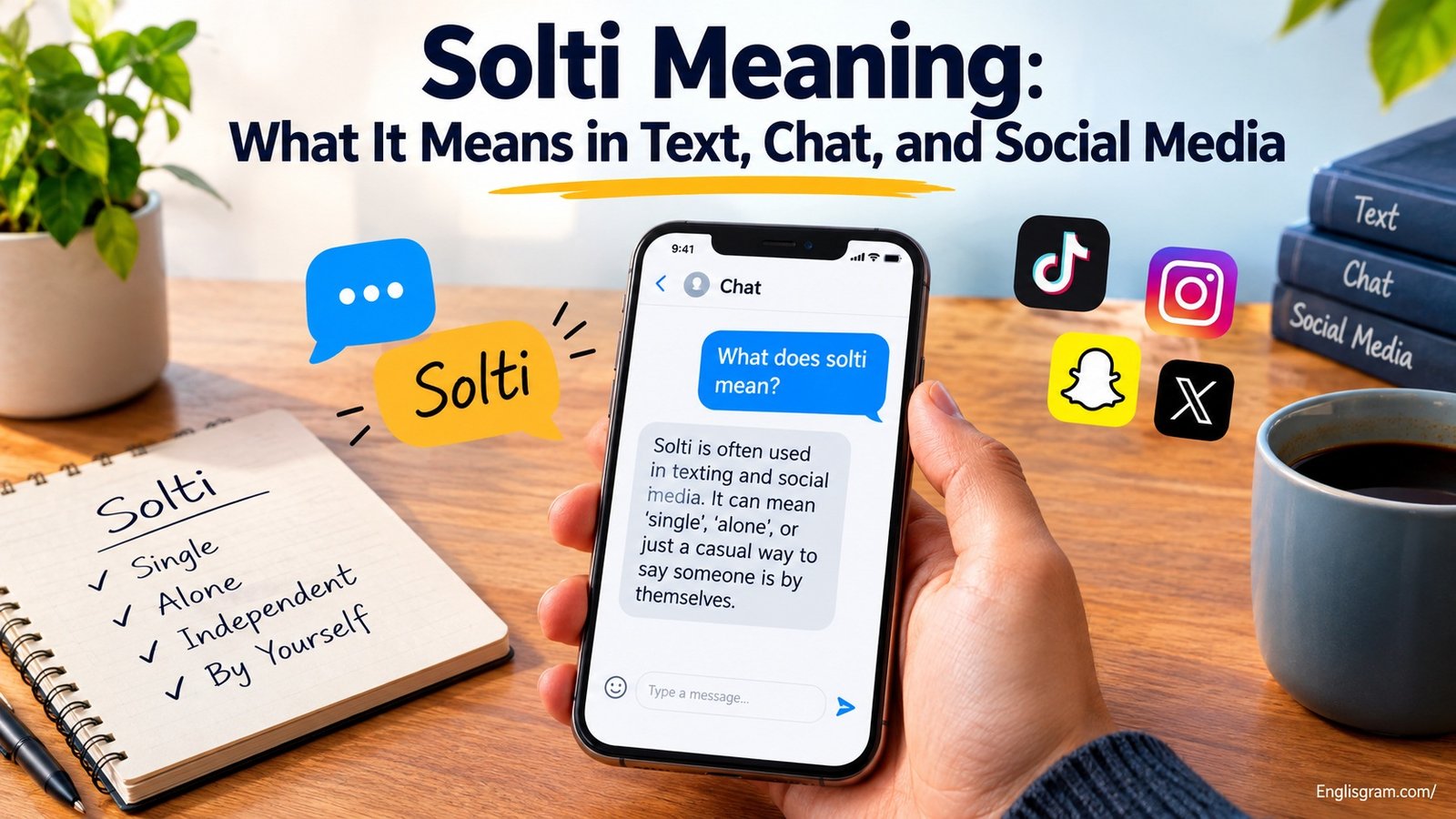
If someone messages you “Hey, solti”, the word can look like ordinary internet slang. It isn’t quite that simple. Solti is a Nepali term with cultural and relationship-based meanings, and people may use it differently depending on who is speaking, where the conversation happens, and what the surrounding words say.
In casual digital conversations, solti is often used as a familiar form of address, roughly comparable to “bro,” “buddy,” “mate,” or “friend” in English. However, reducing it to one translation can miss an important part of the word’s cultural context. It can also occur in kinship contexts, while Solti may appear separately as a personal name or surname.
That distinction matters when you see the word on WhatsApp, TikTok, Instagram, Facebook, or another platform. The app doesn’t create the meaning. The relationship between the people using the word usually tells you much more.
What Does Solti Mean?
Solti generally refers to a familiar male person in Nepali usage and can function as a friendly form of address similar to “bro,” “buddy,” or “mate.” In some contexts, it also carries a kinship-related meaning.
The safest English translation depends on the conversation. For example, a Nepali speaker might use solti with a friend in a way that sounds completely natural as “bro” in American English.
Consider these examples:
- “Hey solti, where are you?” → “Hey bro, where are you?”
- “Thanks, solti!” → “Thanks, buddy!”
- “What’s up, solti?” → “What’s up, man?”
- “Solti, let’s go.” → “Bro, let’s go.”
These translations capture the tone rather than providing a perfect word-for-word equivalent.
Quick Answer
Solti meaning in casual text or chat is usually a friendly, informal way of addressing someone, especially a male friend or familiar person. In Nepali cultural or family contexts, the word can carry a more specific relationship meaning.
Solti Meaning in Simple English
In simple English, the closest meanings include:
- Bro
- Buddy
- Friend
- Mate
- Dude
- Familiar male companion
The important point is that these words aren’t exact synonyms. “Bro” may sound closest in a relaxed conversation, while “buddy” might better fit a friendly exchange.
A dictionary-style translation can only go so far. Think of solti as a word whose emotional shade comes from the relationship between the speakers.
Is Solti a Nepali Word or Slang?
Solti is associated with Nepali language and culture. Calling it simply “internet slang” can therefore be misleading.
Slang usually refers to informal vocabulary that develops within a particular social group or community. A culturally established word can certainly become common in online conversations without having originated on the internet.
That’s what makes the distinction useful.
Solti as an Informal Form of Address
When friends use solti with each other, it can work much like an informal nickname or familiar address. The speaker doesn’t necessarily intend to define the other person’s exact social role.
For instance:
“Solti, are you coming tonight?”
The speaker isn’t necessarily saying, “You are my brother.” The word can simply establish familiarity.
The same pattern appears in American English. Someone might say:
“Hey, man, are you coming tonight?”
“Man” doesn’t literally describe the person’s entire identity or relationship to the speaker. It functions as a conversational address. Solti can work in a similar way within its cultural setting.
Why Calling It “Internet Slang” Can Cause Confusion
A person may first encounter solti through a TikTok comment or Instagram message. That doesn’t mean TikTok invented the word.
The better way to understand it is:
- The word has a cultural and linguistic background.
- People use it informally in spoken interaction.
- Digital platforms provide another place to use it.
- The surrounding conversation determines the intended sense.
That distinction prevents a common mistake: assuming every unfamiliar word appearing online is newly created social-media slang.
Solti Meaning in Text Messages
Texting strips away facial expressions, voice, and body language. As a result, a single word can sometimes feel more ambiguous than it would in person.
With solti, the surrounding message usually provides the missing clues.
“Hey Solti” Meaning
When someone writes “Hey solti,” the word most likely functions as a casual form of address.
The closest American English versions might be:
- “Hey bro.”
- “Hey buddy.”
- “Hey man.”
- “Hey dude.”
Which translation sounds best depends on the relationship.
If two close friends use the term regularly, it may feel warm and familiar. If someone uses it jokingly with a new acquaintance, the tone can feel more playful.
“Thanks Solti” Meaning
“Thanks, solti” usually carries a friendly tone.
It may express appreciation after someone provides help, sends information, gives advice, or does a favor.
For example:
“You sent me the notes? Thanks, solti!”
In American English, that could naturally become:
“You sent me the notes? Thanks, bro!”
The word doesn’t automatically indicate romance. It also doesn’t automatically indicate a literal family relationship.
“What’s Up, Solti?” Meaning
Here, solti works much like an informal greeting.
“What’s up, solti?”
Possible English equivalents include:
“What’s up, bro?”
or
“What’s up, buddy?”
Again, context carries the weight.
When Someone Sends Only “Solti”
A message containing only “Solti” gives you less information.
It could be:
- A greeting
- A way to get someone’s attention
- A playful address
- A response within an ongoing conversation
- A culturally familiar nickname
Don’t force a precise interpretation from one isolated word. Look at the messages immediately before and after it.
Read More: Mushroom Symbolism & Spiritual Meaning in the USA
Solti Meaning on Social Media
Social media changes how quickly words cross linguistic and cultural boundaries. A Nepali expression can appear in a comment written partly in English, partly in Nepali, or entirely in Romanized Nepali.
That’s especially common in informal online communication.
Solti Meaning on TikTok
On TikTok, solti may appear in comments, captions, replies, or videos involving Nepali speakers and audiences.
For example:
“Solti, this is too funny”
The word here functions as a familiar address. The laughing emoji adds a playful cue, but the emoji itself doesn’t define the word.
A TikTok comment shouldn’t automatically be interpreted according to an English slang dictionary. If the commenter is using Nepali cultural vocabulary, the linguistic context matters.
Solti Meaning on Instagram
On Instagram, you might encounter solti in:
- Comments
- Direct messages
- Captions
- Group conversations
- Friend tags
- Usernames
A message such as “Nice one, solti” may simply express friendly recognition.
However, Solti in a username doesn’t necessarily mean the account owner is using the word as slang. It might be a nickname, surname, chosen handle, or reference to something else entirely.
Solti Meaning in WhatsApp
WhatsApp conversations often provide more context than public comments because participants usually know each other.
A message like:
“Solti, call me when you reach home.”
strongly suggests an informal relationship between the speaker and recipient.
If the next messages discuss family relationships, however, the interpretation could change.
Solti in Facebook Comments and Group Chats
Facebook groups can bring together people from different generations and regions. That makes context especially important.
A Nepali-speaking community might use solti naturally while an American reader could mistake it for a new piece of social-media slang.
The platform is the setting, not the definition.
Is Solti Friendly, Flirty, or Insulting?
Most casual uses of solti are better understood as familiar or friendly rather than inherently romantic or insulting.
Still, tone matters.
A word can sound affectionate between close friends and sarcastic between people who are arguing. English has the same feature.
For example, “buddy” can sound warm:
“Thanks, buddy!”
But it can also sound sarcastic:
“Listen, buddy, that’s not what happened.”
The word hasn’t changed. The context has.
When Solti Sounds Friendly
It often feels friendly when the message includes:
- A casual greeting
- Thanks or appreciation
- A joke
- Friendly emojis
- Familiar conversation
- An invitation to hang out
When Solti Could Sound Playful
Friends may use familiar terms while teasing each other.
For example:
“Solti, you really thought that was a good idea?”
The wording could be affectionate teasing rather than criticism.
You need the surrounding exchange to know which one applies.
Does Solti Mean Someone Likes You?
Not by itself.
Using solti doesn’t automatically signal romantic interest. Treating every friendly form of address as flirtation can create unnecessary confusion.
If someone is flirting, look for additional evidence in the conversation:
- Romantic language
- Personal compliments
- Repeated attempts to spend time together
- Clearly affectionate messages
- Direct expressions of attraction
The word solti alone isn’t enough to establish romantic intent.
Solti and Nepali Kinship Meaning
One of the most important details in understanding solti meaning is that the word isn’t limited to casual friendship.
Nepali kinship vocabulary can distinguish relationships that English often handles with broad terms such as “brother,” “cousin,” “uncle,” or “in-law.” That means translating a culturally specific term into one English word can flatten its meaning.
Why Kinship Terms Matter
Kinship words don’t merely identify biological relationships. They can also communicate:
- Respect
- Familiarity
- Family connection
- Social position
- Expected behavior
- Cultural closeness
That makes a kinship-related use different from casual online slang.
Why Online Definitions Sometimes Conflict
You may find websites giving slightly different English explanations for solti. That doesn’t automatically mean one source invented the word.
Nepali vocabulary can vary according to region, family usage, social setting, and transliteration. Online sources may also simplify culturally specific relationships for English-speaking readers.
For that reason, a careful explanation should avoid claiming that every Nepali speaker uses solti in exactly the same way.
If the word appears in a family discussion, don’t automatically translate it as “buddy.” Examine the relationship being discussed.
Solti Meaning: Context Is the Key
Here’s the simplest way to understand the different possibilities:
| Context | Likely meaning | Tone | What to check |
| Close friends | Bro, buddy, familiar male friend | Casual | Relationship |
| Friendly text | Informal form of address | Warm | Surrounding messages |
| Social-media comment | Familiar address or nickname | Casual/playful | Comment thread |
| Family conversation | Kinship-related sense | Familiar/respectful | Family relationship |
| Username | Name, nickname, or handle | Varies | Profile context |
| Formal communication | Unusually informal | Casual | Speaker and setting |
This table illustrates an important rule: you shouldn’t translate the word before identifying the situation.
Solti vs. Bro, Buddy, Dude, and Friend
English has several words that can approximate solti, but each carries its own flavor.
Solti vs. Bro
Bro is probably one of the closest casual English equivalents when someone uses solti between male friends.
Both can create a sense of familiarity and camaraderie.
However, bro has its own English-speaking cultural history. It shouldn’t be treated as a perfect linguistic substitute in every Nepali context.
Solti vs. Buddy
Buddy usually sounds friendly and non-romantic.
If someone says:
“Thanks, solti.”
then “Thanks, buddy” can preserve the friendly feeling quite well.
Solti vs. Dude
Dude is highly informal in American English. It often appears between friends and can even work as a general reaction:
“Dude, what happened?”
A similar casual tone may exist in solti usage, but the cultural meaning remains different.
Solti vs. Friend
Friend is broader and more neutral.
Calling someone a “friend” describes the relationship directly. Calling someone solti can function more like an informal address.
That’s a subtle difference, but it matters.
Quick Comparison
| English word | Main feeling | Exact equivalent? |
| Bro | Familiar, casual | Often close in friendship contexts |
| Buddy | Friendly, warm | Often useful |
| Dude | Very casual | Similar in some situations |
| Friend | Neutral relationship | Broader meaning |
| Mate | Informal companionship | Context-dependent |
Is Solti an Acronym?
No, solti is not normally used as an English texting acronym.
That distinction is worth making because internet users often assume unfamiliar capitalized words must stand for a phrase.
Texting abbreviations such as LOL, BRB, and IDK work differently. Each represents a longer English expression.
Solti generally functions as a word or form of address rather than an abbreviation.
If you see SOLTI written in all capital letters, don’t automatically assume the capital letters create a new meaning. People often capitalize usernames, names, titles, or words for emphasis.
How to Reply When Someone Calls You Solti
If someone calls you solti and the conversation feels friendly, you don’t need a complicated response.
You can reply naturally:
- “Hey! What’s up?”
- “Haha, what’s going on?”
- “Hey bro!”
- “All good. You?”
- “What happened?”
- “I’m here. What’s up?”
If you’re unsure about the meaning, simply ask:
“What does solti mean here?”
That’s often better than guessing.
When You Shouldn’t Use Solti Yourself
Understanding a word doesn’t necessarily mean you should start using it.
Avoid using unfamiliar cultural terms with strangers if you’re unsure about the relationship or context. This matters especially in professional communication.
A casual message between friends can tolerate much more linguistic freedom than:
“Dear Mr. Smith, thank you for your assistance, solti.”
That would sound bizarre in most professional settings.
Match the level of familiarity to the relationship.
Common Misunderstandings About Solti
Several misconceptions can appear when people encounter solti through search engines or social media.
Solti Doesn’t Have One Perfect English Translation
Words carry cultural information. A dictionary can offer a useful starting point, but conversation supplies the finer details.
Solti Isn’t Automatically Romantic
A friendly address doesn’t prove attraction. Look at the broader exchange before drawing that conclusion.
Solti Isn’t Just Internet Slang
People may use it online because social media provides a place for everyday language. That doesn’t mean the word originated there.
Solti Doesn’t Always Mean “Friend”
A friendship-related translation can fit some situations. Other contexts may involve kinship or another culturally specific relationship.
Solti Isn’t Defined by TikTok
If you see solti on TikTok, the platform doesn’t automatically assign a new definition to it.
Solti Isn’t Always the Nepali Word
Solti can also appear as a proper name or surname. Context separates these uses.
Solti as a Name or Surname
Not every appearance of Solti has a linguistic connection to Nepali usage.
A well-known example is Sir Georg Solti, the Hungarian-British conductor who became one of the most prominent figures in 20th-century classical music.
His surname is obviously unrelated to someone using solti as a Nepali form of address.
This distinction becomes useful when search results combine different meanings under the same spelling.
How to Tell the Difference
Ask three simple questions:
- Is Solti being used to address a person?
- Is it part of someone’s legal or family name?
- Does the surrounding content involve Nepali language or culture?
The answer usually becomes clear within a few lines of context.
Realistic Examples of Solti in Conversation
Seeing the word in complete sentences makes its usage easier to understand.
Example: Casual Greeting
“Hey solti, how have you been?”
Here, solti works as a familiar address. “Hey bro” or “Hey buddy” might convey a similar tone in American English.
Example: Asking for Help
“Solti, can you send me that photo?”
The word creates an informal tone. The speaker treats the recipient as someone familiar enough for casual language.
Example: Showing Appreciation
“Thanks, solti. I really needed that.”
The word adds warmth to the thanks.
Example: Playful Teasing
“Solti, you forgot your keys again!”
Depending on the speakers’ relationship, this could sound amused rather than angry.
Example: Family Context
“He is my solti.”
Here, don’t immediately substitute “friend.” The statement could involve a kinship relationship depending on the speaker and cultural context.
That’s why sentence-level context matters more than a single dictionary gloss.
A Practical Case Study: Three Different Meanings
Imagine three people use the same word.
Case One: Two Friends
A:
“Solti, we’re leaving at eight.”
B:
“Okay, I’ll be ready.”
The relationship appears casual. “Bro” or “buddy” would likely capture the tone for an American reader.
Case Two: A Social-Media Comment
A commenter writes:
“Solti you really did that?”
The laughing emoji and conversational wording suggest playful familiarity.
The comment doesn’t provide evidence of a family relationship or romance.
Case Three: A Family Discussion
Someone says:
“He’s my solti.”
Now the surrounding discussion becomes crucial.
If the conversation involves relatives, marriage, or family relationships, the word may carry a kinship-specific meaning rather than simply “friend.”
Same spelling. Different context. Different interpretations.
Why Nepali Transliteration Creates Extra Confusion
Another issue comes from writing Nepali words using the Latin alphabet.
A person may write Nepali vocabulary in Roman letters rather than Devanagari. That means the same spoken word can appear in different spellings online.
You may encounter variations created by:
- Different English spellings
- Regional pronunciation
- Informal texting
- Personal transliteration habits
- Keyboard preferences
This is common across many languages.
For an American reader, that means an unfamiliar Romanized word may look like a brand-new English slang term even when it isn’t.
FAQs
1. What does “Solti” mean in text or chat?
“Solti” does not have one universal meaning in texting or chat. Its meaning depends on the conversation, language, and community using it. It may be slang, a nickname, a typo, or a word borrowed from another language.
2. Is “Solti” a slang word?
It can be used informally, but “Solti” is not a standard English slang term with one fixed definition. Always check the surrounding message and the speaker’s language or cultural background.
3. What does “Solti” mean on social media?
On social media, “Solti” may appear as a casual expression, username, nickname, or culturally specific word. The intended meaning can change depending on the platform and context.
4. Can “Solti” have different meanings in different languages?
Yes. A word such as “Solti” may have different interpretations across languages, regions, or online communities. Context is important when determining what someone means.
5. How can I know what someone means by “Solti”?
Look at the sentence, conversation, and relationship between the people using it. If the meaning is still unclear, the most reliable option is to ask the person directly what they meant.
Conclusion
Understanding Solti meaning requires looking at the context in which the word appears. In text messages, chats, and social media, it may have different meanings depending on the language, community, or situation. Rather than assuming one fixed definition, consider the surrounding words and how the person is using it. This makes it easier to understand the intended meaning and avoid confusion when encountering “Solti” online.









1 thought on “Solti Meaning: What It Means in Text, Chat, and Social Media”