
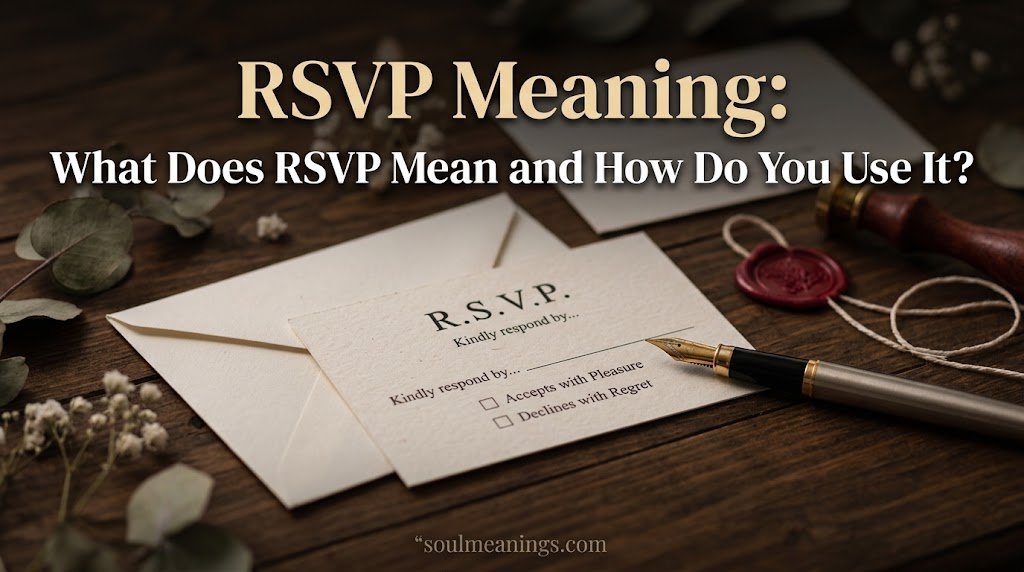
You’ve probably seen “RSVP” at the bottom of a wedding invitation, birthday card, dinner invitation, or event announcement. Sometimes it appears beside a deadline, such as “RSVP by September 20.” Other times, you may see it in a text message asking, “Did you RSVP?”
So, what does RSVP mean?
RSVP means “please respond.” It comes from the French phrase répondez s’il vous plaît, which directly translates to “please respond.” When an invitation asks you to RSVP, the host wants you to confirm whether you’ll attend.
That response might be yes or no. RSVP doesn’t mean that you have to accept the invitation. It simply means the host needs an answer.
Understanding the RSVP meaning is especially useful because invitations often include additional instructions about deadlines, guests, meals, or response methods. A quick response can save the host from guessing how many people will actually show up.
RSVP Meaning at a Glance
The simplest RSVP definition is a request for a response to an invitation.
| Term | Meaning |
| RSVP | Please respond |
| Full phrase | Répondez s’il vous plaît |
| Language of origin | French |
| English meaning | Please respond |
| Common use | Invitations and event planning |
| Expected response | Usually yes or no |
| May include a deadline | Yes |
| Can be digital? | Yes |
The important point is simple: RSVP doesn’t mean “yes.”
If someone writes “Please RSVP,” they’re asking you to tell them whether you’re coming.
For example:
“Please RSVP by October 5.”
This means:
“Please tell us by October 5 whether you will attend.”
That distinction clears up one of the most common misunderstandings about the term.
What Does RSVP Stand For?
RSVP stands for répondez s’il vous plaît.
The phrase comes from French:
- répondez means “respond”
- s’il vous plaît means “please”
Together, the phrase means “please respond.”
English speakers commonly use the four-letter abbreviation RSVP instead of writing the French phrase in full. You’ll find it most often on invitations where the host needs an accurate guest count.
What Does RSVP Mean on an Invitation?
On an invitation, RSVP means the host wants you to confirm your attendance or non-attendance.
For example, a wedding invitation might say:
RSVP by May 10
The couple may need the final guest count before confirming meals, tables, seating arrangements, or other event details.
A birthday invitation might say:
Please RSVP to Sarah by Friday.
In this case, Sarah wants to know who plans to attend.
A business conference might use:
RSVP required.
That means you need to confirm your attendance before the event.
The exact wording changes, but the basic idea remains the same: the host needs a response.
Where Did RSVP Come From?
The abbreviation RSVP comes from French rather than English. It represents the phrase répondez s’il vous plaît, a polite request for someone to reply.
French phrases have appeared in English social and formal settings for centuries. RSVP became especially associated with invitations and social etiquette because a host often needs a clear answer before making arrangements.
Today, most English speakers don’t think about the French translation when they see “RSVP.” It functions almost like an ordinary English abbreviation.
You might see it on a printed wedding card, an online event page, a corporate invitation, or a simple text message.
The French Phrase Behind RSVP
Breaking down the original phrase makes its meaning easy to remember.
Répondez is the formal or plural form of “respond.”
S’il vous plaît means “please.”
So:
Répondez s’il vous plaît → RSVP → Please respond
It’s worth noting that the abbreviation uses the first letters of the French words rather than an English translation.
That’s why RSVP doesn’t stand for “respond soon, very promptly” or any other English phrase. Those are mistaken backronyms that occasionally circulate online.
How RSVP Became Common in English Invitations
The abbreviation became established in English-speaking social etiquette as French expressions were commonly used in formal invitations and correspondence.
Over time, RSVP became particularly tied to invitations because it provides a compact way to request confirmation.
Its use has also survived the shift from paper invitations to digital communication. The format changed, but the purpose didn’t.
A printed card might say:
RSVP by June 1
A modern event page might instead display:
Please confirm attendance by June 1.
Both serve essentially the same function.
Read More: BFFR Meaning in Texting: What Does BFFR Mean in Text Messages?
Why Do Invitations Ask You to RSVP?
An invitation tells you that an event exists. An RSVP tells the host whether you intend to participate.
That information can affect almost every part of event planning.
Imagine that 100 people receive invitations to a dinner. If only 60 confirm attendance, the organizer can plan around 60 guests rather than preparing blindly for all 100.
The same principle applies to weddings, conferences, private parties, classes, and many other gatherings.
Why an RSVP Helps the Host
A confirmed guest count can help with:
- Food and beverages
- Tables and chairs
- Venue capacity
- Seating arrangements
- Name badges
- Event materials
- Transportation
- Room reservations
- Meal selections
- Party favors
- Staffing
For a small gathering, the difference between 10 and 15 guests might matter.
For a wedding with hundreds of invitees, inaccurate responses can create much bigger logistical problems.
Why the RSVP Deadline Matters
An RSVP deadline gives the host a point at which they can stop waiting for responses and finalize plans.
For example, a venue may require a final guest count several days before an event. A caterer may also need advance notice about the number of meals.
That’s why you shouldn’t treat “RSVP by Friday” as a casual suggestion.
If you already know you’ll attend, there’s little benefit in waiting until the final day.
How to RSVP to an Invitation
The easiest rule is this:
Use the response method the host provides.
If the invitation gives you a website, use the website. If it asks for a text message, send a text. If it includes an RSVP card, return the card according to the instructions.
Don’t make the host chase you for an answer.
RSVP by Text Message
Texting works especially well for casual gatherings.
Suppose a friend sends:
“Hey! I’m having a birthday dinner Saturday. Please RSVP by Thursday.”
You could reply:
“Yes! I’ll be there. Thanks for inviting me!”
If you can’t attend:
“Thanks for inviting me! I won’t be able to make it, but I hope you have a great time.”
A text RSVP doesn’t need to sound like a business letter unless the event itself is formal.
RSVP by Email
For professional or formal events, email may be the requested response method.
A useful email might say:
“Thank you for the invitation. I’m pleased to confirm that I’ll attend.”
If the invitation asks for additional details, include them in the same response.
For example:
- Your full name
- Number of attendees
- Meal preference
- Dietary requirements
- Any other information requested
There’s no need to bury the important information in a long message.
RSVP Through a Website or Online Form
Digital invitations often use online RSVP forms.
These forms may ask for more than a simple yes or no.
You might need to provide:
- Your name
- Attendance status
- Number of guests
- Meal selection
- Dietary restrictions
- Contact information
- Accommodation details
- Transportation preferences
Read the form carefully before submitting it.
If you select “yes,” make sure the guest count is accurate. If you’re attending alone, don’t accidentally select two guests simply because the form gives you that option.
RSVP by Mail
Traditional invitations sometimes include a response card.
You may need to:
- Write your name.
- Select whether you’ll attend.
- Select a meal option if requested.
- Indicate the number of guests if applicable.
- Return the card by the stated deadline.
Some formal invitations use a response card with choices such as:
Accepts with pleasure
Declines with regret
The language may sound old-fashioned, but the purpose remains straightforward.
How to RSVP “Yes”
Accepting an invitation is usually simple.
You need to clearly communicate that you intend to attend and provide any additional information the host requested.
For example:
“Thank you for inviting me. I’d be happy to attend.”
For a casual event:
“Absolutely! I’ll be there.”
For a wedding:
“Thank you for the invitation. We’re delighted to confirm that we’ll attend.”
What to Include in a Yes RSVP
Depending on the invitation, your response may include:
- Your name
- Confirmation that you’re attending
- Number of people attending
- Guest names
- Meal choice
- Dietary information
If the invitation says “RSVP for two,” confirm whether two people will attend.
If it asks for a meal selection, don’t leave that section blank.
The goal is to give the host exactly the information needed for planning.
How to RSVP “No”
Declining an invitation doesn’t mean you did anything wrong.
People have work commitments, family obligations, travel plans, health appointments, prior engagements, and countless other reasons they can’t attend.
The important part is to respond rather than leave the host waiting.
For a formal invitation:
“Thank you very much for the invitation. Unfortunately, I’m unable to attend, but I sincerely appreciate being included.”
For a casual invitation:
“Thanks for inviting me! I can’t make it this time, but I hope you have an awesome night.”
You usually don’t need to provide a detailed explanation.
Should You Give a Reason for Declining?
That depends on the relationship and the situation.
A close friend may appreciate a little context. A formal invitation usually doesn’t require a lengthy explanation.
Compare these two responses:
“Unfortunately, I won’t be able to attend. Thank you for thinking of me.”
and:
“I can’t attend because I have to leave work at 5:17, then drive across town, pick up groceries, and…”
The first response is usually enough.
Clear and kind beats overly detailed.
What Does “RSVP by [Date]” Mean?
“RSVP by [date]” means you should provide your response no later than that date.
For example:
RSVP by September 25
You should tell the host whether you’ll attend on or before September 25.
The date gives the host enough time to finalize arrangements.
What Happens If You Miss the RSVP Deadline?
Don’t assume the invitation is automatically canceled.
Instead, contact the host as soon as possible.
You might write:
“I’m sorry I missed the RSVP deadline. I’d still love to attend if there’s room. Please let me know.”
The host may already have finalized catering or seating. They might still be able to accommodate you. However, it’s better to ask than to assume.
RSVP Etiquette: What You Should and Shouldn’t Do
Good RSVP etiquette isn’t complicated. Most of it comes down to being clear, timely, and considerate.
| Do | Don’t |
| Respond by the deadline | Ignore the invitation |
| Give an accurate guest count | Bring an unexpected guest |
| Follow the requested response method | Make the host hunt for your answer |
| Tell the host if your plans change | Disappear after confirming |
| Answer every requested question | Leave important details blank |
| Contact the host if you’re unsure | Assume every invitation includes a plus-one |
Should You RSVP If You Can’t Attend?
Yes.
If an invitation asks for an RSVP, the host generally wants a response regardless of whether you can attend.
A “no” is much more useful than silence.
For example, if 75 people receive invitations and 20 can’t attend, those 20 people should still respond. Otherwise, the organizer has no way to distinguish between people who declined and people who simply forgot.
Can You Change Your RSVP?
Yes. Life happens.
You might accept an invitation and later discover that you can’t attend. Or you might initially decline and then become available.
The important thing is to tell the host as soon as you know about the change.
For example:
“I’m sorry, but something unexpected came up and I won’t be able to attend after all. I wanted to let you know as soon as possible.”
That’s far better than simply not showing up.
Can You Bring a Guest After RSVPing?
Not unless the invitation allows it or the host gives you permission.
A plus-one generally means the invitation permits you to bring another person. If the invitation doesn’t mention an additional guest, don’t assume one is included.
This matters because an unexpected guest can affect:
- Seating
- Catering
- Venue capacity
- Transportation
- Event materials
If you’re unsure, ask.
“Would it be okay if I brought a guest?”
That one sentence can prevent an awkward situation.
RSVP Meaning in Texting and Social Media
The RSVP meaning in texting is essentially the same as its traditional meaning.
When someone writes:
“Please RSVP by Friday.”
They’re asking you to confirm whether you’ll attend.
The abbreviation works well in digital communication because it’s already widely recognized.
You may see it in:
- Group chats
- Text messages
- Facebook event posts
- Online invitations
- Workplace messages
- Event websites
- Social media announcements
RSVP Meaning in a Text Message
In casual texting, RSVP doesn’t necessarily require a formal response.
For example:
Friend:
“Game night at my place Saturday. RSVP by Wednesday.”
You:
“Count me in!”
Or:
You:
“Thanks! I can’t make it Saturday.”
Both responses fulfill the basic purpose of an RSVP.
The communication style can change. The meaning doesn’t.
Common RSVP Terms and Phrases Explained
Invitation language can sometimes feel more complicated than it needs to be.
Here’s a quick guide.
| Phrase | What it means |
| RSVP | Please respond |
| RSVP by Friday | Respond no later than Friday |
| RSVP required | You need to confirm your attendance status |
| RSVP only | Attendance is generally based on confirmed responses |
| Regrets only | Respond only if you can’t attend |
| No RSVP necessary | You don’t need to confirm |
| RSVP for two | Confirm attendance for two people |
| RSVP online | Respond through the specified website or form |
| Kindly RSVP | A polite request for a response |
| Please confirm attendance | State whether you’ll attend |
The exact wording can vary from one invitation to another.
When in doubt, follow the specific instructions on the invitation.
FAQS
What does RSVP mean?
RSVP means “please respond.” It comes from the French phrase répondez s’il vous plaît. On an invitation, it asks you to confirm whether you plan to attend the event.
What does RSVP stand for?
RSVP stands for répondez s’il vous plaît, a French phrase that translates to “please respond.” The abbreviation comes from the first letters of the French words.
Does RSVP mean yes or no?
No. RSVP doesn’t mean yes or no. It means the host wants you to provide a response. You can RSVP yes if you plan to attend or RSVP no if you can’t attend.
How do you RSVP to an invitation?
Follow the response instructions provided by the host. You might need to reply by text, email, mail, or an online form. Clearly state whether you’ll attend and provide any requested guest or meal information.
What does “RSVP by Friday” mean?
“RSVP by Friday” means you should respond no later than Friday. The host needs your answer before the deadline to finalize details such as seating, catering, guest numbers, or other event arrangements.
Here’s a polished conclusion that wraps up the article naturally while reinforcing the target keyword.
Conclusion
Understanding the RSVP meaning is simple once you know where the abbreviation comes from. RSVP stands for répondez s’il vous plaît, a French phrase that means “please respond.” When you see RSVP on an invitation, the host is asking you to confirm whether you plan to attend.
Remember that RSVP doesn’t mean you have to say yes. You can accept the invitation, politely decline, or contact the host if your plans change. The important thing is to give a clear response within the requested time.









1 thought on “RSVP Meaning: What Does RSVP Mean and How Do You Use It?”