
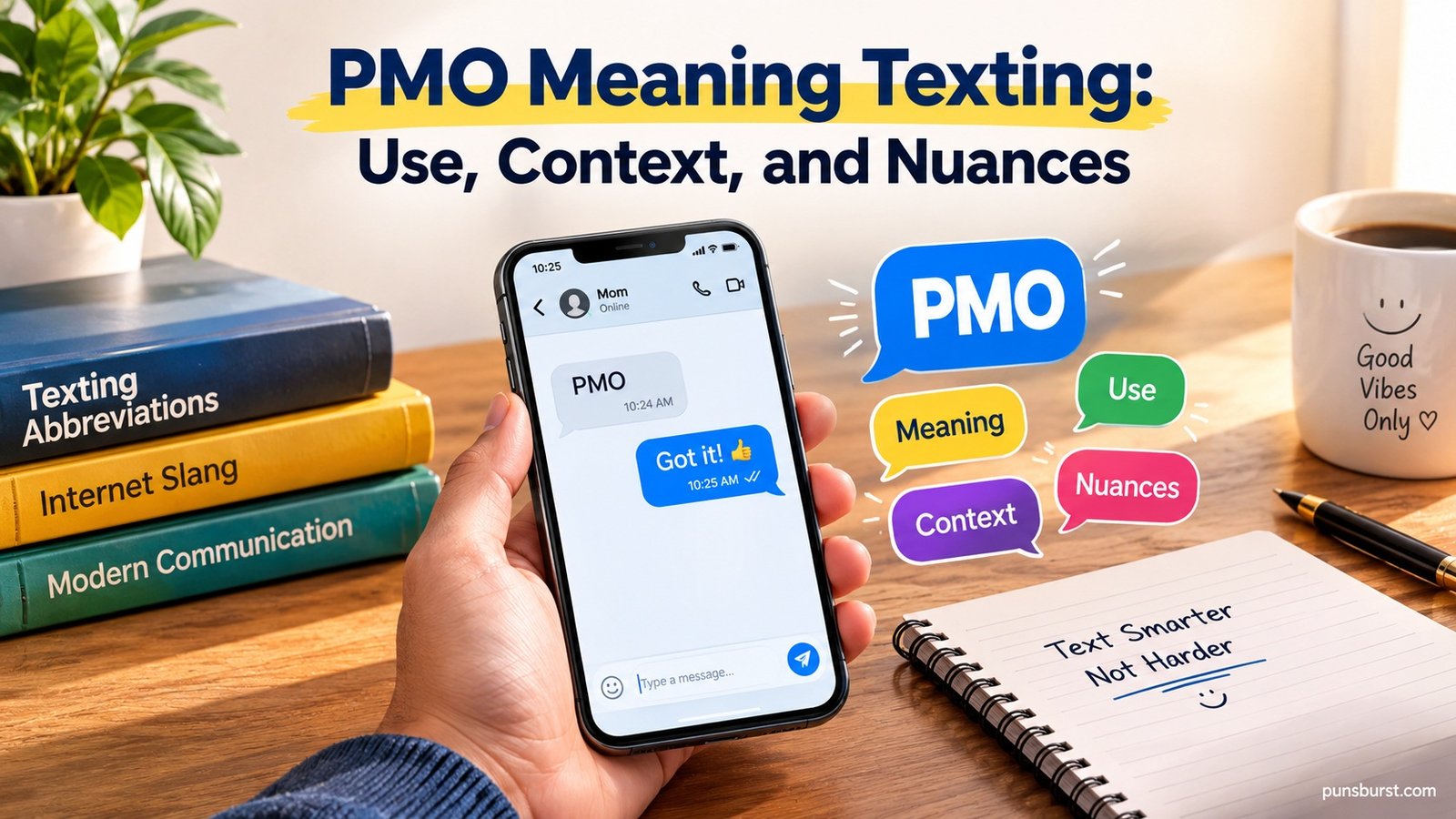
PMO Meaning Texting helps explain how PMO appears in TikTok comments, Snapchat streaks, and casual chats when its meaning depends on context.In everyday texting, PMO is a casual internet phrase that can mean “piss me off,” “pissing me off,” or “pisses me off.” This acronym and abbreviation help Gen Z and younger users make chats faster, funnier, and more expressive.
Someone stuck in traffic may use PMO to vent frustration or show annoyance while another person may use it simply to express a feeling or reaction online. Because PMO has multiple meanings, readers can confuse one use with another. Social media culture, slang culture, and trending language in 2026 make these internet terms especially versatile, so the vibe, replies, conversation, and surrounding words can reveal what the letters mean.
A PMO-related post may describe annoyance, while a PMO-related discussion in business may refer to business slang or a serious business term connected to the workplace. Looking at the full text, people, context, and digital spaces helps identify the intended texting meaning and avoid common mistakes when someone types the phrase.
Quick Answer
PMO Meaning Texting usually means “put me on” or “piss me off.” In American online slang, “put me on” asks for a recommendation or introduction, while “piss me off” expresses irritation or frustration.
TL;DR
- PMO has two major meanings in casual American texting.
- “Put me on” usually asks for recommendations or introductions.
- “Piss me off” communicates annoyance, frustration, or anger.
- Context usually reveals which meaning the sender intends.
- PMO is informal and can sound blunt in some conversations.
- Professional uses of PMO can have completely different meanings.
What Does PMO Mean in Texting?
PMO is an initialism used to shorten phrases in fast digital conversations. Unlike a normal word, its meaning can change dramatically depending on what surrounds it.
The two most important slang meanings are “put me on” and “piss me off.” These meanings developed separately, so they shouldn’t be treated as two versions of the same phrase.
PMO as “Put Me On”
When PMO means “put me on,” the speaker usually wants information, access, or an introduction.
For example, someone might write, “PMO to some good restaurants.” They’re asking a friend to recommend restaurants worth trying.
The phrase can also involve people. “PMO with your friend” may suggest introducing someone to another person.
PMO as “Piss Me Off”
The second meaning expresses irritation. It can stand for “piss me off,” “pisses me off,” or “pissing me off,” depending on the sentence.
For example, “This traffic PMO” means the traffic is irritating the speaker. In casual online speech, the phrase can describe serious frustration or exaggerated annoyance over something minor.
Why Does PMO Have Multiple Meanings?
The short answer is that internet slang develops through different communities at different times. The same abbreviation can therefore acquire separate meanings before one becomes more familiar to a wider audience.
PMO is a good example of this process. Its meanings aren’t arranged in a strict hierarchy, and there isn’t one universal interpretation that works in every conversation.
Context Is the Main Clue
Look at the words immediately surrounding PMO. They often reveal the intended meaning quickly.
- “PMO to that new artist” suggests a recommendation.
- “PMO some good movies” suggests sharing suggestions.
- “That delay PMO” suggests frustration.
- “You really PMO sometimes” usually expresses annoyance.
Grammar can also help. A phrase beginning with “PMO to” commonly points toward “put me on.”
Tone Matters Too
Digital messages don’t include facial expressions or vocal emphasis. Therefore, a short abbreviation can seem harsher than intended.
A laughing reaction may make PMO feel playful. A complaint or argument can make the same abbreviation sound genuinely angry.
What Is the History of PMO Slang?
PMO doesn’t have one single origin story because its two major meanings developed separately. Online records show the frustration-related meaning appearing years before the recommendation-related meaning became widely visible.
One documented online definition of PMO as “pisses me off” appeared in 2005. A separate “put me on” meaning appeared in online slang records later, including a documented 2016 entry.
From Internet Forums to Social Media
Early internet slang spread through forums, social networks, message boards, and informal online communities. Users favored abbreviations because they made casual conversations faster.
Later, smartphones and social platforms accelerated this process. Short comments became especially useful when people were reacting quickly to videos, posts, and messages.
The Rise of “Put Me On”
“Put me on” has a longer linguistic life than the acronym itself. In American informal speech, the phrase can mean introducing someone to information, music, people, products, or experiences.
The expression has strong connections with Black American speech and culture. Hip-hop and online culture helped expose the phrase to much wider audiences.
By the early 2020s, abbreviated PMO became especially visible on TikTok and other social platforms.
How Is PMO Used in America?
In the United States, PMO is primarily an informal digital expression rather than a formal part of standard written English. Its meaning depends heavily on the social setting.
American texting culture favors shortened expressions because people often communicate quickly. PMO fits that environment particularly well.
Common American Uses
- Asking friends for music, movies, restaurants, or fashion recommendations.
- Requesting an introduction to another person.
- Complaining about traffic, delays, or frustrating situations.
- Reacting humorously to an irritating social-media post.
- Expressing exaggerated annoyance in a group chat.
PMO and American Online Culture
American social media has helped slang travel across age groups and communities. A phrase that once belonged mainly to a particular speech community can become recognizable nationally.
However, wider recognition doesn’t erase the phrase’s cultural history. People can use slang without knowing where it developed, which sometimes creates debates about cultural borrowing.
Read More: What Is the Spiritual and Rain Symbolism Meaning?
What Does “Put Me On” Mean?
“Put me on” generally means introduce me to something. The “something” might be music, food, entertainment, fashion, information, or even another person.
This meaning has a positive or curious emotional quality. Instead of complaining, the speaker is asking someone else to share knowledge or taste.
Examples of “Put Me On”
“PMO to some good podcasts” means “recommend some good podcasts to me.”
“PMO to that restaurant” asks someone to explain or recommend the restaurant.
“PMO with someone who knows photography” could request an introduction or useful connection.
The phrase can therefore express curiosity, trust, or appreciation for someone’s knowledge.
What Does “Piss Me Off” Mean?
When PMO means “piss me off,” it communicates irritation or anger. The exact intensity depends on the speaker and situation.
Someone may use it seriously after an upsetting event. However, younger internet users also frequently use frustration slang in exaggerated or humorous ways.
Serious Versus Playful Annoyance
Consider the difference between these situations:
“Being lied to really PMO.”
Here, the speaker may be genuinely angry.
“My Wi-Fi froze for three seconds. PMO.”
Here, the speaker may simply be joking about a small inconvenience.
Because online language often exaggerates emotions, PMO doesn’t automatically indicate serious hostility.
How Do You Tell Which PMO Meaning Someone Means?
The safest approach is to examine the entire message instead of interpreting the three letters alone.
Context is especially important when PMO appears by itself. A standalone “PMO” can be genuinely ambiguous.
A Simple Context Guide
| Context | Likely Meaning | Common Association | Tone |
| “PMO to this artist” | Put me on | Recommendation | Curious |
| “PMO to some restaurants” | Put me on | Suggestions | Friendly |
| “That traffic PMO” | Piss me off | Frustration | Annoyed |
| “You PMO sometimes” | Piss me off | Personal irritation | Blunt |
| “PMO to your friend” | Put me on | Introduction | Social |
When there’s still doubt, asking “Do you mean put me on?” is perfectly reasonable.
How Is PMO Used on TikTok, Snapchat, and Instagram?
Social platforms have helped PMO move beyond private texting. It can now appear in comments, captions, direct messages, and short reactions.
However, platform culture doesn’t completely determine the meaning. The surrounding conversation remains more important than the app itself.
TikTok
TikTok comments often use PMO as a quick reaction. A person might use it to complain about a video, joke about an awkward moment, or ask someone to recommend something.
The frustration meaning has also become associated with combinations of other short slang expressions. These combinations can make messages harder for people unfamiliar with current internet language.
Instagram and Snapchat
On Instagram and Snapchat, PMO can appear in both private and public interactions. Someone might ask for the name of an outfit, restaurant, song, or creator.
Meanwhile, a frustrated user may place PMO at the end of a complaint.
What Does PMO Say About Emotion and Identity?
Slang is more than shortened spelling. It can also signal familiarity, humor, social belonging, and emotional style.
PMO allows people to communicate a feeling quickly without writing the complete phrase.
Emotional Associations
When used as “put me on,” PMO can signal:
- Curiosity about something unfamiliar.
- Trust in another person’s taste.
- Interest in discovering something new.
- A desire for social connection.
When used as “piss me off,” it can signal:
- Frustration with a situation.
- Playful irritation between friends.
- Stronger anger during an argument.
- Exaggerated reactions to everyday problems.
The emotional meaning comes from the whole message, not the abbreviation alone.
Is PMO Appropriate for Every Situation?
No. PMO belongs mainly to casual communication, and the frustration meaning contains profanity.
That doesn’t make it inherently inappropriate. However, the setting and relationship between speakers matter.
Where PMO Usually Fits
PMO is generally comfortable in casual spaces such as:
- Friend-to-friend text messages.
- Informal group chats.
- Casual social-media comments.
- Memes and humorous posts.
- Conversations with people who understand the slang.
Where to Be Careful
Avoid assuming everyone understands the abbreviation. Older readers, international audiences, employers, teachers, and unfamiliar contacts may interpret it differently.
In professional communication, writing the full idea is usually clearer. If you need to express frustration politely, a direct phrase such as “That’s frustrating” avoids confusion.
What Other Meanings Can PMO Have?
PMO isn’t limited to internet slang. Acronyms often appear in professional, organizational, and technical settings.
One important example is Project Management Office, a business term unrelated to either slang definition.
Why This Matters
A workplace email mentioning a PMO may have nothing to do with texting culture. The writer could be referring to a department or organizational function.
This is why the same three letters shouldn’t automatically be interpreted as slang.
| Setting | Possible Meaning | What It Usually Refers To |
| Casual texting | Put me on | Recommendation or introduction |
| Casual texting | Piss me off | Annoyance or frustration |
| Business | Project Management Office | Project oversight and coordination |
| Online communities | Context-dependent | Community-specific shorthand |
The surrounding words and setting should always come first.
Has PMO’s Meaning Changed Over Time?
Yes. PMO illustrates how digital language constantly shifts.
The frustration-related abbreviation has documented online use dating back to the mid-2000s. The “put me on” meaning appeared later and became particularly visible through social media.
From Niche Slang to Mainstream Awareness
Digital platforms changed how quickly slang could spread. TikTok, Instagram, and similar services allow a phrase to move between communities within a short time.
As a result, PMO can now be recognized by people who would never have encountered it in earlier internet communities.
However, recognition doesn’t mean everyone uses it the same way. Some people know only one definition, which can create misunderstandings.
Are There Controversies Around PMO?
Most controversy around PMO concerns language, cultural borrowing, and online slang rather than the abbreviation itself.
The “put me on” expression has connections to African American speech and cultural traditions. As the phrase entered broader internet culture, questions arose about how slang from Black communities is adopted and sometimes stripped from its original context.
Understanding Cultural Borrowing
Using a slang phrase doesn’t automatically mean someone is disrespecting its cultural origins. Language naturally spreads between communities.
However, problems can arise when people imitate a speech style for entertainment, exaggerate stereotypes, or treat culturally rooted expressions as costumes.
The best approach is simple: understand the phrase, use it naturally, and avoid mocking the communities associated with its history.
How Is PMO Used in Modern Culture?
Today, PMO belongs to the wider culture of compressed digital language. Its appeal comes partly from speed and partly from shared recognition.
A three-letter abbreviation can communicate an entire emotional reaction or request.
Social Media and Personal Expression
People may use PMO in captions, comments, private messages, memes, and group conversations. The abbreviation can make a message feel more casual and immediate.
It can also signal that the writer understands current internet culture. For some users, that shared slang creates a feeling of belonging.
Why Short Slang Feels Powerful
Digital conversations reward brevity. People scroll quickly, reply quickly, and often communicate through fragments.
PMO works well because the reader supplies the missing words mentally. That makes the exchange feel fast, informal, and socially familiar.
FAQs
What does PMO mean in texting?
PMO usually means “put me on” or “piss me off.” The sentence and surrounding conversation usually reveal which meaning is intended.
Does PMO mean “put me on”?
Yes. In this use, PMO asks someone to recommend, introduce, or share something. “PMO to some good music” is a typical example.
Does PMO mean “piss me off”?
Yes. PMO can mean “piss me off,” “pisses me off,” or “pissing me off.” It commonly appears when someone is expressing annoyance.
What does PMO mean on TikTok?
On TikTok, PMO can have either major slang meaning. Comments about recommendations often use “put me on,” while complaints often use “piss me off.”
Is PMO rude?
It can be, especially when it means “piss me off.” Because that meaning contains profanity, it’s better suited to casual conversations than formal settings.
What does PMO mean in business?
In business, PMO commonly means Project Management Office. That professional meaning is unrelated to the main texting slang meanings.
Conclusion
PMO has become a useful example of how American digital language can carry several meanings at once. “Put me on” suggests curiosity and connection, while “piss me off” communicates annoyance or frustration.
The key is context. PMO Meaning Texting (2026): Use, Context, and Nuances is less about memorizing one definition and more about understanding how people communicate online.
When you see PMO in a message, read the surrounding words before deciding what it means. In fast-moving digital conversations, those few extra clues can make the difference between understanding a joke and completely misreading the message.









1 thought on “PMO Meaning Texting: Use, Context, and Nuances”