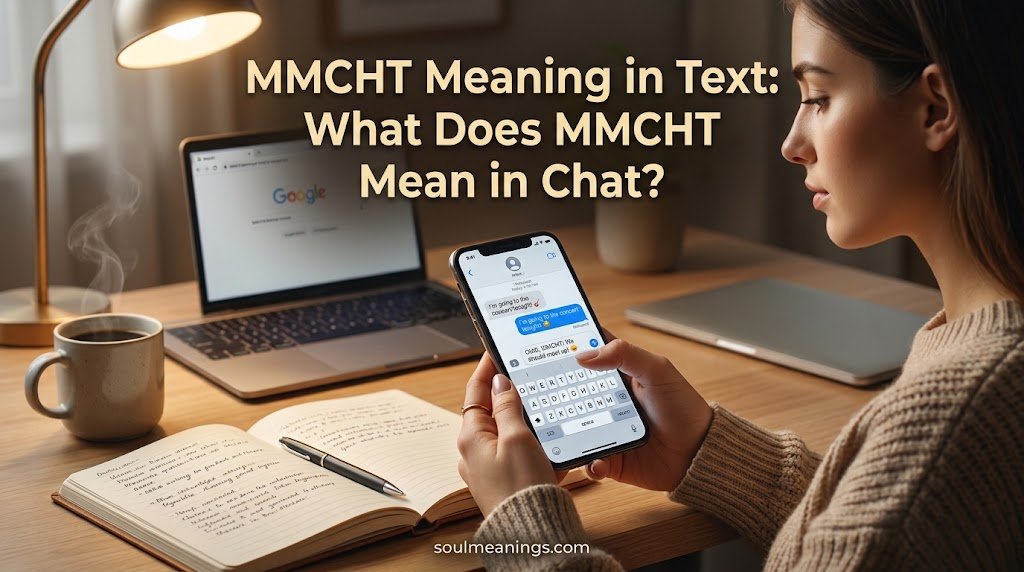
If someone sends you “MMCHT”, you might stare at the screen for a second and wonder whether you missed a new texting acronym. It certainly looks like one. However, MMCHT meaning in text is usually less complicated than it appears.
In casual online communication, MMCHT is commonly used to represent a sound or reaction associated with tongue-clicking or teeth-sucking. Depending on the conversation, it can express annoyance, disbelief, disapproval, impatience, skepticism, frustration, or playful dismissal.
The tricky part is tone. A person who types “MMCHT” isn’t necessarily furious. They might simply be reacting with an “Oh, please,” “Seriously?” or “Come on” attitude. The surrounding conversation usually tells you which meaning fits.
Quick Answer: What Does MMCHT Mean in Text?
MMCHT meaning in text generally refers to a written representation of a tongue-clicking, teeth-sucking, or similar expressive sound. People use it to show annoyance, disbelief, disapproval, skepticism, impatience, frustration, or dismissal.
It usually works more like a typed reaction than a traditional acronym such as LOL, BRB, or IDK.
For example:
Person A: “I forgot my wallet again.”
Person B: “MMCHT…”
Here, MMCHT can communicate something like, “Seriously? Again?”
The exact emotion depends on the context.
What Is the MMCHT Meaning in Text?
The most useful way to understand MMCHT is to think of it as a written sound effect.
When people communicate face-to-face, they can express irritation or disbelief without saying a complete sentence. They might click their tongue, suck their teeth, sigh, roll their eyes, or make another small vocal reaction.
Texting removes those physical signals. Expressions such as MMCHT can fill that gap.
Instead of writing:
“I’m disappointed that you did that again.”
Someone might simply type:
“MMCHT…”
That short reaction can carry a surprising amount of attitude.
What Can MMCHT Express?
Depending on the situation, MMCHT may communicate:
- Annoyance
- Disapproval
- Disbelief
- Skepticism
- Frustration
- Impatience
- Dismissal
- Mild disappointment
- Playful teasing
It doesn’t have one fixed emotional translation.
That’s important because texting expressions don’t always behave like dictionary words. Their meaning can shift with punctuation, emojis, relationship, and conversation.
Is MMCHT an Acronym or a Sound?
This distinction clears up much of the confusion surrounding MMCHT meaning in text.
A conventional acronym uses letters to represent words. For example:
- LOL = laughing out loud
- BRB = be right back
- IDK = I don’t know
- TBH = to be honest
MMCHT generally doesn’t work in the same straightforward way.
Instead, it is better understood as a textual representation of a sound or reaction.
In linguistics, words that imitate sounds are often called onomatopoeia. Digital communication has expanded this idea because people can create spellings that imitate reactions they normally communicate through speech, facial expressions, or gestures.
Think about expressions such as:
- “Ugh”
- “Hmm”
- “Tsk”
- “Pfft”
- “Mmm”
- “Ahem”
These aren’t necessarily acronyms. They represent sounds, attitudes, or reactions.
MMCHT fits more naturally into this expressive category than into the traditional acronym category.
Why Does It Look Like an Acronym?
That’s simply part of what makes it confusing.
The combination of capital letters can make readers assume that every letter stands for a separate word. When they search for a “full form,” they may encounter different explanations.
However, a phonetic reaction doesn’t need a letter-by-letter expansion.
The spelling is attempting to capture how a reaction sounds, not necessarily what a sentence says.
What Does MMCHT Sound Like?
Imagine someone hears something irritating and responds with a quick tongue click or teeth-sucking sound.
That reaction might communicate:
“Really?”
Or:
“Come on.”
Or:
“I don’t believe that.”
Or even:
“Oh, please.”
The exact sound varies between speakers and communities. Written forms also vary because there isn’t one universally standardized spelling for these kinds of reactions.
That’s why you’ll encounter related spellings and expressions online.
The important point isn’t to pronounce every letter of MMCHT like a conventional word. Its value comes from the reaction it represents.
MMCHT vs. a Spoken Reaction
Consider this exchange:
Friend: “I told you I wouldn’t be late.”
You: “You arrived 45 minutes late.”
Friend: “Traffic!”
A typed “MMCHT…” could replace a longer response such as:
“Yeah, okay.”
The reader understands the attitude from the reaction itself.
Common Emotions Behind MMCHT
One reason MMCHT meaning in text can seem slippery is that the same expression can communicate several closely related emotions.
| Emotion | What MMCHT may communicate | Example situation |
| Annoyance | “That’s irritating.” | Someone repeats the same mistake |
| Disbelief | “I don’t believe you.” | Someone makes an unbelievable claim |
| Disapproval | “I don’t approve of that.” | Someone behaves badly |
| Skepticism | “Are you serious?” | Someone makes an unlikely claim |
| Frustration | “Come on!” | Something goes wrong again |
| Impatience | “Can we move on?” | Someone keeps delaying a decision |
| Dismissal | “Whatever.” | Someone doesn’t want to argue |
| Playful teasing | “Oh, please!” | Friends joke with one another |
Notice something important: none of these interpretations requires MMCHT to have a different dictionary definition.
The emotional setting changes while the expressive reaction remains similar.
MMCHT Meaning in Different Texting Situations
Context does most of the heavy lifting when you’re trying to understand a message.
When Someone Is Annoyed
Suppose you’ve promised three times to remember something and forgot again.
Your friend might write:
“MMCHT. You did it again.”
Here, the expression clearly carries irritation.
It works almost like a verbal eye roll. The sender doesn’t need to explain every feeling because the reaction already establishes the tone.
When Someone Doesn’t Believe You
Now imagine this:
You: “I accidentally met my favorite actor at the grocery store.”
Friend: “MMCHT ”
The meaning may be closer to:
“Yeah, right!”
The laughing emoji can soften the reaction and turn skepticism into playful disbelief.
When Someone Is Disappointed
Consider:
Person A: “You said you’d call me.”
Person B: “I forgot.”
Person A: “MMCHT…”
Here, the expression could communicate disappointment rather than outright anger.
The ellipsis matters. It creates a pause and can make the response feel more like a quiet reaction.
When Someone Is Teasing
Friends may also use MMCHT without serious hostility.
For example:
You: “I’m definitely going to win this game.”
Friend: “MMCHT, sure ”
In this case, the expression is closer to playful skepticism.
The relationship between the people matters enormously. The same message between close friends may feel harmless. Between strangers, it could sound dismissive.
Read More: B Meaning in Texts: What Does “B” Mean in a Text?
MMCHT Meaning on TikTok, Instagram, and Social Media
Short expressive reactions fit naturally into social media because online conversations often move quickly.
A person may not want to type a complete sentence when a small reaction communicates the feeling instantly.
You might encounter MMCHT in:
- TikTok comments
- Instagram comments
- Instagram DMs
- Group chats
- Meme discussions
- Casual text messages
- Online arguments
- Reaction posts
Social media also encourages people to experiment with spelling. Users stretch sounds, repeat letters, add punctuation, or combine expressions with emojis.
For example:
“MMCHTTTT ”
can feel more dramatic than:
“MMCHT.”
Likewise:
“MMCHT…”
can feel more restrained or disappointed.
And:
“MMCHT 😭”
may suggest humorous frustration rather than genuine anger.
Why Short Reactions Work So Well Online
Digital conversations don’t provide all the physical cues of face-to-face communication.
You can’t hear someone’s voice through ordinary text. You can’t see their expression. You don’t know whether they’re sighing, smiling, or rolling their eyes.
Expressive text helps recreate some of those missing signals.
That’s why reaction sounds remain useful even in a world filled with emojis, GIFs, stickers, and reaction buttons.
The Cultural Background of MMCHT
The reaction represented by MMCHT connects with a broader tradition of teeth-sucking, tongue-clicking, and similar nonverbal expressions.
People use these sounds in different communities to communicate attitudes such as annoyance, disapproval, disbelief, impatience, or frustration.
Online spelling attempts to capture a sound that normally happens in conversation.
This matters because there isn’t always a neat English sentence that translates the reaction perfectly.
A tongue click might mean:
“No.”
In another situation, it could mean:
“That’s ridiculous.”
In another, it could simply mean:
“I’m not impressed.”
The physical gesture, social setting, relationship, and tone all contribute to its meaning.
Why Written Spellings Vary
Sounds don’t always fit neatly into the English alphabet.
When people try to write a sound, they choose letters that seem closest to what they hear or produce. Different communities may therefore create different spellings.
You’ll find forms such as:
- MMCHT
- MTCHEW
- MSCHEW
- MCH
- TCHEW
These forms shouldn’t automatically be treated as exact synonyms in every community. Their meanings can depend on local usage and context.
The broader point is that digital language often turns spoken reactions into written symbols.
Does MMCHT Have a Full Form?
MMCHT does not have one universally established full form that explains every use.
This is where online searches can become confusing.
Some websites attempt to expand MMCHT into a phrase by assigning a word to each letter. However, a supposed expansion doesn’t automatically make that expansion the accepted meaning.
If the expression functions as a written sound, forcing it into a conventional acronym format can create more confusion than clarity.
Three Different Things Can Look Similar
| Type | Example | How it works |
| Acronym | LOL | Letters represent words |
| Initialism | IDK | Initial letters represent words |
| Expressive sound | MMCHT | Spelling represents a sound or reaction |
This distinction is especially useful when researching unfamiliar internet language.
Not every group of capital letters is an acronym.
Some are simply attempts to capture speech, emotion, or attitude in written form.
MMCHT vs. Similar Text Expressions
MMCHT shares some emotional territory with familiar reactions. Still, the expressions aren’t identical.
| Expression | Common function | Typical tone |
| MMCHT | Expresses a reaction such as disapproval or disbelief | Annoyed, skeptical, dismissive |
| Tsk | Shows disapproval or irritation | Mildly negative |
| Ugh | Shows frustration or disgust | Negative |
| SMH | Shows disbelief or disapproval | Critical |
| “Seriously?” | Questions or challenges something | Context-dependent |
| Pfft | Dismisses or mocks something | Playful or dismissive |
| LOL | Signals laughter | Humorous |
The key difference is that MMCHT is primarily a sound-like reaction.
For instance, SMH literally uses initials from a phrase. MMCHT doesn’t necessarily require that kind of expansion.
MMCHT and “Tsk”
“Tsk” is probably one of the easiest comparisons.
Both can communicate disapproval or irritation.
However, MMCHT may feel more culturally and stylistically specific depending on the community using it. “Tsk” has a long history as a written representation of a clicking sound in English-language writing.
Neither expression automatically tells you exactly how angry someone feels.
How to Tell What MMCHT Means in a Specific Message
When someone sends MMCHT, don’t immediately assume they’re angry.
Instead, examine the conversation around it.
Check the Previous Message
Ask what triggered the reaction.
If the previous message contains a mistake, MMCHT may signal annoyance.
If the previous message contains an unbelievable story, it may signal skepticism.
Look at the Punctuation
Punctuation can dramatically change the emotional texture.
Compare:
MMCHT.
with:
MMCHT…
and:
MMCHT
The first may feel blunt.
The second can sound like a long, disappointed pause.
The third may suggest playful disbelief.
Check for Emojis
Emojis provide useful emotional clues.
For example:
- can make it playful.
- can signal exaggerated frustration or humor.
- reinforces an eye-roll feeling.
- can strengthen annoyance.
- can soften an otherwise sharp reaction.
An emoji doesn’t guarantee the meaning. It simply provides another clue.
Consider Your Relationship
A close friend may send:
“MMCHT ”
without intending any real offense.
A coworker or stranger using the same expression could create a different impression.
Relationships changes how people interpret short reactions.
Consider the Overall Tone
Read the entire conversation instead of isolating one word.
Text slang behaves much like facial expression. One small signal rarely tells the whole story.
FAQS
What does MMCHT mean in texting?
MMCHT generally represents a tongue-clicking or teeth-sucking reaction. It can express annoyance, disbelief, disapproval, frustration, skepticism, or playful dismissal.
Is MMCHT an acronym?
Not usually. MMCHT is better understood as a written reaction sound rather than a conventional acronym where every letter represents a separate word.
Is MMCHT rude?
It can sound rude or dismissive when used seriously. However, friends may use it playfully to show disbelief or teasing. The surrounding conversation determines the tone.
What does MMCHT mean on social media?
On platforms such as TikTok and Instagram, MMCHT can be used as a quick reaction to something unbelievable, irritating, ridiculous, or amusing. Emojis and punctuation can change its tone.
How should you respond to MMCHT?
Look at the context first. If the sender seems annoyed, acknowledge the issue. If they’re joking, you can respond playfully. When the meaning isn’t clear, asking what they mean is the safest option.
Conclusion
MMCHT meaning in text is best understood as an expressive reaction rather than a standard acronym. It commonly represents a tongue-clicking or teeth-sucking sound that can show annoyance, disbelief, disapproval, skepticism, frustration, or playful teasing.
The meaning isn’t locked to one emotion. Context is the key. A simple “MMCHT 😂” between friends may be harmless banter, while “MMCHT…” during an argument can sound dismissive or irritated.








1 thought on “MMCHT Meaning in Text: What Does MMCHT Mean in Chat?”