
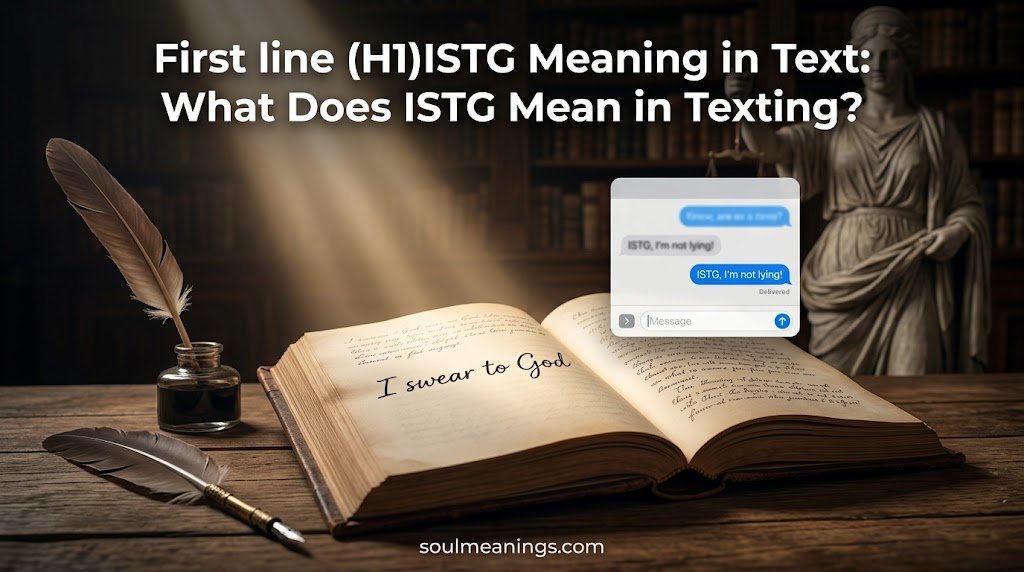
If someone sends you “ISTG” in a text, comment, or DM, they usually mean “I swear to God.” But the exact feeling behind those four letters can change depending on the conversation.
Someone might write “ISTG I’m telling the truth” because they want you to believe them. Another person might say “ISTG, you never listen” because they’re frustrated. A friend could even write “ISTG this is the funniest thing I’ve seen all week” as a playful exaggeration.
That’s what makes ISTG meaning in text worth understanding. The abbreviation has one basic definition, yet people use it for several emotional purposes.
This guide explains what ISTG means, where it fits in texting, how its tone changes, how it compares with similar slang, and how to respond when someone sends it.
Quick Answer: What Does ISTG Mean in Text?
ISTG means “I swear to God.”
In texting and social media, people commonly use ISTG to emphasize something they say. It can communicate:
- Sincerity
- Frustration
- Surprise
- Disbelief
- Annoyance
- A warning
- Playful exaggeration
- Strong emphasis
For example:
“ISTG I didn’t eat your leftovers.”
Here, ISTG strengthens the speaker’s denial.
Meanwhile:
“ISTG this movie is hilarious ”
sounds playful rather than angry.
The surrounding words usually tell you which meaning the sender intends.
What Does ISTG Mean in Text?
The most common ISTG meaning in text is “I swear to God.”
It works as an initialism, with each letter representing a word:
| Letter | Word |
| I | I |
| S | Swear |
| T | To |
| G | God |
People use the shortened form because texting favors quick expressions. Instead of typing the entire phrase, someone can write four letters and still communicate a strong emotional reaction.
However, ISTG doesn’t always carry the same level of seriousness as the full phrase.
Consider these two messages:
“I swear to God I didn’t do it.”
“ISTG this cat has more attitude than anyone I know .”
The first sounds like a serious assurance. The second uses the expression for humor and emphasis.
That’s an important part of understanding texting slang. Literal meaning and conversational meaning aren’t always identical.
What Does ISTG Stand For?
ISTG stands for “I swear to God.”
The full expression has traditionally been used to emphasize the truthfulness or seriousness of a statement. In casual digital communication, however, people often use it more loosely.
Someone may use ISTG when they want to say:
- “I really mean this.”
- “I’m serious.”
- “Believe me.”
- “I can’t believe this.”
- “I’m getting really annoyed.”
- “This is absolutely true.”
- “I’m warning you.”
- “I’m exaggerating for effect.”
So while the words remain the same, the conversational function can change.
ISTG Meaning in Text at a Glance
| Expression | Basic meaning | Typical purpose |
| ISTG | I swear to God | Emphasis or strong emotion |
| istg | I swear to God | Casual texting |
| ISTG… | I swear to God | Frustration or dramatic emphasis |
| ISTG I’m serious | I swear to God, I’m serious | Assurance |
| ISTG | I swear to God | Humor or exaggeration |
Capitalization usually doesn’t change the meaning.
ISTG, istg, and Istg generally refer to the same expression. The difference mostly comes from typing style.
ISTG Meaning in Different Texting Situations
One reason ISTG can confuse people is that it doesn’t have one fixed emotional tone.
Think of it like the phrase “I swear.” You can say those words while laughing, arguing, explaining yourself, or making a serious promise.
The same principle applies to ISTG.
ISTG When Someone Is Frustrated
One of the most common uses appears during moments of irritation.
For example:
“ISTG, you never check your messages.”
The sender isn’t necessarily making a religious statement. They’re emphasizing their frustration.
Another example:
“ISTG this Wi-Fi keeps disconnecting.”
Here, ISTG adds emotional weight to an ordinary complaint.
Without ISTG:
“This Wi-Fi keeps disconnecting.”
With ISTG:
“ISTG this Wi-Fi keeps disconnecting.”
The second version sounds more emotional and dramatic.
ISTG When Someone Is Being Sincere
ISTG can also strengthen a statement when someone wants you to believe them.
For example:
“ISTG I saw your brother at the mall.”
The sender is essentially saying:
“I’m seriously telling you the truth.”
You might see this during an argument when one person doubts another person’s story.
Example:
Friend: “You took my hoodie.”
You: “ISTG I didn’t.”
Here, ISTG reinforces the denial.
ISTG When Someone Is Surprised
People also use ISTG when something seems unbelievable.
For example:
“ISTG, he actually showed up.”
The sender may have expected someone not to appear. The abbreviation adds a sense of astonishment.
Another example:
“ISTG that was the longest line I’ve ever seen.”
The statement doesn’t necessarily involve anger. It simply gives the observation extra force.
ISTG as a Warning
The expression can become more serious when someone follows it with a condition.
For example:
“ISTG if you touch my fries again…”
That unfinished sentence creates a warning.
The sender may be joking with a friend. They could also genuinely be annoyed. The relationship and the rest of the conversation matter.
Another example:
“ISTG, if this happens again, I’m leaving.”
That message carries much more weight.
ISTG as a Dramatic or Playful Expression
Friends often use ISTG for exaggerated reactions.
For example:
“ISTG this dog thinks he’s a celebrity .”
Or:
“ISTG you always steal my snacks.”
These messages don’t necessarily signal serious conflict. The sender may simply be adding personality to an ordinary conversation.
That’s why reading ISTG in isolation can be misleading.
Read More: WSG Meaning in Text: What Does WSG Mean in Texting and Chat?
ISTG Meaning on Social Media
The abbreviation ISTG can appear in many forms of casual online communication, including:
- Text messages
- Group chats
- Direct messages
- Comments
- Captions
- Replies
- Memes
- Short-form social posts
Its basic meaning stays the same across these settings.
What changes is the context.
For example, a comment saying:
“ISTG ”
may depend almost entirely on the video, image, or post above it.
The same two words can communicate laughter, disbelief, frustration, or amazement depending on what the person is reacting to.
Why Punctuation Matters
Punctuation can also influence the tone.
Compare:
“ISTG you did not just say that.”
with:
“ISTG!!! You did not just say that.”
The second version looks more intense.
Now compare:
“ISTG you always do this.”
The laughing emoji makes the statement feel more playful.
Texting has no vocal tone, facial expression, or body language. As a result, people use punctuation, emojis, capitalization, and surrounding words to provide emotional clues.
How to Understand the Tone of ISTG
Understanding ISTG meaning in text requires more than memorizing its definition.
Look at the entire message.
Ask yourself:
- What happened immediately before the message?
- Is the person joking?
- Are they arguing?
- Are they trying to convince you?
- Did they add an emoji?
- Are they making a threat or simply exaggerating?
- What is the relationship between the people involved?
Here are some useful examples:
| Text | Likely tone |
| “ISTG I told you already.” | Frustrated |
| “ISTG I’m not lying.” | Serious or defensive |
| “ISTG that was hilarious.” | Playful |
| “ISTG that was insane.” | Shocked |
| “ISTG if you eat my food…” | Warning, playful or annoyed |
| “ISTG I saw her there.” | Strong assurance |
| “ISTG this exam was brutal.” | Frustration or exaggeration |
These interpretations aren’t rigid rules. Context can always change the intended tone.
ISTG vs. “I Swear to God”
ISTG and “I swear to God” have the same basic meaning.
The biggest difference comes from format and tone.
The full phrase may feel more deliberate:
“I swear to God I’m telling you the truth.”
The abbreviated version feels more natural in casual digital conversation:
“ISTG I’m telling you the truth.”
Neither version automatically means the speaker is making a formal oath.
In everyday texting, people frequently use “I swear to God” as an emotional intensifier.
Side-by-Side Example
Full phrase:
“I swear to God, I didn’t touch your phone.”
Abbreviation:
“ISTG I didn’t touch your phone.”
The message communicates essentially the same idea.
However, the full version may sound more forceful when spoken aloud. ISTG usually belongs to informal digital communication.
ISTG vs. Other Similar Text Abbreviations
Several slang terms can overlap with ISTG. They aren’t identical, though.
Understanding the differences helps you interpret messages more accurately.
| Term | Meaning | Common purpose |
| ISTG | I swear to God | Strong emphasis or assurance |
| FR | For real | Agreement, emphasis, or sincerity |
| NGL | Not gonna lie | Introduces an honest statement |
| ONG | On God | Strong affirmation or agreement |
| TBH | To be honest | Signals an honest opinion |
| I swear | Strong assurance | Emphasis or sincerity |
| IJBOL | I just burst out laughing | Strong reaction to something funny |
ISTG vs. FR
FR means “for real.”
For example:
“That movie was amazing fr.”
The sender is emphasizing agreement or sincerity.
ISTG has a stronger oath-like structure:
“ISTG that movie was amazing.”
Both can add emphasis. Their tone isn’t exactly the same.
ISTG vs. ONG
ONG generally means “on God.”
It can express strong agreement, confirmation, or sincerity.
For example:
“That was the best burger I’ve ever had ong.”
ISTG and ONG can sometimes appear in similar conversations. However, they’re separate expressions with different wording.
ISTG vs. NGL
NGL means “not gonna lie.”
It usually introduces an honest opinion or admission:
“NGL, I didn’t like the ending.”
ISTG focuses more on strong emphasis or assurance:
“ISTG, I watched the entire thing.”
These abbreviations can appear together:
“NGL, ISTG that was one of the weirdest movies I’ve seen.”
What Does ISTG Mean From a Girl or Guy?
ISTG doesn’t have a different meaning based on the sender’s gender.
If a girl sends:
“ISTG you’re impossible ”
the abbreviation still means “I swear to God.”
If a guy sends:
“ISTG I’m telling the truth.”
it has the same basic meaning.
What matters more is the sentence, relationship, and situation.
For example, a close friend might use ISTG playfully. A stranger could use it during an argument. The same abbreviation appears in both messages, yet the emotional context differs.
So when someone asks what ISTG means “from a girl” or “from a guy,” the useful answer is to examine the message around it rather than assign a separate definition.
Is ISTG Rude?
ISTG isn’t automatically rude.
Its tone depends on how someone uses it.
Consider:
“ISTG you’re too funny.”
That’s probably playful.
Now consider:
“ISTG, stop doing that.”
That sounds more irritated.
And:
“ISTG if you do that again, we’re done.”
That sounds much more serious.
The abbreviation itself doesn’t determine whether a message is rude. The surrounding words do much of the work.
Factors That Can Make ISTG Sound Harsh
- An angry conversation
- Multiple exclamation marks
- Insults
- Threatening language
- Repeated accusations
- Capital letters
- A command immediately after ISTG
Factors That Can Make ISTG Sound Playful
- Laughing emojis
- Friendly teasing
- An obviously exaggerated statement
- A close friendship
- A funny situation
- Casual slang throughout the conversation
When in doubt, read the previous few messages. Context often solves the mystery quickly.
Is ISTG a Bad Word?
ISTG itself isn’t profanity.
However, it represents the phrase “I swear to God,” which uses religious language.
For some people, that phrase is an ordinary expression. Others may avoid it because of their religious beliefs or personal preferences.
That difference matters when you’re choosing how to communicate.
A casual text to a close friend is very different from a formal message to a teacher, employer, client, or professional contact.
Where ISTG Usually Fits
Natural settings:
- Friends’ group chats
- Casual texting
- Social media comments
- Memes
- Informal DMs
- Playful conversations
Usually better avoided:
- Formal business emails
- Job applications
- Professional reports
- Formal academic writing
- Official correspondence
You don’t need to treat ISTG as inherently offensive. Just consider your audience.
FAQs
What does ISTG mean in text?
ISTG means “I swear to God.” People use it to emphasize a statement, show sincerity, express frustration, or react strongly to something.
What does ISTG mean from a girl or guy?
ISTG has the same meaning regardless of the sender’s gender. The tone depends on the surrounding conversation. It can sound serious, playful, frustrated, or surprised.
Is ISTG rude?
ISTG isn’t automatically rude. A message such as “ISTG you’re hilarious” sounds playful, while “ISTG, stop doing that” may sound annoying or confrontational.
Is ISTG a bad word?
ISTG isn’t profanity itself. It abbreviates “I swear to God,” which contains religious language. Whether someone considers that inappropriate depends on their beliefs and the social setting.
Can ISTG be used jokingly?
Yes. People often use ISTG jokingly with friends to add dramatic emphasis. For example, “ISTG this cat thinks it owns the house ” is usually playful rather than serious.
Here’s a polished conclusion that wraps up the article naturally while reinforcing the target keyword.
Conclusion:
Understanding ISTG meaning in text is simple once you know the phrase behind it. ISTG means “I swear to God,” and people commonly use it to add strong emphasis to a message.However, the tone can change with the situation. Someone might use ISTG to show sincerity, frustration, surprise, annoyance, disbelief, or humor. For example, “ISTG I’m telling the truth” sounds serious, while “ISTG this is hilarious” feels playful.









1 thought on “ISTG Meaning in Text: What Does ISTG Mean in Texting?”