
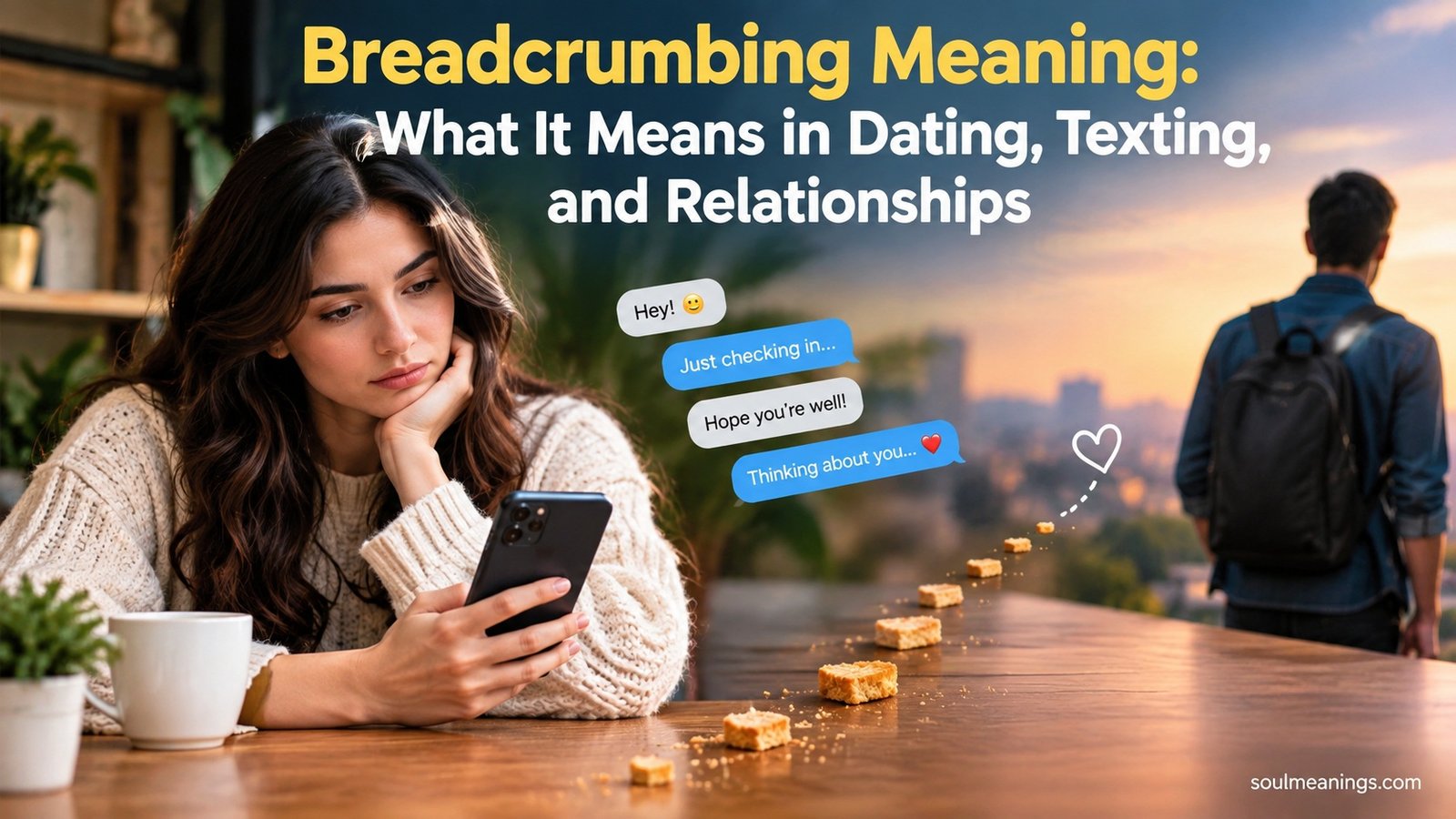
If someone sends you a flirty message, disappears for days, then suddenly returns with another burst of attention, you may wonder what’s going on. Maybe they say they miss you. Maybe they react to your Instagram story. Perhaps they promise to meet soon but never actually make a plan.
This confusing pattern has a name: breadcrumbing.
The breadcrumbing meaning describes a pattern in which someone gives another person small, occasional signs of attention or romantic interest without making a genuine effort to build a relationship. The attention keeps the connection alive, yet the relationship rarely moves forward.
Breadcrumbing can happen in dating, texting, friendships, situationships, and social media interactions. It doesn’t always come from someone who consciously plans to manipulate another person. Sometimes uncertainty, loneliness, poor communication, or a desire for attention plays a role.
The important part is the pattern.
A single late reply doesn’t mean someone is breadcrumbing you. Life gets busy. People lose track of conversations. Someone may also need time to decide what they want. Breadcrumbing becomes more apparent when inconsistent attention repeatedly replaces meaningful communication and follow-through.
What Does Breadcrumbing Mean?
Breadcrumbing means giving someone just enough attention to maintain their interest without offering consistent effort, clarity, or commitment.
The term comes from the image of leaving tiny pieces of bread along a path. In relationships, those “breadcrumbs” can look like occasional texts, compliments, likes, calls, flirtation, or vague promises.
The person doesn’t completely disappear. Instead, they appear just often enough to keep the connection going.
For example, imagine someone you’ve been talking to romantically. They message you every few weeks with something like:
“Hey, I’ve been thinking about you.”
You respond warmly. The conversation becomes flirty. They say you’d look great together and suggest meeting “soon.” Then they vanish again.
A few weeks later, they return.
The cycle starts over.
That’s much closer to breadcrumbing behavior than an ordinary inconsistent conversation.
Breadcrumbing meaning in simple words
In simple terms, breadcrumbing is when someone gives you small doses of attention without giving you a real relationship.
Those small signs may create hope. However, their actions don’t support the level of interest their messages suggest.
A useful way to remember it is:
Attention without progression can become breadcrumbing.
The key word is pattern. You shouldn’t label someone a breadcrumber because they missed one date, answered late, or had a busy week.
Breadcrumbing Meaning in Dating
Dating is probably where people encounter breadcrumbing most often.
Modern dating gives people many ways to maintain loose connections. Dating apps, texting, social platforms, and instant messaging make it easy to contact someone without investing much time or emotional energy.
Someone might send a charming message at midnight. They may react to your photos the next day. Then they disappear for a week.
When they return, they act interested again.
This creates a push-pull dynamic.
The person receiving the attention may think:
- “Maybe they’re still interested.”
- “Maybe they’ll ask me out this time.”
- “Maybe they’re just busy.”
- “Maybe I should give them another chance.”
- “Why do they keep coming back?”
Those questions can become exhausting.
Healthy dating doesn’t require constant communication. Two people can have different texting habits and still develop a strong connection. The bigger issue is whether their actions consistently support their stated interest.
Someone who genuinely wants to date you might communicate differently from you. They might not text every day. Yet they usually make some effort to maintain the connection and follow through when they suggest seeing you.
What Does Breadcrumbing Mean in Texting?
Breadcrumbing in texting happens when messages provide enough emotional or romantic stimulation to keep someone engaged without leading toward meaningful interaction.
The messages themselves may look completely harmless.
Common examples include:
- “Hey stranger!”
- “I’ve been thinking about you.”
- “We need to hang out sometime.”
- “I miss our conversations.”
- “You looked amazing in that picture.”
- “Let’s get together soon.”
- “I was just wondering how you’re doing.”
- A random heart or flirtatious emoji after several days of silence.
None of these messages proves breadcrumbing by itself.
Context matters.
Suppose someone says, “We should grab coffee sometime,” and then follows up with an actual date and time. That’s normal interest.
But if someone says the same thing repeatedly for several months while avoiding every concrete plan, the pattern means something different.
A simple texting comparison
| Genuine interest | Breadcrumbing |
| Messages support an ongoing connection | Messages appear sporadically |
| Makes specific plans | Uses vague promises |
| Follows through | Frequently cancels or disappears |
| Shows curiosity about your life | Focuses mainly on keeping attention |
| Communicates when circumstances change | Leaves you guessing |
| Relationship gradually develops | Connection remains stuck |
| Effort is generally mutual | You carry most of the effort |
Signs Someone Is Breadcrumbing You
Breadcrumbing doesn’t always look dramatic. In fact, that’s part of what makes it confusing.
The behavior often appears in small pieces.
They contact you only occasionally
A breadcrumber may disappear for days or weeks before suddenly appearing again.
The timing can feel random. One day you hear nothing. The next day you receive a warm, affectionate message.
If this happens repeatedly, look at the overall pattern rather than focusing on each individual message.
They flirt without taking things further
Flirting can create a strong sense of romantic interest.
Someone might compliment you, use affectionate language, or talk about chemistry. Yet when the conversation reaches the point of actually meeting or defining the relationship, they pull away.
Words create possibility. Actions create progress.
That distinction matters.
They avoid making concrete plans
One of the clearest signs involves vague plans.
You might hear:
- “We should hang out.”
- “Let’s do something soon.”
- “I’ll let you know.”
- “Maybe next weekend.”
- “Things are crazy right now.”
Occasionally, these statements are perfectly reasonable. Repeatedly hearing them without a specific plan is different.
They disappear and suddenly return
This pattern often creates emotional whiplash.
The person goes silent. You begin moving on. Then they return with a friendly or romantic message.
Their return can immediately revive feelings that had started to fade.
Their messages keep you interested but go nowhere
Breadcrumbing often produces conversation without development.
You may talk about attraction, memories, plans, or feelings. Yet months later, you’re essentially standing in the same place.
It’s like walking on a treadmill. You’re moving, but you’re not getting anywhere.
They give just enough attention to keep the connection alive
This is central to the breadcrumbing meaning.
The person doesn’t necessarily give you enough attention to create a stable relationship. They give enough to prevent the connection from completely disappearing.
That might mean one message every few weeks or occasional social media engagement.
They make future promises without follow-through
Promises become meaningful when behavior backs them up.
If someone repeatedly says they’ll call, visit, meet, or make time for you but rarely does, pay attention to the pattern.
Repeated promises without action can create false expectations.
They interact with your social media instead of talking meaningfully
Social media makes low-effort contact extremely easy.
Someone may:
- Like several old photos.
- React to your stories.
- Send a fire emoji.
- Comment on your appearance.
- Watch nearly every story.
- Send you a meme after weeks of silence.
These behaviors aren’t automatically breadcrumbing. However, they can become breadcrumbs when they repeatedly replace genuine communication.
They become more interested when you pull away
Sometimes the pattern becomes obvious when you stop initiating contact.
You may notice that the person suddenly becomes attentive once you stop chasing them.
Then, when you respond and become available again, their interest fades.
This push-pull cycle can keep you emotionally invested.
They avoid relationship conversations
You might eventually ask:
“What are you looking for here?”
Instead of giving a clear answer, they may change the subject, joke about it, or offer an extremely vague response.
Uncertainty doesn’t automatically mean bad intentions. Still, repeated avoidance can tell you that the person isn’t prepared to offer the clarity you want.
Their words and actions don’t match
This may be the most useful test.
Someone can say:
“I really like you.”
But if they repeatedly disappear, cancel plans, and avoid meaningful conversations, their behavior provides important information.
You don’t need to decide whether they’re a good or bad person.
You simply need to decide whether their behavior works for you.
You constantly feel unsure about their interest
Healthy relationships aren’t perfectly predictable. However, persistent confusion deserves attention.
If you spend more time analyzing someone’s texts than enjoying your connection, something may be off.
They keep you as an option
Breadcrumbing can sometimes involve keeping another person available without committing to them.
The person may not want a relationship now. Yet they also don’t want the connection to disappear completely.
That creates an uncomfortable middle ground.
The relationship never moves forward
Time provides useful evidence.
If weeks or months pass with the same vague conversations, repeated disappearances, and unfulfilled plans, ask yourself whether the relationship is actually developing.
Connection isn’t the same thing as progress.
Read More: Delulu Meaning Slang: What “Delulu” Really Means Online
Breadcrumbing Examples in Real Life
Understanding examples can make the concept much easier to recognize.
Dating app example
You match with someone on a dating app. They immediately flirt and say they think you’re attractive.
You have a great conversation.
They suggest meeting.
Then nothing happens.
Two weeks later, they send:
“Hey! Sorry I disappeared. We definitely need to meet.”
You agree.
Again, no plan follows.
After another period of silence, they return with another flirty message.
That’s a classic pattern worth questioning.
Texting example
Someone you like sends affectionate messages every couple of weeks.
They tell you they miss you. They ask whether you’re dating anyone else. They sometimes flirt late at night.
Yet they don’t make consistent plans or show interest in building something deeper.
The messages keep your emotional connection alive without creating a stable relationship.
Social media example
An old romantic interest never directly contacts you.
However, they frequently watch your stories, like your posts, and occasionally respond with a heart emoji.
Whenever you start moving on, they send a casual message.
Social media interaction alone isn’t enough to call this breadcrumbing. But if those interactions repeatedly keep you emotionally engaged without meaningful communication, the label may fit.
Ex-partner example
An ex occasionally sends messages such as:
“I still think about us.”
They may send old photos or ask whether you’re seeing anyone.
However, they don’t clearly ask to reconcile or discuss what would change.
This can keep the emotional door open without creating a real path forward.
Breadcrumbing vs. Genuine Interest
Not every inconsistent texter is a breadcrumber.
People have different communication styles. Work schedules change. Family responsibilities arise. Someone may also experience personal circumstances that temporarily affect their availability.
The better question is:
Does the person consistently make reasonable effort when they can?
Genuine interest usually becomes visible through behavior.
Someone interested in building a relationship doesn’t have to text constantly. They can be busy and still communicate honestly.
They might say:
“This week is packed, but I’d love to see you next Saturday.”
That message provides clarity.
Breadcrumbing tends to leave you with uncertainty instead.
Breadcrumbing vs. Ghosting
Ghosting generally involves abruptly stopping communication without explanation.
Breadcrumbing works differently.
A breadcrumber continues making occasional contact. They provide small signs of interest rather than disappearing completely.
| Behavior | Main pattern |
| Ghosting | Communication suddenly stops |
| Breadcrumbing | Occasional attention continues |
| Genuine dating | Communication and effort generally develop |
| Benching | Someone keeps another person available as an option |
| Orbiting | Someone maintains social media presence without meaningful contact |
A person can also move between these behaviors. Someone might breadcrumb for months and eventually ghost.
Breadcrumbing vs. Benching
Benching refers to keeping someone available while not fully pursuing the relationship.
The two concepts overlap.
For example, someone may keep several romantic prospects in their orbit and contact each person occasionally. Their goal might be to maintain options rather than develop a committed relationship.
Breadcrumbing focuses more on the small pieces of attention that maintain someone’s interest.
Benching emphasizes the person’s position as a potential backup or secondary option.
The behaviors can exist at the same time.
Breadcrumbing vs. Orbiting
Orbiting usually describes someone who remains present around your social media life without maintaining a meaningful relationship.
An ex who watches every story but never talks to you might be orbiting.
If that person periodically sends romantic messages to keep your emotional connection alive, the behavior may also resemble breadcrumbing.
The distinction isn’t always perfectly clear. Modern digital behavior often overlaps.
Why Do People Breadcrumb Others?
There isn’t one universal reason.
Human behavior rarely fits into a single box.
They want attention
Some people enjoy knowing that someone finds them attractive or interesting.
A quick message can provide reassurance without requiring much investment.
They enjoy the connection but don’t want commitment
A person might genuinely enjoy talking to you while not wanting a relationship.
The problem arises when they communicate in ways that encourage expectations they don’t intend to meet.
They want to keep their options open
Dating can involve uncertainty and multiple connections.
Someone may maintain contact because they don’t want to close the door completely.
They feel lonely or bored
Loneliness can encourage people to reconnect with familiar people.
A late-night message may come from a moment of loneliness rather than a serious desire to build a relationship.
They have poor communication skills
Not every case involves calculated manipulation.
Some people avoid difficult conversations because they don’t know how to say, “I’m interested in you, but I don’t want a relationship.”
Poor communication can still hurt someone even when malicious intent isn’t present.
They don’t know what they want
Uncertainty is common in relationships.
Someone may genuinely feel attracted to you while remaining unsure about commitment.
That doesn’t automatically make them a breadcrumber. The difference often appears in how honestly they communicate that uncertainty.
Is Breadcrumbing Manipulation?
Breadcrumbing can become emotionally manipulative, particularly when someone knowingly uses intermittent attention to keep another person attached.
However, intent is difficult to determine from the outside.
It’s safer to focus on observable behavior.
Ask:
- Does this pattern happen repeatedly?
- Does the person make promises without following through?
- Do they become attentive when you pull away?
- Do they avoid clarity?
- Does the interaction leave you consistently confused?
- Have you communicated your needs?
- Has their behavior changed after that conversation?
These questions provide more useful information than trying to diagnose someone’s motives.
The Psychology Behind Breadcrumbing
One reason breadcrumbing can feel so powerful involves intermittent reinforcement.
Intermittent reinforcement occurs when a reward appears unpredictably rather than consistently.
Think about a notification arriving after several days of silence. You don’t know when the next one will come. When it finally appears, the emotional impact can feel surprisingly strong.
That unpredictability can encourage repeated checking and anticipation.
The cycle may look like this:
Silence → anticipation → unexpected attention → excitement → renewed hope → silence
This doesn’t mean every person experiencing inconsistent communication develops a psychological dependency. It does explain why unpredictable attention can become emotionally gripping.
The brain naturally pays attention to uncertainty. That’s one reason intermittent rewards appear in many areas of human behavior.
In relationships, however, the emotional cost can become significant.
You may begin checking your phone more often. You may reread old messages. You may interpret emojis, story views, or response times.
Suddenly, a relationship that barely exists in real life occupies a lot of mental space.
How Breadcrumbing Can Make You Feel
Breadcrumbing can produce a mixture of emotions because the person isn’t completely absent.
You might feel:
- Confused because their behavior changes.
- Hopeful when they return.
- Anxious when they disappear.
- Excited when they send a message.
- Rejected when they fail to follow through.
- Frustrated by repeated uncertainty.
- Preoccupied with interpreting their behavior.
- Drained after repeated cycles.
One message can feel wonderful.
The next week can feel awful.
That emotional contrast often makes breadcrumbing more difficult than straightforward rejection.
A clear “I’m not interested” hurts. Yet it gives you information.
Breadcrumbing can leave the door cracked open.
FAQS
What does breadcrumbing mean in dating?
Breadcrumbing means giving someone small, occasional signs of romantic interest without making consistent efforts to build a relationship. This may include flirty texts, vague plans, social media attention, or sudden messages after long periods of silence.
What does breadcrumbing mean in texting?
Breadcrumbing in texting involves intermittent messages that keep someone’s interest alive without meaningful progress. For example, a person may send “I miss you” every few weeks but never make a real plan to meet or discuss the relationship.
How can you tell if someone is breadcrumbing you?
Look for a repeated pattern rather than one isolated incident. Common signs include inconsistent communication, vague invitations, broken promises, disappearing and returning, flirting without progress, and avoiding direct conversations about intentions.
Why do people breadcrumb others?
People may breadcrumb because they want attention, feel lonely, enjoy the connection, fear commitment, want to keep their options open, or aren’t sure what they want. Some cases involve deliberate manipulation while others result from poor communication or emotional uncertainty.
What should you do if someone is breadcrumbing you?
Start by looking at their actions rather than their occasional affectionate messages. If you’re interested, ask directly what they want and explain what you need. If the pattern continues despite clear communication, stepping back can protect your time and emotional energy.
Conclusion
Understanding the breadcrumbing meaning can help you recognize when occasional attention isn’t turning into a genuine connection. A few texts or social media reactions don’t prove anything on their own. The repeated pattern matters.
If someone regularly disappears, returns with affection, makes vague promises, and avoids meaningful progress, their actions deserve more attention than their words. Healthy connections don’t require constant texting, but they do need clarity, consistency, mutual effort, and follow-through.
You don’t have to keep chasing uncertain attention or decoding every message. Ask for clarity, communicate your boundaries, and watch what happens next. When someone’s actions consistently match their words, you have something real to build on. When they don’t, stepping back may be the clearest answer.









1 thought on “Breadcrumbing Meaning: What It Means in Dating, Texting, and Relationships”