
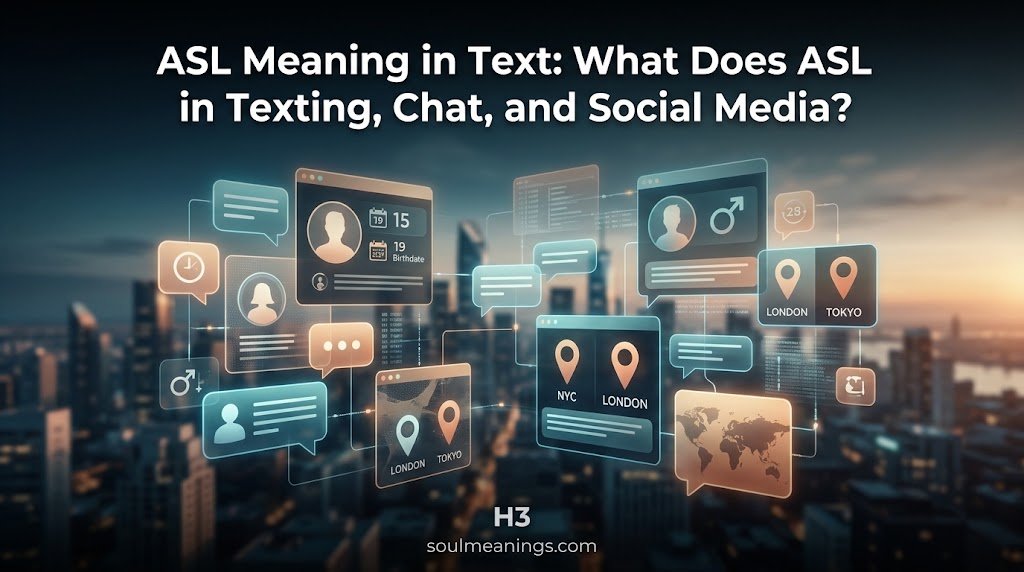
Seeing ASL in a message can leave you scratching your head for a second. The same three letters can mean very different things depending on where they appear and what the sender is talking about.
In modern texting, asl often means “as hell.” It works as an informal intensifier in phrases such as “tired asl” or “funny asl.” However, the older internet abbreviation ASL? means “age, sex, location?” American Sign Language is another major meaning, especially in conversations about language, Deaf culture, education, and accessibility.
That makes context the real key.
If someone writes “That movie was scary asl,” they aren’t asking for your age or location. They’re saying the movie was extremely scary. On the other hand, if someone simply sends “ASL?”, they may be using the older chat-room abbreviation.
This guide breaks down the ASL meaning in text, explains how the abbreviation has changed, and shows you exactly how to interpret it in different conversations.
Quick Answer: What Does ASL Mean in Text?
ASL can have three major meanings in texting and online communication:
| ASL meaning | What it means | Typical example |
| As hell | Adds strong emphasis | “That was funny asl.” |
| Age, Sex, Location | Asks for basic personal information | “Hey, ASL?” |
| American Sign Language | A natural visual language | “I’m learning ASL.” |
There is an easy way to tell them apart.
When asl comes after an adjective, it usually means “as hell.” When ASL? appears alone as a question, it traditionally means “age, sex, location?” When the conversation involves signing, Deaf culture, language learning, or accessibility, ASL usually means American Sign Language.
So don’t judge the meaning from the letters alone. Look at the entire sentence.
What Does ASL Mean in Text?
The most important thing to understand about ASL meaning in text is that the abbreviation doesn’t have one permanent definition.
Modern social media has given asl a common slang meaning: “as hell.” It acts like an intensifier, making the word before it stronger.
For example:
“I’m tired asl.”
This means:
“I’m extremely tired.”
You’ll often see this pattern after adjectives or descriptions:
- funny asl
- cute asl
- tired asl
- busy asl
- cold asl
- expensive asl
- loud asl
- scary asl
- happy asl
The older ASL meaning is different. In early internet chat, people used it to mean “age, sex, location?” Cambridge Dictionary still defines a/s/l as an internet-chat abbreviation for asking someone’s age, sex, and location.
Then there’s American Sign Language, which has nothing to do with either slang meaning.
That’s why three letters can cause surprisingly different interpretations.
ASL Meaning in Text: “As Hell”
The modern slang meaning deserves special attention because it appears frequently in casual digital communication.
When someone writes:
“That test was hard asl.”
they mean:
“That test was extremely hard.”
Here, asl doesn’t stand for three separate words in the same way that the older abbreviation does. Instead, it shortens “as hell” into a compact texting form.
The construction usually follows this pattern:
adjective + asl
For example:
| Text | Meaning |
| “I’m tired asl.” | I’m extremely tired. |
| “That was funny asl.” | That was extremely funny. |
| “She’s busy asl.” | She’s extremely busy. |
| “This food is spicy asl.” | This food is extremely spicy. |
| “That car is expensive asl.” | That car is extremely expensive. |
| “It’s cold asl outside.” | It’s extremely cold outside. |
The expression is highly informal. You wouldn’t normally use it in a job application, formal email, academic paper, or professional report.
In a casual conversation, however, it can function almost like adding “very,” “really,” or “extremely” to a description.
Why Do People Write “asl” Instead of “as hell”?
Texting rewards speed and compression. People naturally shorten familiar phrases when the meaning remains obvious.
The same basic idea appears in many online abbreviations. Instead of writing a complete phrase, users remove words that the reader can easily reconstruct.
With asl, the meaning often becomes clear from its position.
Compare these two messages:
“ASL?”
and
“That restaurant is expensive asl.”
They use the same letters. They don’t mean the same thing.
That’s why punctuation and sentence structure matter more than capitalization alone.
Read More: CMP Meaning in Text: What Does CMP Mean in Texting?
ASL Meaning in Text: “Age, Sex, Location”
The classic ASL meaning in text comes from early online chat culture.
ASL traditionally stood for:
- A = Age
- S = Sex
- L = Location
A person might enter a chat room and type:
“ASL?”
The sender wanted three pieces of information about the person on the other side of the screen.
The question was particularly common in anonymous online conversations where users had little information about one another. Historical research on internet chat culture documents A/S/L as a familiar early online introduction. A 2001 Pew Research report on teenage internet use also identified A/S/L as a common question in chat rooms.
The abbreviation eventually became part of internet folklore.
What Does Each Letter Mean?
Age asks how old the person is.
Sex originally asked whether the person was male or female. Modern conversations often use the broader concept of gender instead, depending on the context and the people involved.
Location asks where the person is located.
The original expression was designed for quick communication. Rather than asking three separate questions, someone could type three letters and a question mark.
It was the early internet’s version of getting straight to the point.
Example of the Older ASL Meaning
Consider this conversation:
Person A: Hey!
Person B: Hey
Person A: ASL?
Person B: 24, male, Chicago
Here, ASL clearly means “age, sex, location?”
Nothing in the exchange suggests “as hell” or American Sign Language.
The question itself gives the clue.
Is “ASL?” Still Used Today?
Yes, but its meaning as “age, sex, location?” is much more closely tied to older internet-chat culture than everyday modern texting.
Early chatrooms made the abbreviation especially useful because people often interacted with strangers without detailed profiles. Today, social platforms usually provide usernames, profile pictures, biographies, locations, interests, and other information.
That changed the need for a three-letter introduction.
Still, the abbreviation hasn’t disappeared completely. You may encounter it in older online communities, discussions about internet culture, gaming conversations, random chats, or messages from people familiar with older chat slang.
The important point is this: don’t assume that every modern use of ASL refers to the old chat abbreviation.
If someone writes:
“That outfit is cute asl.”
the intended meaning is almost certainly “cute as hell.”
If someone writes:
“ASL?”
the older meaning becomes much more plausible.
ASL Meaning on Snapchat
The ASL meaning on Snapchat depends heavily on how the person uses it.
For example:
“I’m bored asl.”
Here, asl means “as hell.”
The sender is saying they are extremely bored.
Now compare that with:
“ASL?”
That standalone question can mean “age, sex, location?”
Snapchat itself doesn’t force one universal definition. The surrounding message determines what the sender likely means.
Common Snapchat Examples
Example 1:
“This filter is funny asl 😂”
Meaning: The filter is extremely funny.
Example 2:
“You look good asl.”
Meaning: You look extremely good.
Example 3:
“ASL?”
Meaning: What is your age, sex, and location?
The third example carries a very different tone from the first two.
ASL Meaning on Instagram and TikTok
Instagram and TikTok conversations can produce the same ambiguity.
Social-media slang frequently compresses phrases because comments and direct messages move quickly. A person may write:
“That dance was hard asl.”
The meaning is “That dance was extremely hard.”
Similarly:
“This song is good asl.”
means:
“This song is really good.”
However, a message such as:
“ASL?”
can still invoke the older internet-chat meaning.
This distinction matters because modern users may encounter the old abbreviation without realizing it comes from an earlier era of online communication.
A Useful Rule
If asl appears at the end of a description, think “as hell.”
If ASL? appears as a standalone question, consider “age, sex, location?”
If ASL appears in a discussion about signing or Deaf culture, think “American Sign Language.”
It isn’t a perfect rule. It is simply a useful starting point.
ASL Meaning in Text for Gen Z and Younger Internet Users
For modern casual internet language, lowercase asl often functions as an intensifier.
The pattern is easy to recognize:
description + asl
Examples include:
- “cute asl”
- “wild asl”
- “hungry asl”
- “sleepy asl”
- “weird asl”
- “cold asl”
- “busy asl”
This usage is quite different from the older A/S/L question.
Modern slang also demonstrates why capitalization isn’t enough to identify meaning. Someone may write ASL, asl, or another capitalization style depending on their typing habits.
The words surrounding the abbreviation provide a stronger clue.
ASL vs. A/S/L: Are They the Same?
When A/S/L means “age, sex, location,” it is essentially the same expression as ASL.
The slashes simply separate the three words.
You may see:
- ASL?
- A/S/L?
- asl?
- a/s/l?
The formatting can vary while the basic meaning remains the same.
Cambridge Dictionary specifically lists a/s/l as a written abbreviation for “age, sex, and location” used in internet chat rooms.
Why Were Slashes Used?
The slashes made the three components visually obvious.
Think of them as tiny dividers:
Age / Sex / Location
Over time, people often dropped the punctuation and simply wrote ASL.
Digital language tends to evolve this way. Once readers understand an abbreviation, extra punctuation can become unnecessary.
ASL Meaning in American Sign Language Contexts
Not every ASL meaning in text belongs to internet slang.
In many conversations, ASL means American Sign Language.
This is especially likely when the message discusses:
- Deaf communities
- Sign language
- Language learning
- Interpreters
- Accessibility
- Education
- Communication
- Deaf culture
- ASL classes
For example:
“I’m taking an ASL class this semester.”
Here, the meaning is obvious.
The person is talking about American Sign Language, not asking someone’s age or saying something is “as hell.”
ASL Is a Real Language
American Sign Language isn’t simply English translated into hand movements.
It is a natural language with its own linguistic structure, vocabulary, grammar, and cultural history.
That distinction matters.
A person learning ASL isn’t merely memorizing hand gestures. They’re learning a complete visual language that uses handshape, movement, location, orientation, facial expression, body movement, and spatial relationships to convey meaning.
For example, facial expressions can carry grammatical information in ASL. Body position and movement can also change how a signed message works.
That’s much richer than simply replacing spoken English words with hand signals.
Examples of ASL in This Context
“My sister is learning ASL.”
Meaning: American Sign Language.
“The school offers an ASL course.”
Meaning: American Sign Language.
“Does the event provide an ASL interpreter?”
Meaning: An interpreter who communicates in American Sign Language.
The subject of the conversation makes the intended definition clear.
How to Tell Which ASL Meaning Someone Intended
When ASL appears in a message, don’t rush to one definition.
Use the surrounding context.
Look at the Position of ASL
If it comes after an adjective:
“That was crazy asl.”
It likely means “as hell.”
If it stands alone:
“ASL?”
The older “age, sex, location?” meaning becomes more likely.
If it appears beside words such as “class,” “interpreter,” or “learn”:
“I want to learn ASL.”
It means American Sign Language.
Look at the Topic
Context often solves the puzzle instantly.
| Conversation topic | Most likely meaning |
| Casual texting | As hell |
| Social-media slang | As hell |
| Old internet chat | Age, Sex, Location |
| Stranger asking personal details | Age, Sex, Location |
| Deaf culture | American Sign Language |
| Language class | American Sign Language |
| Accessibility | American Sign Language |
This approach works because abbreviations rarely exist in isolation. The surrounding words act like a signpost.
ASL Meaning in Dating and Online Chats
The older “age, sex, location?” use can appear in conversations where two strangers are getting acquainted.
Historically, people often used it as a fast introduction.
For example:
“Hey, nice profile. ASL?”
The person may simply want basic information.
However, modern online communication has changed the social meaning of the question. Asking a stranger for their age and location can feel intrusive, especially when the person has no reason to trust you.
You don’t have to answer.
Is ASL a Flirty Question?
ASL itself isn’t automatically flirty.
The abbreviation simply asks for personal information in its older meaning.
The tone depends on the conversation.
For example:
“ASL? I’m trying to meet people in this group.”
This may be a straightforward social question.
On the other hand:
“ASL? You seem cute.”
could carry a romantic or flirtatious tone.
The surrounding language creates that tone. The abbreviation doesn’t do it by itself.
FAQS
What does ASL mean in text?
ASL can mean “as hell,” “age, sex, location,” or “American Sign Language.” The surrounding words usually reveal which meaning the sender intends. For example, “tired asl” means “extremely tired,” while “ASL?” can mean “age, sex, location?”
What does ASL mean on Snapchat?
On Snapchat, asl often means “as hell” when it follows a description, such as “funny asl.” However, “ASL?” can refer to the older “age, sex, location?” abbreviation. Context is the best clue.
What is “ASL?” mean from someone online?
When someone sends “ASL?” As a standalone question, it traditionally means “age, sex, location?” They may be asking your age, sex or gender, and general location. You don’t have to share personal information if you’re uncomfortable.
What does “cute asl” mean?
“Cute asl” means “cute as hell.” The abbreviation works as an intensifier that makes the word “cute” stronger. It’s informal internet slang commonly used in casual conversations and social media.
What does ASL mean in school or education?
In an educational context, ASL usually means American Sign Language. For example, “I’m taking an ASL class” refers to studying American Sign Language rather than internet slang.
Conclusion
Understanding ASL meaning in text comes down to context. In older online chat, ASL commonly meant “age, sex, location.” Today, you may also see ASL used as “as hell” in casual texting, while American Sign Language remains an important meaning in education, communication, and everyday life.
If someone simply sends “ASL?” in a chat, look at the conversation around it before deciding what they mean. The platform, wording, and topic can quickly reveal whether they’re asking about personal details, using slang, or referring to sign language.







1 thought on “ASL Meaning in Text: What Does ASL Mean in Texting, Chat, and Social Media?”